
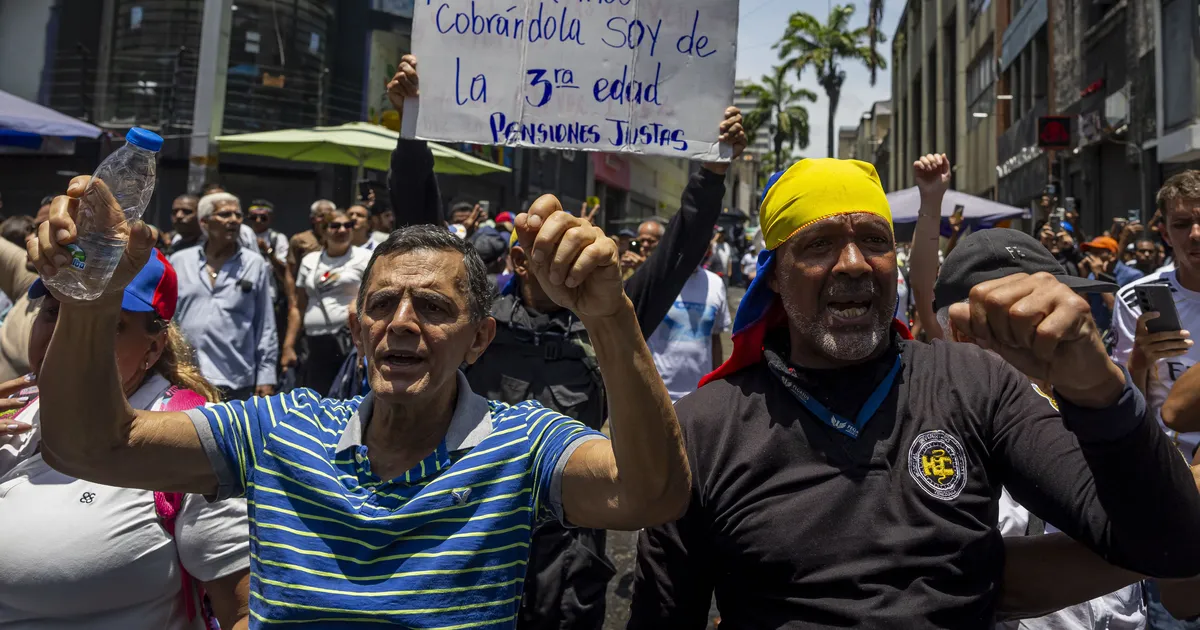
The economic context explains the background of these manifestations. The minimum wage in Venezuela remains at 130 bolivars per month, equivalent to approximately 0.27 dollars at the official rate, after more than four years without real adjustments. Delcy Rodríguez, interim president of the regime since dictator Nicolás Maduro was deposed on January 3, has promised a salary improvement for May 1, although without concrete details about its scope or impact.
“Venezuela is a time bomb, where the situation of widespread poverty, the famine that covers a significant part of society, the political repression, the harassment of the sectors that demand compliance with their rights become a factor of pressure, of mobilization, that is present every time a window opens,” analyzes the former governor of the state Táchira César Pérez Vivas.
The economic malaise finds another protagonist on the political level. A recent Meganalisis survey indicates that 90.4% of Venezuelans do not believe in an economic recovery with Chavismo in power, while 94.5% consider an eventual salary increase of between 100 and 200 dollars insufficient.
It is not a complaint only because of the high cost of living in the country. It is a request for a change of government, one elected by the people. After the capture of Maduro by the United States in January, society once again regained hope and lost fear, says the former governor.
“These last years of intense political repression, of murder of citizens in the streets for exercising the right to protest, in some way, had demobilized the country, paralyzed it, because the main actors were under persecution or in jail, and an environment of fear of repression and persecution was established,” he continues. “However, the events of January 3 have generated new hope, but they have also revealed, clearly and clearly, the worsening of the socioeconomic situation, because the majority of workers and pensioners do not have an income to feed themselves with dignity, and they depend on remittances that their relatives send or they also depend on other jobs. And, frankly, what we have is a nation that is dying of decline.”
The Venezuelan exodus, according to reports from 2025, exceeded 10 million. And both from exile and internally, the population expects real change. That Delcy replaces Maduro was not exactly what the country wanted, says Pérez Vivas.
“We could not speak of an irreversible break, because the power structure established by Nicolás Maduro is completely maintained. Although there have been some changes, they are cosmetic changes, they are not profound changes that represent the arrival in government and state positions of people committed to democratic values. They are, on the contrary, new actors who were in the background to try to maintain the dictatorship and to allow Delcy Rodríguez to gain time in his strategy of staying in power, despite the fact that the entire constitutional order Venezuelan demands that public powers call presidential elections.”
Signs of change?
Last week’s peaceful protest in Caracas, unlike some with the same objective of reaching the Presidential Palace, had only one differentiator: there were no deaths. But there was repression, arbitrary arrests – although they were already released – and censorship of the media, as well as theft of equipment.
Not much has changed, only the main actor changed but not the script called repression.
Lawyer Eduardo Torres, former political prisoner, warns that the repression is not temporary, but part of a scheme sustained over time.
“If the people are left alone, criminalization will persist and increase,” he says, referring to arrests and attacks during recent protests. However, it also identifies signs of resistance that contrast with the idea of a completely contained society.
“We are seeing samples… of relatives of political prisoners, workers and students. The popular force is enormous, the regime is not able to contain the aspirations for change. We are operating under the risk of persecution, imprisonment and danger to integrity and life. However, we have to take advantage of hundreds of human rights defenders, political and social leaders, journalists, among others, to strengthen the democratic resistance, which is going on the offensive to demand rights, freedom, justice, democratic institutions.”
Torres rejects binary readings about the country’s moment. “Neither of the two,” he responds when asked if Venezuela is closer to a social explosion or the consolidation of the repressive model.
His analysis incorporates the weight of recent history. Remember that the country was marked by the social outbreak of 1989, which continues to condition the state response.
“The police and military forces have a repressive culture when it comes to containing demonstrations,” he points out.
Even so, he insists on the erosion of power. “The regime is in decline, it has no people,” he says. But he warns that the change will not be automatic: “The only thing missing is for the democratic political leadership to assume a policy of superior unity and a route to achieve it.”
Rising pressure
The scenario combines social pressure, economic deterioration and political control. On the one hand, a population that faces minimum income that does not cover basic needs and that begins to return to the streets. On the other, a state apparatus that maintains institutional control and responds with containment.
Pérez Vivas warns that the country is “beyond the threshold of tolerance” and in a “situation of desperation,” where hunger can push sectors to overcome fear.
But it also introduces a central warning: a social outbreak does not guarantee political change if there is no structure that channels it.
“Certainly, we are facing an exhaustion of the model. None of us has a crystal ball to guess how behavior is going to develop… because there are elements that can generate an unexpected event that achieves the final collapse of the dictatorship. On the one hand, there is a situation of misery, poverty, hunger in Venezuela, which can produce a social outbreak. Now, these social outbreaks, if they are not accompanied by an action of force, can be consumed, and structural power can continue. There are examples like Cuba… where the dictatorship manages to crush those explosions.”
Torres, in contrast, rules out an immediate explosion scenario and opts for a transition based on political organization, social majority and institutional reconstruction.
Both agree, although from different perspectives, on one point: the model shows wear, but retains control capacity.
The result is an unstable equilibrium.
A country with salaries of pennies, majority political rejection and protests that reappear despite repression.
