
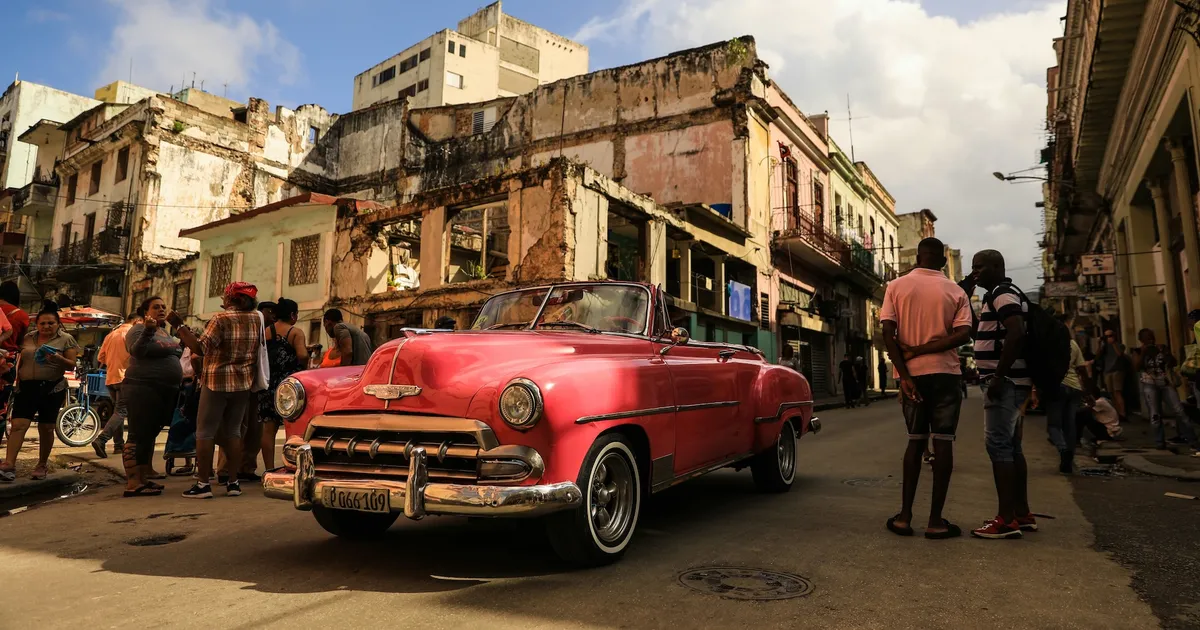
HAVANA. – Under the intense midday sun, Gabriel, 56 years old, agricultural laborer, plants beans on a farm of reddish and fertile land located in Cuba, the Alquízar municipality, a little more than 50 kilometers southwest of Havana.
He works barefoot in waterlogged furrows. He wears an old yarey hat, a worn long-sleeved shirt, and olive green pants. After planting the seeds, he raises his head, looks at the horizon and wipes his sweat with a cloth. He leaves his farm tools in a wooden shed and walks to a turbine. He turns on the faucet, gets under the stream of water and cools off from the horrible heat.
Then he sits in the shade of a leafy avocado tree and has lunch of some white rice with chicken sausages in tomato sauce. Then he drinks half a liter of water from a recycled bottle and starts talking with other day laborers.
“We talk about how hard life is in Cuba and what is going to happen in the future,” says Gabriel, who arrived in the Mayabeque province seven years ago fleeing the misery of a remote town in the III Frente municipality, Santiago de Cuba, more than 1,000 kilometers east of Havana.
“I worked between 10 and 12 hours a day in a logging business owned by Commander Guillermo García (former guerrilla from the Sierra Maestra, who at almost 100 years old is one of the heavyweights of the Castro dictatorship). The pay was shit. It wasn’t enough for me to support my family. They gave good food and from time to time a bag with food, pork or chicken plus what you could steal from the farm. But it wasn’t enough,” recalls Gabriel.
One night he got on a train and traveled to Havana, where he would try to change his destiny. When you ask him what Cuba he would like, after a brief pause he answers slowly, as if chewing his words.
“I finished the seventh grade with a bang. I read little and poorly. And politics is a thing for crafty people. But like any Cuban, I would like the situation to change. For my children to be able to escape poverty, for eating to not be a headache and for daily life not to be so complicated. I don’t think I’m asking for so much,” he says.
What types of changes? Political, economic, both, a democratic government with diverse parties, freedom of expression, independent judicial system, private companies, I ask you.
The laborer smiles. “Compay, if the government doesn’t interfere so much in the lives of Cubans, one can own a piece of land and have a legal business, they won’t put you in prison for saying what you think, the blackouts will end and having lunch and eating won’t be a feat. I think the majority of people would raise their hands and approve of it. The system should be capitalist, because socialism didn’t work. The rest, at least for me, is not important.”
Ideas
Roldán works 14 hours driving a dilapidated Willvs jeep that he uses as a collective taxi. He is a prepared guy. “I am a physics graduate. I left my job due to low salaries. I earned 6,000 pesos a month (about 13 dollars at the parallel exchange rate). Now as a taxi driver I earn that in a day. I would like the rulers to resign en masse, from ministers to lower positions. I would prohibit the communist party and compulsory military service. Due to the lack of workforce, we should not have an army, like Costa Rica. Only a professional coast guard that would coordinate with the United States and other countries of the area, the fight against drug trafficking and human trafficking.”
“And it would reduce the State Security forces. Let them dedicate themselves to ensuring the national security of the country and confronting terrorism and not being the praetorian guard of the government. In the future, a capitalist model with a market economy should be adopted, but with an emphasis on the social. We are one of the societies in the world with the most elderly inhabitants. Citizens must choose who will govern them,” he states.
Raisa, an engineer, believes that “it is time for the population to pressure the government to hold a plebiscite. This concept is spreading more and more on social networks. If the government is truly interested in Cuba and the Cubans, the most dignified thing is for them to leave power. If they did so voluntarily they could participate in the reconstruction of the country. For me it would not be democratic to outlaw the communist party. We cannot be the same as them. One of the problems for peaceful change is political bureaucracy. It constitutes a powerful brake.”
Then he adds: “They have lived by profiting from the system, they are an impoverishing structure. Institutions are more important than individuals. If the government did not voluntarily resign, the international community, particularly the United States, should force them to resign. Due to repression and fear, we do not have enough convening power to get rid of this scourge.”
A 24-year-old university student considers that “the change in Cuba, for it to be real, will have to remove the rulers from power. If they do as in Venezuela, they reinvent themselves and last an eternity. There should be no dialogue, only an ultimatum: leave the country. I would give them a month’s time. If they do not leave, I would hold a trial like the one in Nuremberg and let justice decide. Almost all of them would go to prison for many years. Those who have committed crimes could be shot.”
Reforms
The majority of Cubans consulted are committed to profound political and economic reforms. They lean towards the capitalist model. With some nuances on social issues.
Camila, a retired professor, thinks that “some social achievements achieved in public health, access to culture and sports should be maintained and strengthened. Also in the future we should be a country with participatory democracy like Switzerland and other Nordic nations, with total transparency.”
A sector of the opposition, represented by Manuel Cuesta Morúa and Professor Alina Bárbara Hernández, opts for a modern and inclusive social democracy where national sovereignty is not negotiated.
Some, like Henry, a gastronomic, assure “that many Cubans, although they do not say it because it is not politically correct, would like to be the 51st State of the United States. Or at least a model similar to that of Puerto Rico where all Cubans can have permission to travel to the United States. Why do I want a sovereign nation, if later, because of a political system such as communism or the prevailing corruption, they hand the country over to another nation or steal the national heritage while the people are dying of hunger.”
Nuria, a graduate in political science, is convinced that “if the Cuban people could freely choose at the polls the model of country they wanted, we would be in for a surprise. The option of capitalism would win. Those most qualified in politics would bet on a social capitalism of a humanist nature. But there are people in favor of annexation. Others, of a change of government using the military force of the United States.”
Carlos, a sociologist, expresses that “as at any end of the cycle, citizens enthusiastically debate what model of country they want. These desires are not always viable. For many reasons, from economic, political and genetic, we will not have a democracy like that of the United States overnight. But that the issue is in the spotlight, it shows that a high percentage of Cubans want changes not only economic, but also political.”
Doubts
The big doubt that many on the Island have is whether they are prepared for these reforms. Gabriel, the agricultural laborer, shakes his head from side to side: “If the Cubans living abroad do not return, the country will not move forward. There is a pile of old people here. There is a lack of people to work the land and rebuild Cuba.”
Dinorah, an architect, agrees that “dreams are not always tempered by reality. We have 30% of elderly people, even the most qualified, who do not master the current cutting-edge tools and technologies. I suppose that, if an autonomous and impartial legal framework and laws that favor investments are approved, many compatriots abroad will return, if not definitely, at least invest in their country. It is key so that within a period of eight to ten years we begin to develop.”
According to Gustavo, an economist, the “present is terrible, but the future is not a bed of roses. A country must be built almost from scratch. This entails investments of billions of dollars. Just to rebuild the national electrical energy system, between 7,000 and 12,000 million dollars must be disbursed. Electricity is the basis of progress. And the state coffers are empty. Cuban businessmen who reside in the United States are not going to risk their capital if there is no legal and political guarantees.”
When you talk to Cubans on the street, the future does not scare them. They won’t be worse.
