
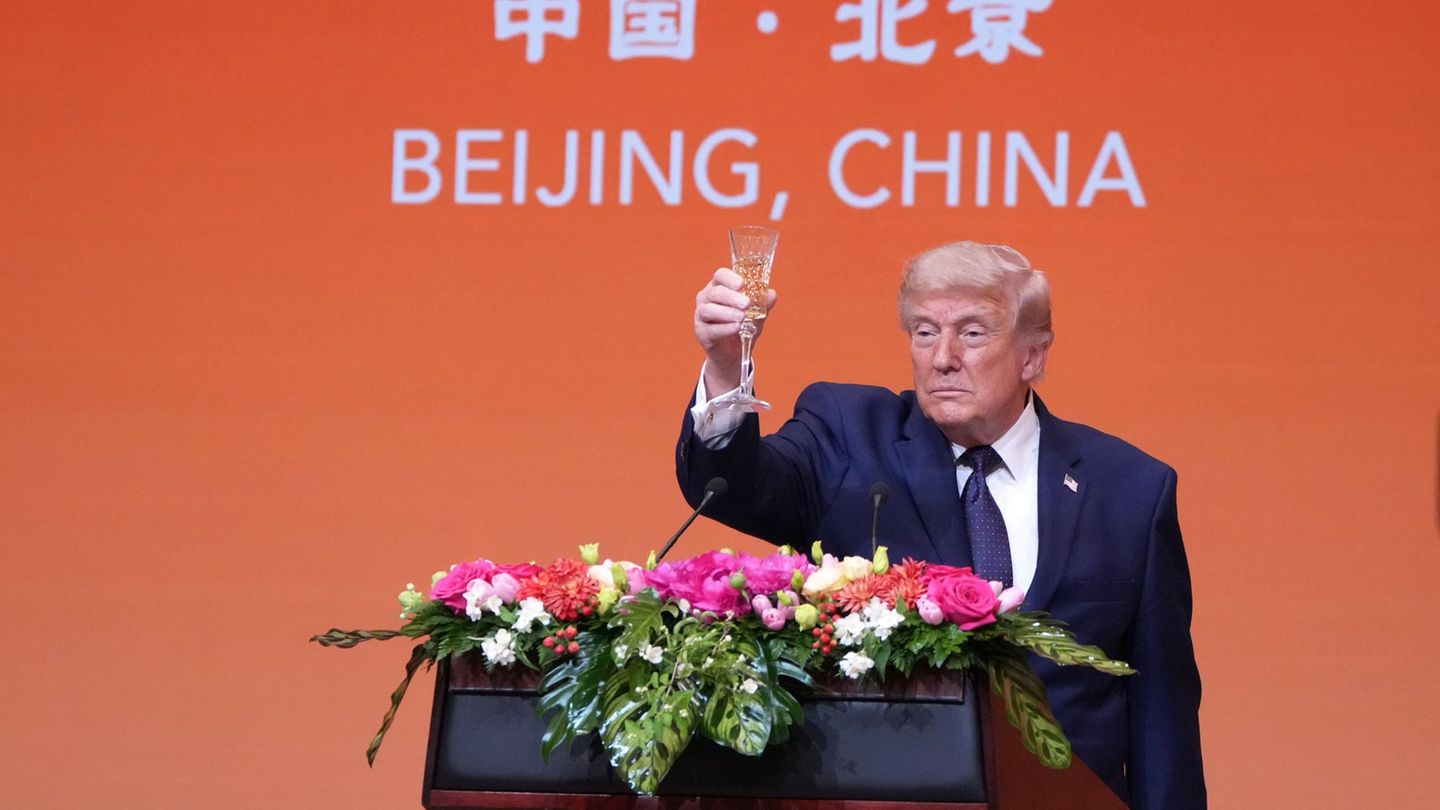
The USA is relying on China’s support to resolve the conflict with Iran over the Strait of Hormuz – according to US President Donald Trump, President Xi Jinping has also offered his help. “He said, ‘If I can help in any way, I would like to,'” Trump told Fox News after meeting his Chinese counterpart in Beijing.
The White House said at the meeting that both sides had agreed that the strait must remain open for energy transport. Accordingly, Xi is said to have made clear China’s rejection of the militarization of the road and is also against charging for passage.
US Secretary of State Marco Rubio told Fox News that Beijing should play a more active role and encourage Iran to “back away from what it is currently doing and trying to do in the Persian Gulf.”
Iran sees the USA as a blocker
Iran sees responsibility for the blockade primarily on the USA. “The obstacle is not us, but the USA with its blockade,” said Iranian Foreign Minister Abbas Araghchi to state broadcaster Press TV on the sidelines of the Brics foreign ministers meeting in New Delhi. “As far as we are concerned, the Strait of Hormuz is open to all merchant ships,” Araghchi continued, but any passage would have to be coordinated in advance with the Iranian naval forces.
According to the Iranian Revolutionary Guard, around 30 ships have passed through the important strait since last night, including Chinese ones, according to the Tasnim agency.
In the Strait of Hormuz, which is important for the global oil and gas market, there has been a kind of stalemate between the warring parties for a long time, which is putting a strain on the global economy: Iran made the strait largely impassable by threatening and shelling tankers and cargo ships after the war began on February 28th. The US responded by blocking ships entering or leaving Iranian ports.
Consequences for the energy market
The International Energy Agency (IEA) expects a sharper decline in global oil demand and a decline in oil reserves due to the consequences of the Iran war. Because supply is tightening, global demand for crude oil is expected to fall by an average of 420,000 barrels (159 liters each) per day to around 104 million barrels per day this year, according to the monthly report published in Paris by the association of major industrialized countries.
“Faced with local supply shortages, governments and companies are working to curb oil consumption and thus bring the crisis under control,” the monthly report continues. This is achieved through austerity measures, price controls or even rationing.
New negotiations between Israel and Lebanon
At the diplomatic level, at least in the Lebanon conflict, there are new attempts at a solution. Representatives of the enemy countries Israel and Lebanon want to meet for further talks in Washington under the mediation of the USA. According to earlier US statements, both delegations want to advance a “comprehensive peace and security agreement that substantially takes into account the key concerns of both countries.”
According to the military, several civilians were injured in an attack by the Lebanese Hezbollah militia with an explosive drone in northern Israel. In the coastal town of Rosh Hanikra, right on the border with Lebanon, three people were injured in a parking lot, two of them seriously, the Israeli news portal “ynet” reported. They were taken to a hospital.
The Israeli army’s statement spoke of a serious violation by Hezbollah of the ceasefire that has been in effect since mid-April. According to authorities, almost 400 people have been killed in Lebanon since the ceasefire came into force, and several soldiers have been killed in Israel.
Has Netanyahu visited the United Arab Emirates?
The United Arab Emirates (UAE) has rejected reports of an alleged visit by Israeli Prime Minister Benjamin Netanyahu to the Emirates. The Foreign Ministry said no military delegation was received.
Israeli Prime Minister Benjamin Netanyahu’s office said the head of government secretly visited the UAE during the Iran war. Netanyahu is said to have met with President Mohammed bin Sajid there. The visit led to “a historic breakthrough in relations between Israel and the United Arab Emirates,” it said.
Criticism from Iran: “unforgivable”
Sharp criticism of the Emirates came from Iran. The state broadcaster Irib reported, citing Foreign Minister Abbas Araghchi, that Iran was informed about Netanyahu’s trip – “and this at the height of the military confrontation”. The Iranian chief diplomat described the hostility towards Iran as a “stupid gamble” and stated that cooperation between the UAE and Israel would be “unforgivable” for Tehran.
