
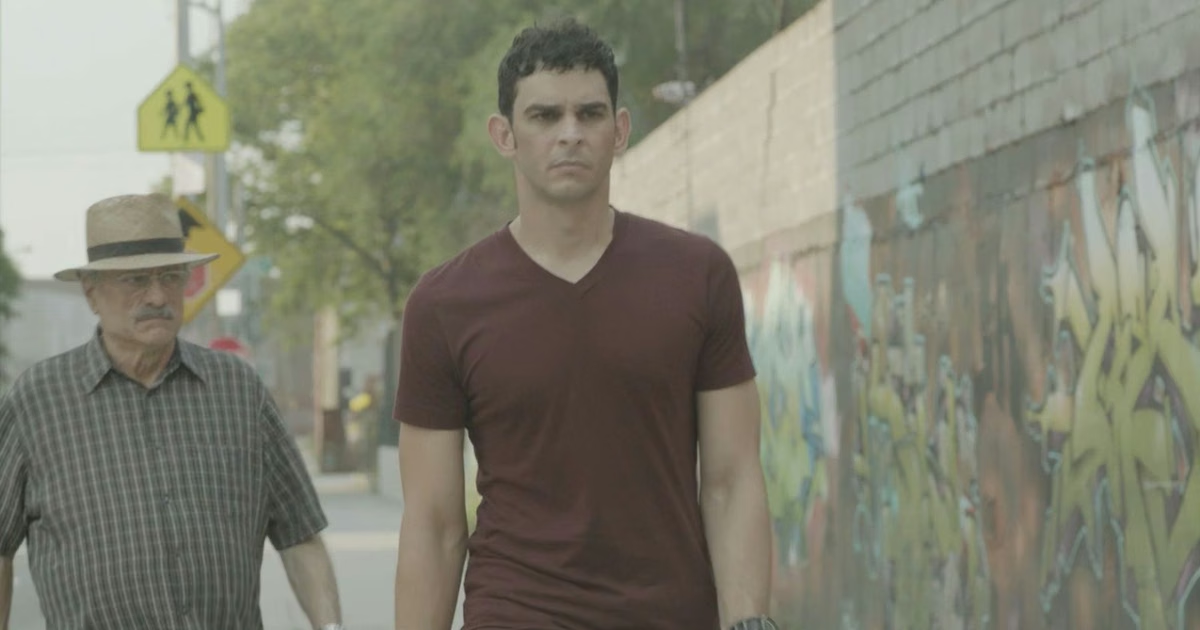
Part of those questions The Uncle’s Request (Uncle’s request), written and directed by Cuban Ricardo Bacallao. The award-winning film turns this possible encounter between victim and perpetrator into the starting point of a political and moral thriller about memory, justice, impunity, forgiveness and that dangerous frontier in which the search for justice can lead to taking it into one’s own hands and even revenge.
Winner of the award for Best Feature Film Screenplay at the 2026 Manhattan Film Festival, Uncle’s Request will be screened this Thursday, September 24, at 7 pm, at O Cinema South Beach, after a first presentation at Florida International University (FIU), in Miami, where the room reached its capacity and several dozen people were unable to enter.
Filmed in New York and inspired by real events, it tells the story of Manolo, an old Cuban exile and hunter of communist repressors who recognizes the man he blames for the death of his brother decades ago. Time has passed, but for him the account is still open. Already aged, he involves his young great-nephew in a quest that will end up confronting both of them not only with the past, but also with their own convictions and actions.
“The questions raised by the film are still completely valid. Some have yet to be answered and others have only just begun to elaborate them, even though more than six decades have passed since the terrible process of the Cuban Revolution began. And now we live in moments that generate optimism and, at the same time, pessimism. We have always had everything very complicated,” explained Bacallao, who has insisted that his purpose is not to offer answers. “My idea was always to reflect, since it is a film with many more questions than answers,” he said.
The conflict finds one of its central faces in the late actor Manny Alfaro, who plays Uncle Manolo. Alfaro developed an extensive career in the United States and appeared in emblematic productions of North American cinema such as Sea of Love (1989), starring Al Pacino; Goodfellas (1990), by Martin Scorsese, alongside Robert De Niro, Ray Liotta and Joe Pesci; and The Basketball Diaries (1995), with Leonardo DiCaprio and Mark Wahlberg. Years later it also appeared in Bushwick.
The Cuban Vidal Silva, who before settling in Miami lived in New York, plays Manolito, who receives the request that gives the film its title. If Manolo represents a generation directly marked by the events that occurred in Cuba, Manolito embodies the person who receives that history as an inevitable inheritance and must decide, like millions of Cubans, how much of that debt really belongs to him and how he should act.
The professor is played by Chaz Mena, an actor with an extensive career in American film, television and theater, with titles such as Pain & Gain, directed by Michael Bay and starring Mark Wahlberg, and series such as Bloodline, Law & Order, Burn Notice, Magic City, Graceland and Charlie’s Angels. Mena has also developed an important theatrical career and has received the Carbonell Award for Best Actor.
“As in other films, in this one the chase and the characters are sometimes just the surface of the story. The true territory of The Uncle’s Request It is a network of many decades where impotence, justice, morality, indolence and the generational clash produced by that battle that is sometimes established between the impossibility of some to forget the horror and the desire of others to forget, and even the bad idea of a clean slate, and even detachment or misunderstanding, come together. The history of Castroism is long and complex. There are too many victims and not a few perpetrators,” explains Luis Leonel León, journalist and filmmaker who studied with Bacallao in Havana, producer of the film and executive director of the Cuban Studies Institute.
“But what can happen when someone comes to the conclusion that the institutions have never done justice and, even worse, that they are not going to do it? What right does a victim have to demand justice on their own? When can it become revenge? What responsibility does a generation have in the face of the tragedy inherited from their parents and grandparents? What should we do the day this fiction becomes a daily reality not only outside, but also inside Cuba? These are questions that arise from this film, whose characters generate very different reactions and to the which, as in real life, we have criteria for and against. That was one of the ideas of my friend Bacallao, whom I have known since we started studying film in Havana exactly 30 Septembers ago and with whom we still continue to collaborate,” adds León.
The Uncle’s Request nor does it remain exclusively in the territory of fiction. Bacallao intersperses real testimonies related to political repression in Cuba in the narrative, among them those of the poet and former political prisoner Jorge Valls, who spent more than twenty years in prison, Armando Álvarez and Tony Morales. In this way, cinematic drama constantly encounters voices and experiences belonging to real history. The cast also includes Vicent Bloch as young Manolo, Edison Carrera, Ino Martel Casuso, Oscar Colón, Wiston Estévez, Hamlet Lavastida, Joseph Menchaca and Karl O’Brian Williams.
Graduated in Direction from the Faculty of Audiovisual Media of the Higher Institute of Art in Havana, Bacallao later completed a master’s degree in Film Production in the Tisch Asia program at New York University, for which this film was his thesis project. His filmography includes works such as Bebo, Cuban Mondongo, Cubans at the Edge of the Berlin Wall, Bay of Pigs: Our Perspective and Short Radiography of Hip Hop in Cuba, in addition to other projects focused on Cuba, emigration and the Cuban diaspora.
Bacallao has traveled to Miami again to present The Uncle’s Request alongside actors Vidal Silva and Chaz Mena and producer Luis Leonel León. The presentation is promoted by Artes Miami, an organization chaired by Aida Levitan, and by the Cuban Studies Institute, with the support of Eastern Engineering Group and Estrella Medical Centers. “I am very grateful to my friends and to the reception of such a special and natural audience for this film: the Cubans of Miami,” said Bacallao.
But the invitation is not only addressed to those who follow the Cuban issue, political history or diaspora cinema. The Uncle’s Request It can also challenge those who, Cuban or not, have experienced similar situations: people who have lost relatives as a result of political violence, who have been imprisoned or persecuted, who have had to leave their country, who have seen those responsible for those events continue their lives without answering to justice or who have inherited stories from parents and grandparents whose burden still remains.
“This Thursday in Miami Beach we will repeat the same format that we did before at FIU together with Sebastián Arcos, where after the screening we held an interesting meeting with the public, artists, former political prisoners, academics, relatives of victims and Cubans of different generations who debated for more than an hour. That presentation was a success not only because of the attendance, but because of the exchange, precisely one of the purposes of the film: to provoke the public to try to answer the questions that the story raises. And I hope that it happens again and that Those who could not enter that first screening now have the opportunity to see the film in Miami Beach. We are very fond of seeing you all,” said Bacallao.
The Uncle’s Request (Uncle’s request), Thursday, September 24, 7 pm, at O Cinema South Beach, 1130 Washington Ave. #200, in Miami Beach.
For reservations or more information, visit www.o-cinema.org/events/the-uncles-request
