
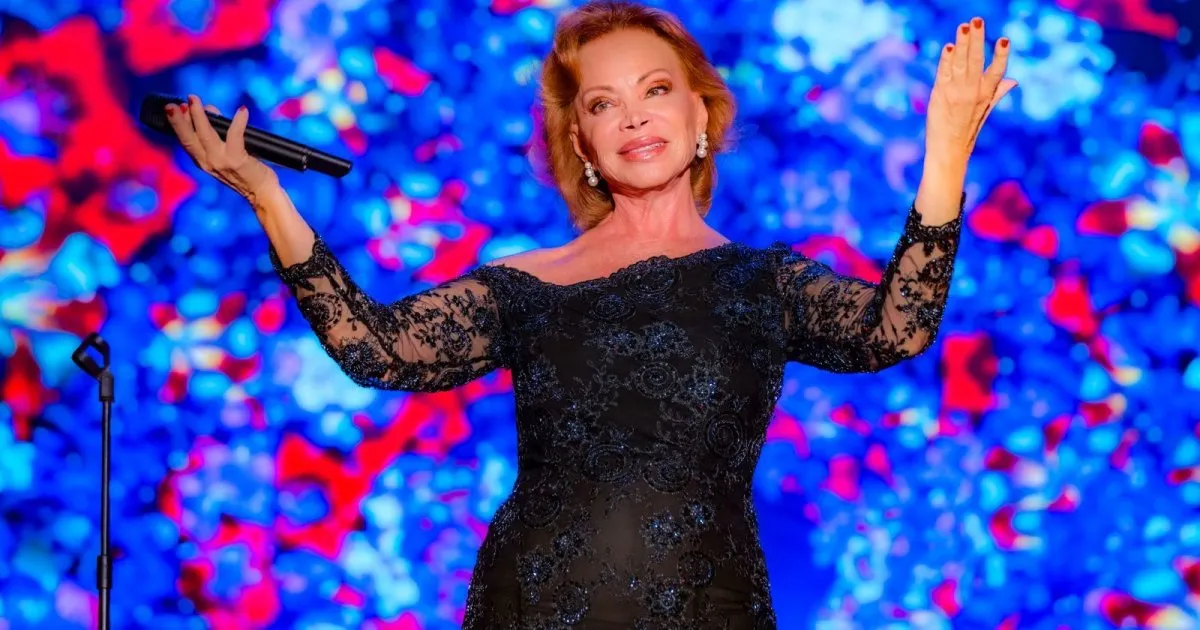
And he will do it before the Miami public on April 12 at the James L. Knight Centerin what will be the last show of his career in the City of the Sun, as part of the Gracias tour.
“In Miami, it really is the last concert What am I going to give? And I only have a few countries pending where I might go in the fall. Countries that I haven’t touched yet, that are pending. The tour started in October 2024, we have done about 60 concerts,” he said. Pigeon Saint Basil in an interview with DIARIO LAS AMÉRICAS.
“I think it is a word (thank you) that is small and big enough to express my gratitude to the people for the love, the respect, for being there and never leaving me alone, and because they have been part of my life all this time. Also to the authors who have given us part of the repertoire that I make, and to everyone with whom I have had the privilege of sharing songs through generations, some of my own and others of other composers. We must be grateful, because there is always something to give thanks for,” he added about why he chose the title of the tour.
For the singer, it is essential to continue exploring creativity. And that is what he intends to do with this farewell that marks a new beginning.
“I have entered into another new adventure. I am closing the cycle of concerts to enter a different stage. I started a play in November in which there are also songs, but the most important thing is the text, because I have always wanted to do acting work, I really like acting. And I finally found with the author of the play, Juan Carlos Rubio, the profile of what we were looking for. I am on tour throughout Spain until the end of next year. I am very happy because it is a wonderful play, based on Dulcinea, the character of Don Quixote, by Cervantes. So I continue on stage, but in a different way,” he explained.
“The artist also needs to move to other spaces, to search. To continue learning and getting excited about what he does. And for me, interpretation, from a very young age, is something fundamental. I am doing a very acting job, because Dulcinea is a character who never spoke and we are giving her a voice through texts from Don Quixote and Miguel de Unamuno. There are songs that illustrate some of the five characters, it is a female, kaleidoscopic character, it is really as if I were interpreting four women. And that is also where the music It is an important part, because the text is always accompanied, like in the soundtrack of the movies. We would say that the text has a soundtrack, which is the piano that accompanies me and from time to time there is a song that illustrates each stage moment,” he said about the theatrical piece.
on the tables
Although his voice has captivated audiences for 50 years, acting seduced him at an early age and today, at 75, he returns to his essence.
“Since I was little, I was an actress who sang. I really liked acting. In fact, when I was seven years old, I put on my shows for my parents’ friends. There were always stories, sometimes they were comic, other times dramatic. I also sang comic or dramatic songs. And that’s what I have continued doing. That’s why I have always done musicals. When I felt I had to go back to theater school, I did a musical. And there I continued learning, working, and then continuing with my tours. Acting has always been fundamental for me,” he said.
Likewise, he said that he plans to bring the production to theaters on this side of the Atlantic, which features a song written by his only daughter, Ivana, a music producer, composer and arranger based in California.
“I think it is a very universal piece. The idea is to bring it to America, because there are several countries interested. And it is also quite easy to move, because the concept is small, although it is really very big as a staging and also as a literary idea. They are wonderful texts, even the songs are also made with texts by Cervantes. Except for one that my daughter has composed for the play, which is called My Dear Don Quixote. When we finish the cycle in Spain, I think that maybe by the end of 2027 we could make a small one. tour of America. I would love to.”
A life for music
Throughout five decades of history, music has served the Madrid woman as an instrument of self-improvement and a tool to see life in a peculiar way.
“This is a way of living, of knowing the world. It is a wonderful vehicle of communication. It universalizes you as a person, because you arrive in any country and see how your songs reach people you don’t know. Sometimes I say: I am in so many houses. Music has brought me a way of life, a journey. It has brought me closer to countries and has allowed me to continue growing as an artist and human being,” he expressed.
“In Spain it used to be very common, because the kitchens of the houses opened onto a patio, so when the housewives were cooking they would turn on the radio. And the music would go from one kitchen to another without asking permission. And that was a fantastic form of communication too.”
When comparing the lyrics of that time with those that emerge today, he commented:
“I think they are songs not so much about evasion, but about identity. Well, they invite you to identify with the text, with what is happening, with what the person singing is saying. They are songs where the text was very important. That is already a fundamental point. Right now the rhythm predominates, which really is wonderful, but it is still the most basic area of music. And on the other hand there, in all those generations, what predominated was the melody, the lyrics, the story. So, it is much easier that history penetrates and goes from one generation to another.”
“I think that is what fundamentally differentiates it. The story and the melody have been changed for the rhythmic one. It is much easier to communicate to your children or grandchildren a story with a text, with some words, with some characters and with a melodic line that you can hum. It is difficult for a song to transcend from one generation to another solely based on the rhythmic, because the rhythmic begins and ends in itself.”
But singing and acting are not her only talents, literature also calls her. He published his third novel, Uxoa, el secreto del valle, in 2025. Set between the 16th and 18th centuries, the story is inspired by a loss he suffered in the pandemic.
“I lost my mother very young, at 30 years old. My older sister was older than me for many years, she was single and lived with me. She died of COVID and that loss for me was tremendous. So, from that deep feeling of loneliness for the first time in my life, the idea of fleeing was born.
Ágara, the name of the protagonist, means flight in Hebrew,” he recalled.
“To write you have to have your ears, your eyes and your mind very open, because you have to capture what is around you. You find many of the things in people. In what they tell you, in things you see. And then there is always an autobiographical point, in which you tell things about yourself that are incorporated into the characters. It is a very difficult introspective work that forces me to look inward and take life slowly, not to be in a hurry. To sit down and have a coffee with milk and see how it happens the afternoon until it gets dark, and continue writing. It is very interesting.”
