
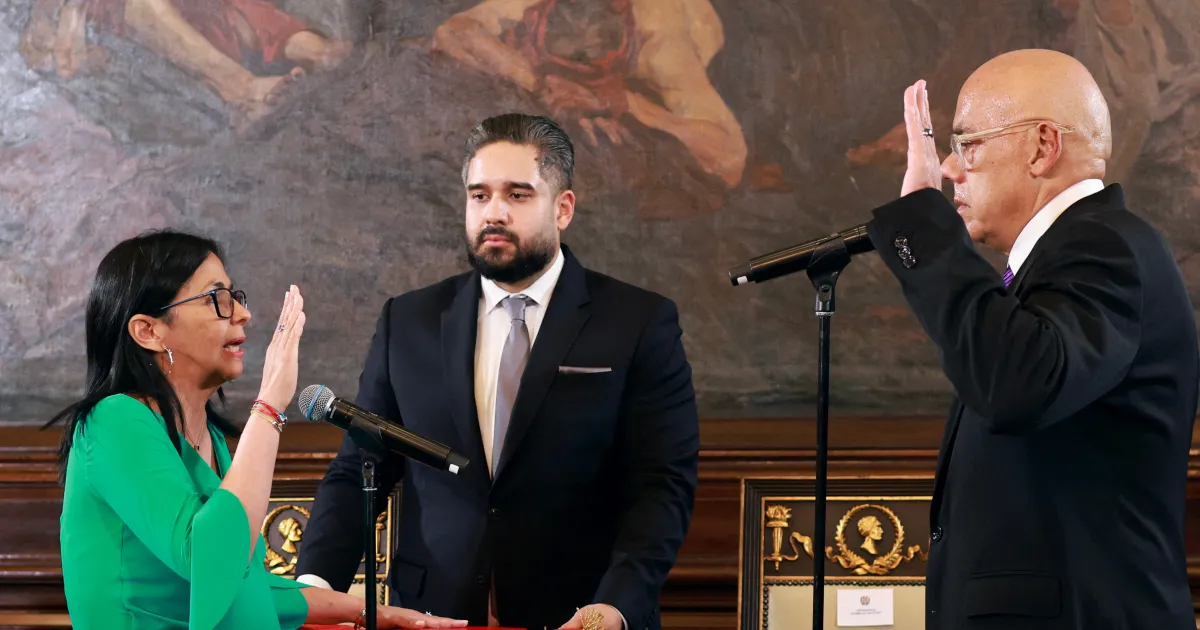
HAVANA.- After the capture of Nicolás Maduro on January 3, 2026 by US forces in an unprecedented lightning military operation in Caracas, Venezuela is experiencing a profound transformation not only in its internal policy, but also in its external projection. The interim command led by Delcy Rodríguez, oriented towards pragmatic decisions, has prioritized economic stabilization and reconciliation with Washington.
In this new scenario, the historic alliance with Cuba woven by the late Fidel Castro and Hugo Chávez, almost in filial terms, has been relegated to a strictly diplomatic and symbolic level. Caracas no longer supports the Havana regime as before: neither with large-scale subsidized oil, nor with fervent anti-imperialist rhetoric, nor with gestures of militant solidarity. Castroism, in the words of analysts, has been “left to its fate.”
“Limited speech”
A Google search of the most recent official pronouncements from Caracas yields a revealing panorama: the mentions of Cuba, now limited to a diminished foreign minister Yván Gil, are scarce, formal and lacking the ideological closeness that characterized Maduro’s speeches.
Gil, who remains at the head of the Foreign Ministry, limits himself to ratifying “the historical position” of brotherhood and cooperation between both countries, always within the framework of international law and self-determination. There are no emphatic condemnations of the US “blockade” nor calls for continental resistance. It is a lukewarm, almost administrative tone, which contrasts with the rhetoric of previous years, when the dictatorships of Venezuela and Cuba presented themselves as bulwarks against “Yankee imperialism.”
This distancing is not accidental. It is part of what the sociologist and analyst Fernando Mires has called the “third Chavismo”: a post-populist phase in which the Venezuelan regime abandons ideological banners to adopt a pragmatism that prioritizes the attraction of foreign capital and dialogue with Washington and Brussels.
In the high-level speeches of the new leadership—including interventions by the head of the Venezuelan regime, Delcy Rodríguez, and other key officials, such as his brother Jorge Rodríguez, head of the Venezuelan Parliament—any message of explicit solidarity with Cuba is conspicuous by its absence. “Imperialism” is not questioned as in the past; Nor is the “revolutionary brotherhood” mentioned. The focus is on internal recovery, the reopening of the economy and the normalization of relations with the US and the European Union (EU).
In this context, Yván Gil’s role has become visibly secondary. Diplomatic and journalistic sources agree that strategic relations with the US and the EU have passed into the hands of a non-Chavista vice chancellor, Oliver Blanco, who has been appointed within the framework of the pragmatic opening of the interim regime.
“New logic”
Gil, meanwhile, is in charge of the residual issues of the “Bolivarian brotherhood”, such as Cuba, while the priority files – oil investments, lifting of sanctions and dialogue with the White House – are handled from other offices. It is a structural change that reflects the new logic of Miraflores: red carpet (literally) for senior US officials and open doors to transnational private capital that was previously stigmatized as “neoliberal.”
The unexpected visit of Cuban Foreign Minister Bruno Rodríguez to Caracas, just days after the fall of Maduro, has been interpreted in retrospect as the symbolic moment of the closing of the once close alliance between Caracas and Havana.
Subsequent events confirm that reading. Last February, international media reported the massive departure of Cuban security advisors and medical personnel from Venezuela, under clear US pressure. Washington, in line with Donald Trump’s policy of “surrounding” the Miguel Díaz-Canel regime, promoted the end of that presence to dismantle the last network of Castroist influence on the continent.
From Buenos Aires, Infobae detailed how the exodus of these officials has represented a direct financial blow for Havana, which loses not only Venezuelan oil, but also foreign exchange from “collaboration” programs.
After the capture and extraction of Maduro, those who inherited power in Caracas opted for what analysts call a “constructive normalization” with Washington, betting on the resumption of full diplomatic relations and facilitating the partial privatization of the oil industry. Faced with this, the statements on Cuba are reduced to brief official statements that reiterate “solidarity” without concrete commitments. Caracas is no longer the lifeline of Castroism.
