
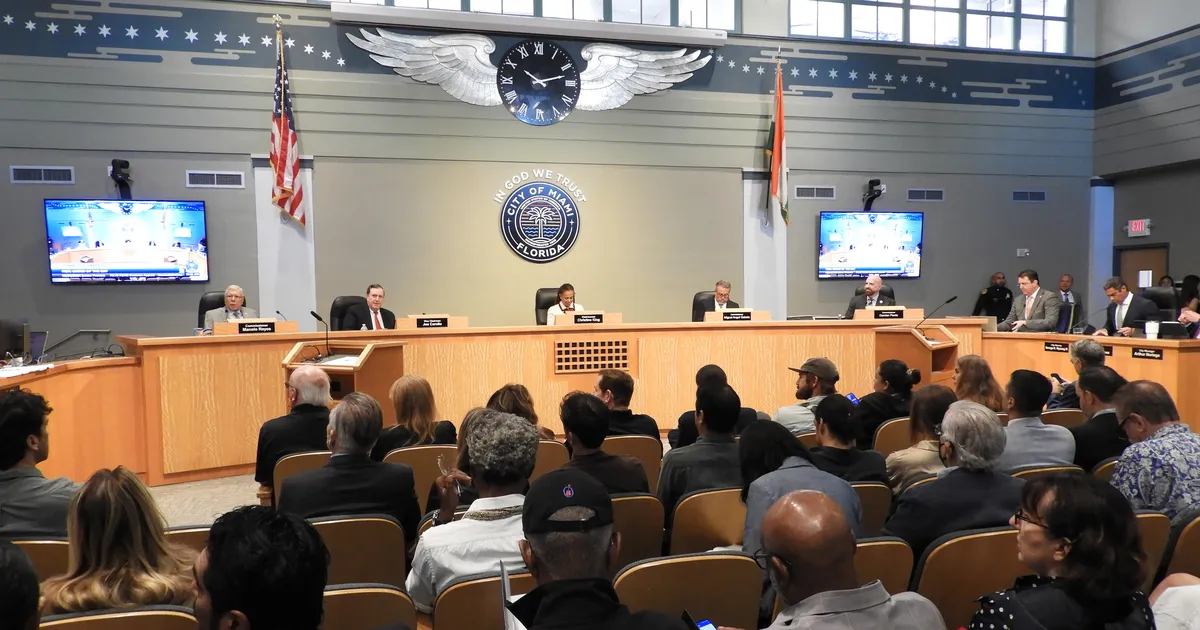
As there was doubt about the effectiveness of the resolution of the municipal legislative body, DIARIO LAS AMÉRICAS went to the office of commissioner Miguel Ángel Gabela, sponsor of the initiative, to understand the true scope of the measure.
The resolution, identified as R-26-0125, orders the city manager and city attorney to initiate legal action under state law to attempt to recover funds used in former Commissioner Carollo’s defense.
First Amendment
The conflict dates back to a lawsuit filed in the Federal Court of the Southern District of Florida by businessmen Fuller and Pinilla, who claim Carollo had retaliated against them for having supported a political rival who competed for the same seat on the Miami Commission in the 2017 elections.
After a trial that lasted 24 days, the jury ruled in favor of the plaintiffs and concluded that the then-commissioner violated their constitutional rights protected by the First Amendment.
The result was a judgment of $63.5 million, later upheld in appeals and consolidated after the refusal of the United States Supreme Court to review the case. The resolution establishes that Carollo acted in his personal capacity, not as an official.
Defense money
According to official data, the City of Miami disbursed approximately 5.27 million dollars in legal fees and costs associated with the case, including the judicial process and appeals.
During the discussion in the Commission, it was indicated that a portion of the expense was covered by insurance, but the City directly assumed a significant portion. That money is what is now being attempted to be recovered through authorized civil action.
Florida law
The legal basis for the resolution is Section 111.07 of the Florida Statutes, which allows local governments to recover legal fees paid with public funds when an official, after a fair trial, is found personally liable for acting outside the scope of his or her duties or in bad faith.
“Carollo’s case reached the Supreme Court and there are no more avenues for appeal. The ruling is final. Under Florida law, the City can try to recover that money,” explained José Sánchez-Gronlier, legal and political advisor to Commissioner Gabela.
Why the resolution
During the March 12 regular meeting, City Attorney George Wysong warned that the success of the action would depend on apparently uncertain factors, such as Carollo’s financial situation and the legal limitations on seizing certain assets, including pensions.
Furthermore, he stated that there is a clear priority. Supposedly, Carollo should answer first for the 63.5 million dollars which according to the ruling after the lawsuit filed in the Federal Court of the Southern District of Florida owes the businessmen of Little Havana, Fuller and Pinilla.
Despite this, the Commission considered it appropriate to move forward with the decision. According to the promoters of the measure, the main reason is strategic. That is, on the one hand, it seeks to establish a precedent and, on the other, ensure a long-term recovery mechanism.
“A sentence lasts 20 years. Many things can happen in that time,” Sánchez-Gronlier explained. “It is about having a lien that allows money to be recovered if at some point there are assets available.”
Miami as a creditor
The resolution, according to those consulted, would seek to position the City as a secondary creditor in the event that the former commissioner generates income or has assets in the future.
Plaintiffs can place liens on Carollo’s properties, although there are legal protections that limit immediate execution on his primary residence.
In that context, Miami seeks to secure a position as a second creditor, which would allow it to claim part of any future income.
This tax could remain in force for two decades, which opens the possibility of recovering at least part of the public funds used in its defense. It is, in essence, a long-term financial protection strategy, explained the advisor.
Cost of the lawsuit
Although apparently the purpose of this resolution would be to recover public money, the legal process itself would imply new expenses for the City.
As the municipal lawyer explained, the case would not be particularly complex, since it involves demonstrating how much money was paid for the defense. However, the cost of this will depend on the firm hired and the development of the litigation.
Preliminary estimates of the possible civil action put fees between $600 and $650 per hour for outside attorneys, plus the costs of experts evaluating legal expenses.
Wysong indicated the case could be resolved through a motion for summary judgment, although he acknowledged that similar litigation has taken years to resolve.
Carollo sues the city
In parallel, Carollo has initiated his own legal action against the City of Miami. The former commissioner claims approximately $1.5 million, alleging that he received a pension less than what he was entitled to.
As explained by Francisco Castañeda, Gabela’s chief of staff, this is an old dispute related to adjustments to his pension more than two decades ago. This new litigation adds complexity to the legal landscape and could influence future negotiations.
Non-payment of the sentence
A concern expressed by Miami taxpayers is whether the city would have any legal obligation in the compensation that the former commissioner must pay. According to the legal text, the $63.5 million judgment was issued against Carollo “in his personal capacity,” so the City has no responsibility for that payment.
A background
In September 2024, the City of Miami agreed to pay $12.5 million to the Ball & Chain businessmen and other Calle Ocho businesses who had sued Carollo three years earlier, alleging that he carried out a political vendetta against their businesses, using city offices, police and the Department of Code Enforcement to, they allege, harass them with fines and inspections. Although the City stated that its officials claimed no fault, reaching that agreement was considered a sound financial decision to avoid a lengthy legal battle and a possible judgment of nearly 30 million taxpayer dollars.
Institutional message
The resolution approved by the Miami Commission, according to those who support it, seeks to establish limits and prevent similar situations from again generating million-dollar costs for taxpayers.
No response from Carollo
DIARIO LAS AMÉRICAS tried on several occasions to contact Joe Carollo to obtain his comments on the resolution approved by the Miami Commission and the accusations it entails; As of press time, we had not received a response.
(email protected)
