
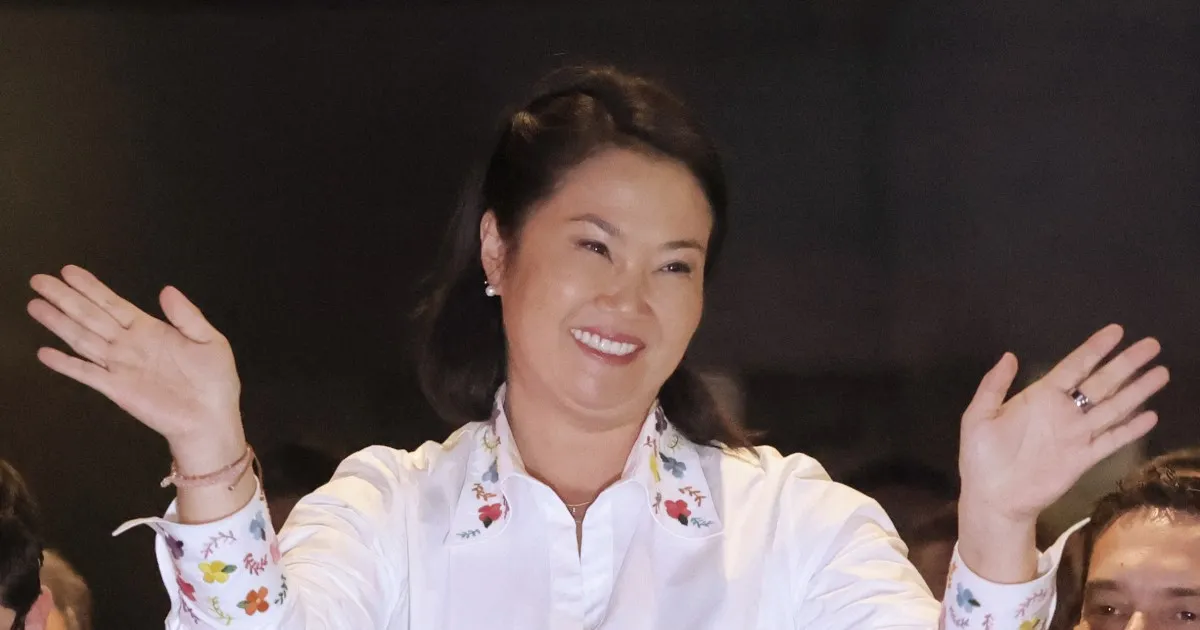
By June 16, the gap between Fujimori and Sánchez widened in favor of the Fuerza Popular candidate, with an advantage of 32,000 votes.
This premonition is based more on his vision, which rules out that the Peruvian electorate is divided towards the extremes of the right and the left. He denies polarization.
For Rivera Prieto, the electoral system of the Andean country is under suspicion: “I maintain that the results are so close because there has been prior manipulation of the electoral process. The electoral institutions have not worked in an impeccable manner. They have been politicized and, therefore, the results have also been manipulated. And that is why the fight has been so close.”
In summary, he asserts that “they wanted to make Sánchez, the representative of the extreme left, win. And really, what happened was that they did not have enough votes and, therefore, Keiko Fujimori ended up winning.” The political analyst reiterates that Peruvian political polarization does not exist and, in any case, it is not at the extremes.
In his analysis he defines Fujimorism as “right-wing populism” and as for Roberto Sánchez’s party he practically denies its existence, because, according to him, “it did not reach 10%” in the first round and it will never be known, “the total support that party had in the second round, because the vote, as I said at the beginning, has been manipulated.”
“They are not half of the country, I can assure you of that. Neither one nor the other,” he points out.
Peruvian electoral experts have broken down the voting numbers and argue that the candidates who went to the runoff were rejected by more than half of the population, none of them even reached 20%, which is interpreted as a coup for whoever is going to govern.
heavy-handed government
Although the honeymoon may be postponed or never happen, Rivera Prieto thinks that most Peruvians want peace and tranquility.
“People want to work and live in peace, improve and prosper. That’s the majority. There are going to be groups that are going to want to form a violent opposition, yes, of course there are going to be some. That’s why they are going to have to create a government with a strong hand against that type of reaction.”
He is not sure that the social protests will reach the level of Bolivia, a country where President Rodrigo Paz has been resisting strong demonstrations, road and city blockades for more than a month, and has even been asked to resign when he has only been governing for seven months.
In Peru, the political analyst does not see this scenario, but warns that the tenor of the demonstrations that occur will have a lot of support, to the extent that the government can meet social demands, in areas where historically the State has not been effective.
“I am referring to the most impoverished areas of the country,” he comments.
No economic model
The fact that Fujimori has committed in the campaign to leave the director of the Central Bank of Peru, who has been in the position for 20 years, in his position, and gave relief to the investors, economic and social sectors of the Andean nation, makes Rivera Prieto reflect and after taking a little breath he says: “I am going to explain something. In Peru there is no economic model. What there is is a consensus regarding the functioning and stability of the currency and the control of inflation.”
It clarifies that there is no strict economic model. Because? Because there is no objective that does not go beyond the fact that the currency remains stable and there is no inflation. “That’s the only thing you get.”
He clarifies that the social gap has not been solved, the problems of the “misnamed informality”, which he prefers to call “popular economy”, have not been resolved either.
According to the National Institute of Statistics and Informatics of Peru, around 7 out of every 10 Peruvian workers work in informal conditions.
Even more, he pontificates that: “Those who believe that only the stability of the currency and low inflation are the objective, do not understand that the economy is not made just for that. The economy is made to serve the people. In other words, in Peru there is no economic model in the strict sense, I repeat.”
What exists? It points out that a basic macroeconomic consensus is aimed at preserving monetary, fiscal and financial stability. That has served to control inflation and maintain fiscal discipline and generate minimal confidence for private investment, but stability does not equal development of the country. That is why the majority in Peru remains poor.
In his opinion, macroeconomic variables are needed that also define a national course, establish strategic priorities, and articulate public policies aimed at specific objectives of collective prosperity. “And therein lies the Peruvian problem. That is, the State does not have a comprehensive economic vision about what country it wants to build in the next 30 to 50 years.”
elephant state
Confusing fiscal discipline with social development leads to an “elephant state,” says the political and financial analyst.
In Peru there is a lack of a national strategy for industrialization, technological innovation, strengthening of the internal market or progressive integration of the “popular economy.” “In other words, what exists is a set of rules designed to avoid macroeconomic imbalances. That is the only thing that exists in Peru.”
He does not foresee changes in the future, because he considers that no model is proposed in Fujimori’s proposals. “Neither Keiko Fujimori nor anyone else has raised it during the electoral process. Neither from the right nor from the left has that been raised.”
He emphasizes that when an economic model truly exists in a country, then there is already strategic predictability. Public policies stop being improvised reactions for the moment and become part of a coherent national direction, a concrete strategy.
It exemplifies that education responds to productive needs, credit promotes sectors that the model prioritizes, and infrastructure is planned with a logic of development. “Peru does not have a model because it does not say, well, we are going to be an agro-industrial country, we are going to be a mining country, we are going to be a fishing country, we are going to be a strategically commercial or services country.”
Rivera Prieto believes that in Peru they have deceived the population by saying that there is an economic model.
He doubts and points out: “If Keiko Fujimori is going to continue doing the same thing, there will not be a model that brings people to development. That is the issue.” He also clarifies that Peru’s macroeconomic success lacks soul and strategic direction.
Reforms for the first 100 days
The recipe for the first 100 days that Rivera Prieto suggests requires structural reforms, which he himself doubts that Keiko Fujimori has the vision to execute.
The first of them is to reduce an elephantine and corrupt public apparatus. “75% of the public budget is lost in current spending (salaries and consultancies to NGOs), leaving investment in infrastructure and basic services such as drinking water, health and education helpless.”
Then, he calls for unblocking the private economy since the state acts as a “web of obstacles” that slows down the economy. Rivera Prieto, from his experience as a businessman, denounces that a job creator in Peru must spend 40% of his time on paperwork before municipalities and regional governments.
Thirdly, it suggests giving incentives to MSMEs (micro, small and medium-sized businesses) with a reduction in the General Sales Tax and tax grace periods so that micro and small businesses can solidly formalize themselves.
A very important measure that it recommends is to stop the advance of organized crime and transnational gangs (such as the Tren de Aragua) or local gangs, even evaluating international cooperation agreements on security, similar to those implemented by Ecuador or Chile with the United States.
Rivera Prieto reflects skepticism and admits it, because Keiko Fujimori’s great challenge is to transform the structures of an inefficient State, however, “his real proposal is limited to better managing what already exists.”
