
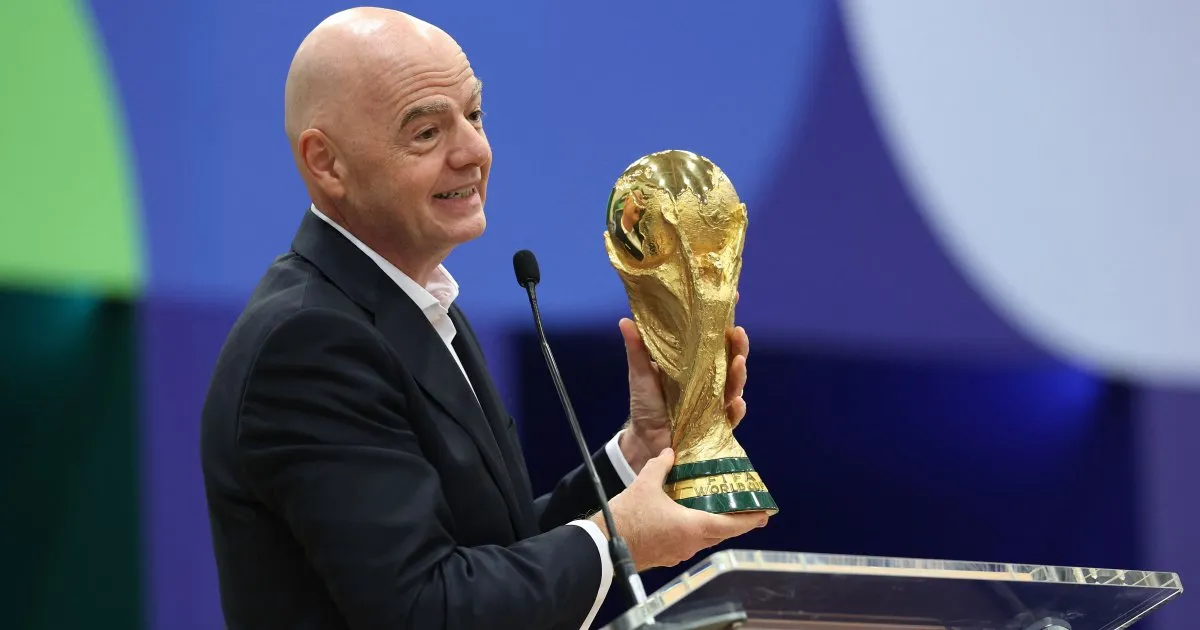
The president of FIFA, Gianni Infantino, received this Friday the support of several South American and Mexican federations, amid the strong opposition he faces seven months before the elections for a fourth and final term at the head of the organization.
Infantino arrived in Cali, Colombia, to attend the presidential inauguration of Abelardo de la Espriella, but his visit was marked by the crisis generated by the project, finally withdrawn, which contemplated the entry of private capital into commercial and sporting activities of FIFA, including the World Cups.
The initiative caused rejection among different sectors of international football and opened a rift with UEFA, which has 55 of the 211 FIFA votes and is emerging as the main opposition bloc to the re-election of the Italian-Swiss leader.
Infantino, 56, is for now the only candidate for the March 2027 elections. To remain in office he needs to get the majority of the votes of the member associations.
During his visit to Cali, the FIFA president avoided answering a question from AFP about whether he considered the crisis over. On the other hand, during an event with projects for young soccer players, he highlighted the importance of working so that boys and girls can enjoy soccer.
Conmebol support for Infantino
Infantino’s arrival in Colombia coincided with new support from South America. Conmebol was the first confederation to publicly support his re-election, last April, and on Thursday it reaffirmed its position despite questioning some of FIFA’s recent unilateral decisions.
The support expressed by Argentina and Paraguay was joined by Venezuela and Ecuador, which also celebrated the withdrawal of the controversial private investment project.
The president of Conmebol, Alejandro Domínguez, accompanied Infantino during his visit to Colombia and defended his management.
“This great work cannot be ignored,” said Domínguez, who opted to maintain dialogue despite the differences between the South American confederation and FIFA.
Brazil, one of the great powers in the region, has not yet officially expressed its support for Infantino. Its president, Samir Xaud, acknowledged that the private investment proposal had not been received favorably, although he did not comment on the leader’s continuity either.
Mexico distances itself from Concacaf
Another important support for Infantino came from Mexico, which distanced itself from the critical position of Concacaf, a confederation that gathers 35 votes in the FIFA elections.
Mexico, one of the three host countries of the 2026 World Cup along with the United States and Canada, expressed its support for Infantino’s “leadership.”
The Swiss leader also maintains a close relationship with US President Donald Trump, to whom FIFA awarded the controversial Peace Prize in December 2025.
Meanwhile, UEFA maintains its pressure and has announced that it will continue its boycott of certain FIFA activities, including the World Cups, despite the fact that the project that caused the dispute has already been withdrawn.
The president of the Norwegian Federation, Lise Klaveness, one of Infantino’s main critics, announced that she will ask for his resignation.
2030 World Cup, another open front
In parallel, Alejandro Domínguez is promoting a proposal to expand the 2030 World Cup from 48 to 64 teams. The centenary tournament will be played mainly in Spain, Portugal and Morocco, with three opening matches in Argentina, Paraguay and Uruguay.
The president of the AFA, Claudio Tapia, also confirmed that he is working so that Argentina can host a complete phase of the tournament.
Asked about the possibility of expanding the World Cup, Infantino left the door open to study the proposal: “Everything will be talked about, let’s see.”
With the support of South America, Mexico and Africa, Infantino retains an important base of support, although the opposition from UEFA and Concacaf keeps a political battle open that will intensify ahead of the March elections.
