
Ali Swenson
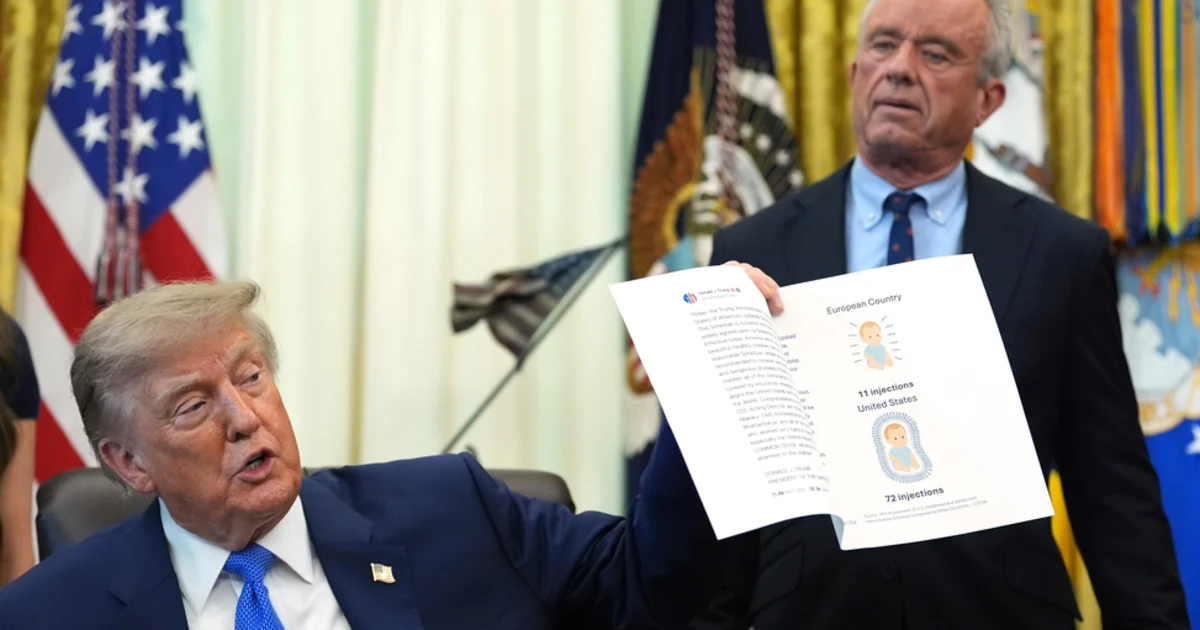
President Donald Trump signed an executive order calling for revising recommendations on childhood vaccines to promote his long-standing position that vaccines should be given spaced out over different doctor visits.
The order will recommend separating the measles, mumps, and rubella (MMR) vaccine into three different doses administered at different visits, in addition to instructing the country’s Department of Health to improve research on vaccines, according to a White House briefing document, initially reported by The Daily Caller.
Trump also said Monday afternoon during an Oval Office event, that one-year-old children should receive their vaccines at five different visits, although it was not clear if he was referring to all the vaccines they receive at that age or to some specific ones.
Public health experts have expressed concern that spacing out vaccinations, as Trump suggests, may increase children’s risk of contracting a vaccine-preventable disease before returning for another visit.
Childhood vaccines, as well as guidelines for how and when to administer them in combination, are rigorously studied, and their safety continues to be monitored for years while they are used.
The separate measles, mumps and rubella vaccines for children, which Trump has said he wants them to receive, are currently not available in the United States.
Although the order calls for reviewing vaccination recommendations, It is the states, and not the federal government, that have the authority to require vaccines for school-age children. The order will recommend states that have school vaccination requirements consider updating their laws to reflect the administration’s recommendations, according to the briefing document.
Last December, Trump ordered the Department of Health and Human Services to review how other developed countries approach vaccine recommendations and consider modifying U.S. guidelines accordingly.
The department responded by reducing the number of vaccines it recommends for all children, a move that was later blocked by the courts.
In the months leading up to Monday’s announcement, the Trump administration had sharply scaled back its statements on vaccine policy and focused on less polarizing issues, such as healthy eating and efforts to lower drug prices ahead of the November elections.
Polls show that most Americans continue to support school vaccination requirements, although Republicans are less likely than Democrats to consider them important.
Even so, Trump has insisted on linking autism to vaccines. However, there is no credible scientific evidence that vaccines cause autism.
Pressure recently increased on Health Secretary Robert F. Kennedy Jr. to identify the cause of autism, something Kennedy had committed to doing through new research presented last year.
Last month, Trump publicly asked the health secretary for an update on autism-related research during a Cabinet meeting.
“How’s the autism research going?” Trump asked.
“We will give you an answer,” Kennedy responded.
Scientific consensus and decades of studies have concluded that there is no link between childhood vaccines and autism.
Monday’s order comes as the school year begins in parts of the country and the United States faces a measles outbreak that experts say could cause the country to lose its measles elimination status.
