
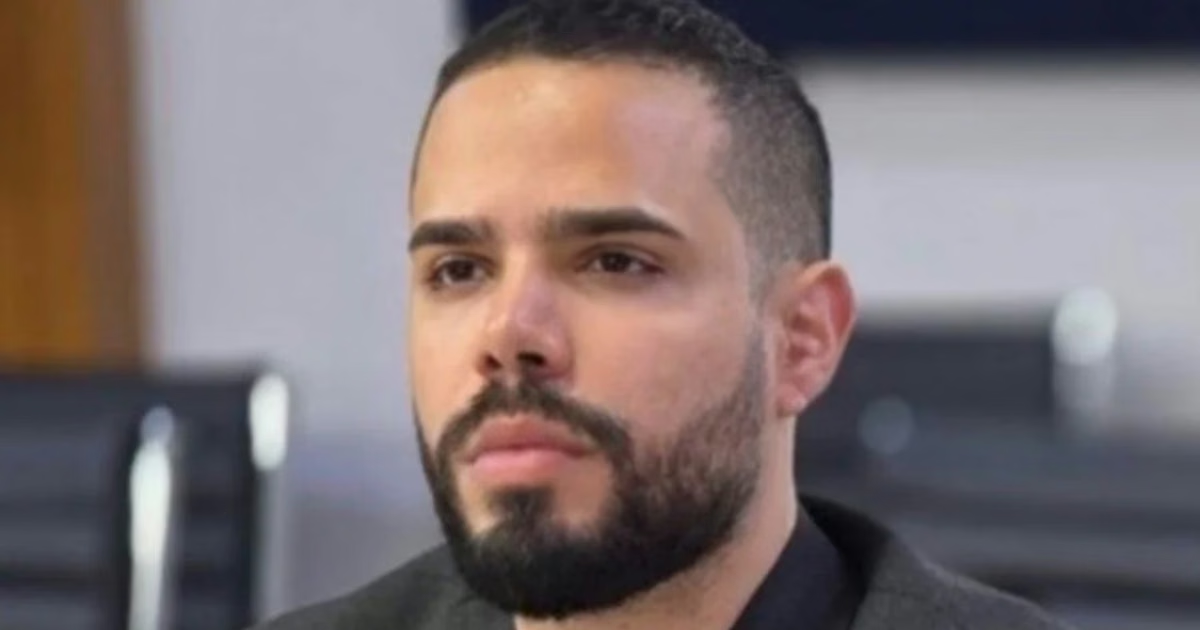
MADRID — Two former Venezuelan diplomats were arrested in Spain with 50 kilos of cocaine, this past September 8. These are Juan Manuel Escorihuela and Kelvin Mato, the first tried to introduce the drug into the Iberian country and the second was waiting at the Adolfo Suárez airport in Madrid-Barajas.
According to what was reported by journalist David Placer, Escorihuela at the time of his arrest by the Civil Guard tried to pass himself off as a diplomat from the South American country, but the Spanish police discovered that he was actually a former diplomat since he had ceased his duties months ago. Now, in addition to the accusation of drug trafficking, he is also accused of usurpation of functions.
Escorihuela was a collaborator of Coromoto Godoy, current Venezuelan ambassador to the UN and had previously worked in India. Godoy was also a diplomat in Trinidad and Tobago and Spain during the administrations of Hugo Chávez and Nicolás Maduro.
While, Kelvin Mato, is known in the Venezuelan embassy in Madrid for being the former brother-in-law of Nicolás Maduro Guerra, known as “Nicolasito”, son of Nicolás Maduro Moros, now in a New York prison and awaiting trial in June 2027.
Mato also worked with Coromoto Godoy at the Embassy in India and participated in the events of the Liberator’s birth on July 24 in Spain where he can be seen greeting the current ambassador Timoteo Zambrano.
In the diplomatic delegation they fired him when they found out about the police investigation. He was also accused of crimes against public health.
The Spanish police believe that the former Chavista diplomats already carried out this drug trafficking route from Caracas with a stopover in the Dominican Republic and to Madrid quite regularly.
The case was left in the hands of the Plaza de Castilla courts, where an investigation remains open to determine how he obtained the drugs, who could have collaborated with him and whether he had previously used the same procedure to introduce cocaine into Spain.
Investigation under confidentiality
The researchers hypothesize that the September transfer it might not have been his first operation.
The Spanish authorities are keeping the case under wraps while investigations continue to establish the scope of the operation and determine if there are other people involved.
For now, the episode is being investigated as a case related to the transfer of cocaine to that country, without it having been publicly established that a structure linked to the Venezuelan embassy exists.
The case also recalls other episodes in which people linked to diplomatic representations have been linked to drug trafficking operations.
Journalist Placer points out that the big question is: Will Delcy Rodríguez’s diplomacy assume some type of responsibilities and investigations for these serious cases?
