
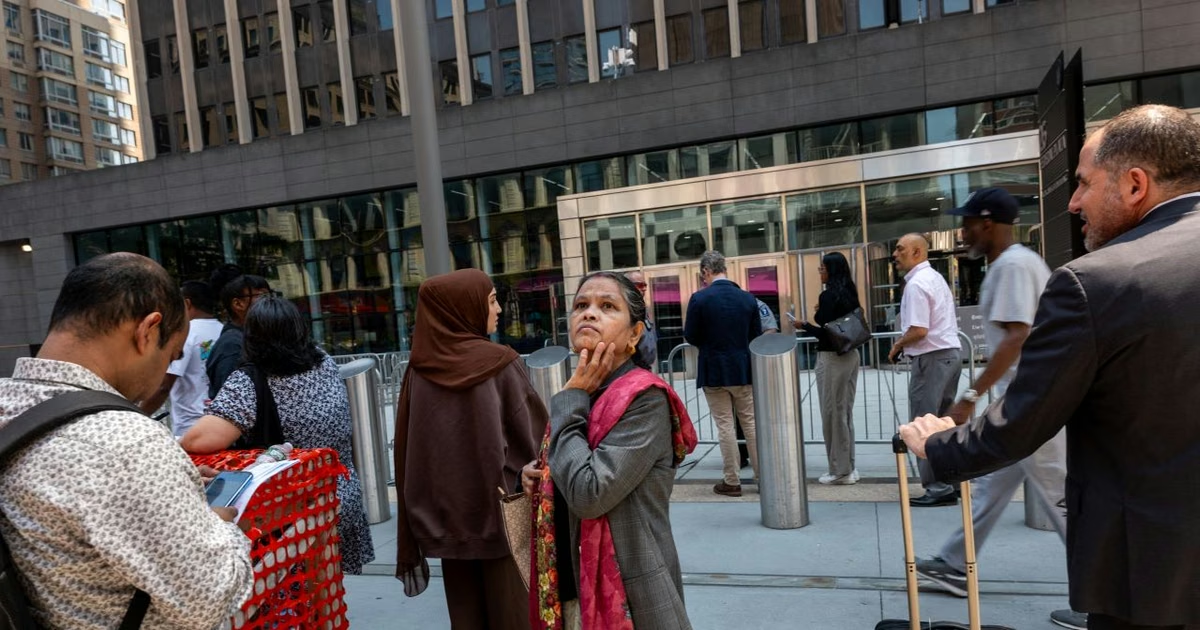
Data from the organization Transactional Records Access Clearinghouse (TRAC), a research center at Syracuse University, by the end of August 2026, there were a total of 3,092,988 cases accumulated in the Immigration Courts, of which 2,278,978 immigrants have already filed formal asylum applications and are now awaiting their asylum hearings or decisions in the Immigration Court.
It is Miami-Dade County, FL, that has the largest backlog of asylum and deportation cases pending in Immigration Court (as of the end of August 2026).
Immigration courts record a total of 514,061 new cases through August in fiscal year 2026. This compares to the 899,741 cases the court completed during this period in fiscal year 2025.
The judicial changes
Changes in immigration courts affected asylum applications, TRAC Reports maintains that one factor was the dismissals and appointments made by President Donald Trump’s administration, which maintains a tough policy against irregular immigration, one of his main campaign promises.
The Executive Office for Immigration Review (EOIR) indicates that a total of 279 immigration judges were fired or resigned between 2025 and 2026.
So far this year, 192 new judges have been hired and 53 temporary judges have joined the body of immigration judges. In total, 743 judges will work on resolving asylum cases during 2026.
In June 2026, the asylum approval rate fell to a record low of 5.5%, while denials rose to 94.1%, according to TRAC monitoring.
The hiring of judges accelerated the resolution of cases to record levels. Between April and May, the resolution of cases exceeded 13,000 and between March and June it reached 14,000.
Stricter interpretations
In the first half of fiscal year 2026, immigration judges approved about 9% of decided asylum cases, compared to 24% in 2025 and 46% in 2024, according to court data compiled by TRAC, which the portal requirements-usa.com/ reported at the end of July of this year.
The portal describes that during fiscal year 2024, immigration courts granted asylum or other protection to about half of the cases decided: it was the year with the most protections granted in the history of immigration courts. It occurred during the administration of Democrat Joe Biden, who maintained an open border policy; More than 10 million migrants crossed the border illegally, according to Customs and Border Protection (CBP) records.
But that trend reversed starting in 2025. With the change in administration came stricter interpretations of existing immigration laws, greater speed in deciding (and denying) cases, and more power for judges to dismiss incomplete applications.
In September, the situation is even more dramatic: only five out of every hundred cases on average are approved according to data disclosed in a Telemundo report this month.
What are the reasons for the decrease?
Immigration attorney Silvia Mintz told Telemundo that: “Judges are being much stricter with approvals and sometimes the person is in deportation proceedings and it may be that the only option they believe they qualify for is asylum when in reality they do not qualify” for that protection intended for victims of political, race, religious or nationality persecution.
A TRAC report reveals that the asylum approval trend is in free fall.
“In June of this year, only 771 cases were approved, equivalent to 5.5% of the total applications. That is, a denial rate that exceeds 94%. In the last administration more than half of the cases were approved,” according to TRAC.
Through a statement, the Department of Justice, to which immigration judges depend, indicated that the Biden administration allowed millions of migrants without adequate verification to enter our communities.
Reducing the backlog of cases in immigration courts remains one of the highest priorities of the current White House administration.
Sometimes, people are not advised correctly, says Niameh Salem, an immigration lawyer to Telemundo, and then they think that, because the violence in their country is great or because organized crime exists, that is why they will qualify for asylum.
What criteria then?
If a country’s violence is not a sufficient reason, what are the criteria to qualify?
Salem states that “to qualify for an asylum case you have to show that you have been persecuted, threatened or tortured for one of these reasons, because of your race, your religion, your membership in a particular group, because of your political position or because you have a characteristic that makes you different from others. You also have to show that you cannot be safe anywhere in your country and that the government refused to protect you.”
Applicants for protection should take into account that Having a pending asylum application is not an immigration statusso people in that situation may be at risk of being detained. In this sense, the Board of Asylums and Friends recommends seeking professional advice in these cases.
What do winning cases have in common?
Applicants who are successful in obtaining asylum approval typically share the following key elements:
- Legal representation: they have a lawyer or accredited representative who prepares the defense and evidence appropriately.
- Solid and consistent evidence: They present verifiable documentation, detailed evidence of persecution or well-founded fear, and complete consistency between their written statements (Form I-589) and their oral testimony.
- Nexus with a protected category: clearly demonstrate that the risk or persecution suffered in their country of origin is specifically linked to five protected grounds: race, religion, nationality, membership in a particular social group or political opinion.
- Credibility: The judge or asylum officer must consider that the applicant’s testimony is fully credible, coherent and persuasive.
To take into account, a weak or poorly documented case has very few possibilities, and the difference is made by the evidence, the coherence of the story and the legal representation.
Fight discrimination against migrants
American voters’ opinions on immigration appear to have changed in the past two years. According to a September NBC News poll: more people (51%) currently prioritize combating discrimination against immigrants and creating a path to citizenship than strengthening border security (7%), a much lower figure compared to the 14% registered in 2024.
The interviewees conclude that, in general terms, the results of the survey are positive on the immigration issue, although they have different points of view on the path that should be followed to legalize millions of people in this country.
It is interpreted from the survey that people are no longer with the negative narrative, thinking that immigrants were all the problems of this country, that yes, they understand that there is a way in which the immigration problem can be solved, but it is with a comprehensive immigration reform.
Respondents are more concerned right now about the cost of housing, gasoline, food, inflation in general, the war against Iran, and not only about the fact of immigration, as was more the case at the beginning of President Trump’s presidency, according to that survey.
Chicago considerable decline
The approval rate for asylum cases in Chicago immigration court has dropped sharply this year, according to a ChicagoSun-Times and WBEZ analysis.
The analysis, published, indicates that 3.3% of asylum cases have been approved this year, compared to 14.6% registered last year. The analysis also detailed that the national average of approved asylum cases fell to 2.1%, compared to 8.8% previously.
According to the Chicago Sun-Times and WBEZ report, obtaining asylum has been “historically difficult.”
Who gets the most asylums approved in the US?
Requisitos-Usa.com points out that nationality does not guarantee or prevent asylum, but it does influence the ease of proving persecution. According to the courts’ most recent nationality data (fiscal year 2024), the highest approval rates were for:
TApproximate rate of approval by country
Belarus 88%
Afghanistan 88%
Uganda 86%
Eritrea 85%
Russia 85%
What do they have in common?
These are countries where political, religious or identity-based persecution is widely documented in international reports, making it easier to connect the applicant’s personal history with a protected reason.
Applicants from Venezuela and Cuba have also maintained rates above average, because many can demonstrate direct persecution by the state apparatus. Even so, no Venezuelan or Cuban has asylum secured by their passport: each case must prove individual persecution, according to Requisitos-Usa.com.
However, the situation with Venezuelans has changed greatly since the publication of a September 4 ruling by the United States Board of Immigration Appeals (BIA) earlier this month, determining that the risk of persecution in Venezuela decreased. The obligation of asylum seekers of Venezuelan origin is to prove that their lives are in danger under the regime of Delcy Rodríguez, president in charge of Venezuela.
The BIA began to incorporate the departure of Nicolás Maduro (captured on January 3 by elite US forces) as an element to make decisions on the request for protection of the citizens of the South American country.
The BIA ruling came after the revocation of the asylum previously granted to a Venezuelan woman who identified herself as an opposition member and entered the United States in 2014.
