
By Leocenis García. Originally published in El Nacional
“Here comes a revolution,” he said before it appeared. “Here comes a blow,” before they hit it. He passed Chávez several times in a car to give him some notes; She meets him there and then they send her with a delegation of what they called “coup victims” to Washington. He worked in counterintelligence—as you read—, commissioned by Roy Chaderton and linked to Otaiza, head of political espionage.
“We are not going to resist this economic siege,” he defined Nicolás. “And a reform must be made.”
Everything was fulfilled.
What was this woman’s biggest mistake since January 3? I could say that the error was in staging, and in those who had to articulate that scene.
Some time ago Steven Camargo, who helps me in international affairs, told me:
—We are going to look for a meeting with María Elvira Salazar.
I told him:
-No.
“But she’s managing the agenda,” he insisted.
I told him no. And I returned to the same reasons why I never, in my travels in Washington, sought a meeting with Rubio.
They in Washington are not a power, they are a position. They are details of real politics that one learns over the years. In public life you have to have the common sense to know where to go and where not to go.
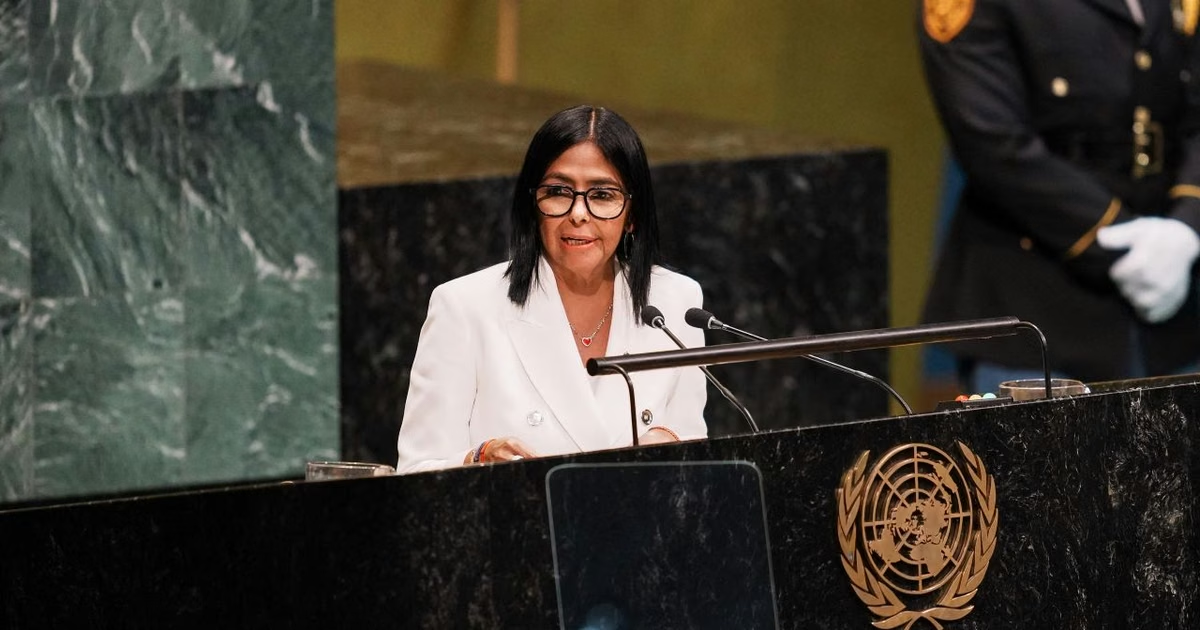
The regrettable spectacle of how the so-called Foreign Ministry and its “Olivetti typewriter covers” have handled the visit of the interim president to New York, within the framework of the UN, is a perfect manual of everything that a president’s entourage should never do.
There is a book that I like, it is called The 48 Laws of Power. One of their laws says: “Never overshadow your boss, lest he seek to change him” and “never bring bad news, lest upon seeing him he will be associated with the tragedy.”
One day my friend, the American businessman Harry Sanger, told me: “There are people who because they speak Spanish think they understand Venezuela,” referring to some of their fellow citizens. And the same goes for those who believe that speaking English makes them understand Washington. And I say Washington and not New York, because what they were dealing with was the politics and communication logic of Washington in the middle of the UN. The UN, for the Government of Venezuela, was an accessory.
What a mess!
And there the disaster began. The interim president gets out of a car—an unexpected van, almost an Uber—and no one waits for her when she gets out; She walks alone while the press calls her name simply, in a hostile manner. She enters the UN building, where those who should have waited for her on the steps of the car were waiting for her inside, leaving the interim to cross the accusatory wall alone, giving the impression of disorder and selling everything but power.
Then, the worst was yet to come: a meeting was arranged with the head of the Spanish government, and it was clear that the president had received a message “everything is ready,” because she had the phone in her hand and crossed the room to go to the meeting. But upon arrival, nothing is ready; The man is sitting talking on the phone. The president, once again, has to do what her “Olivetti typewriter covers” (useless, put there just to create bulk) should do: she backs down. And the person who served as messenger only ran, but did not report well; Now he looked at the scene paralyzed, with a gesture of absolute bewilderment… What a fool’s errand!
Sánchez greeted and sat down immediately. No one on the team had the judgment or the reflex to handle the scene to prevent the person to whom they owe loyalty from being exposed in such embarrassment.
And that’s how it all happened. Those who must serve the majesty of the Venezuelan State do not even reach court jesters, turning the president’s visit into that of a kind of mayor who is accompanied by two heads of municipal affairs through the halls of the UN.
And everything is already shattered. Only the speech remained, but the damage had already been done. Before, there was the photo with Trump, where the young advisor took a separate photo with who he really admires, the president of the United States, I suppose it came from his boss, Dr. Delcy Rodríguez.
And then, the public photo.
Power is power; and in high politics you not only have to be it, but look like it.
During the speech of the head of state, whom the chancellery sold as a mayor, the faces of her companions were a poem.
