
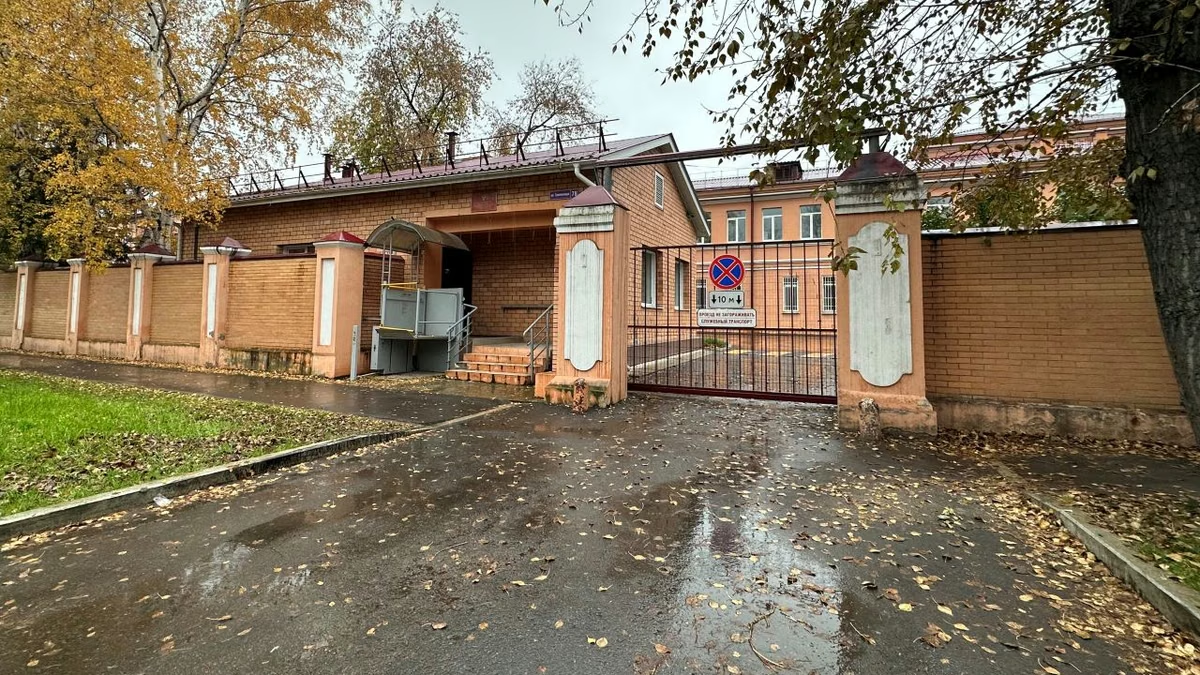
WASHINGTON — President Donald Trump said Tuesday that he planned to speak soon with his Russian counterpart, Vladimir Putin, after reports of the death of an employee at an institute specializing in pneumonic plague in Siberia.
Russian authorities deny imposing health restrictions in the Siberian region of Irkutsk and downplayed the incident last week.
However, Washington shows growing concern. The head of US diplomacy, Marco Rubio, urged Russia to be transparent about the situation. The World Health Organization (WHO) made a similar call.
“I have a call scheduled, yes,” Trump told reporters at the White House when asked if he had already spoken to Putin about the matter, adding that it will happen “very soon.”
The news that 28-year-old Daria Shipilova had died of pneumonic plague sparked alarm.
contagious disease
Pneumonic plague is a highly contagious lung infection that can be fatal, according to the WHO.
It is spread through droplets, unlike bubonic plague, which affects the lymph nodes and is transmitted through infected fleas.
The Russian consumer and health watchdog, Rospotrebnadzor, insisted on Tuesday that a document circulating on the internet about the tightening of sanitary and epidemiological measures and restrictions in the Irkutsk region is false.
“The document and information in question do not come from official sources and are false,” the agency stated via Telegram.
“At the moment no such decision has been made,” he reported, and stressed that “the sanitary-epidemiological situation in the Irkutsk region (…) remains stable.”
Transparency
This Tuesday, Secretary of State Rubio urged Russia to be “transparent” and “share more information with the world.”
“I think it’s obviously up to Russia to share more information with the world,” Rubio said during his trip to Iceland.
The Wall Street Journal reported that the State Department sent Russia a confidential diplomatic communication, warning Moscow that not revealing details goes against its international health obligations.
Trump declared on Monday that he was willing to help Russia if necessary.
The Russian media People of Baikal, citing anonymous sources close to regional security services, claimed on Friday that the deceased woman could have contracted pneumonic plague through a broken test tube.
Other media outlets claimed that his death was due to a laboratory accident at the facility.
Up to 200 people with whom he had contact are in quarantine, People of Baikal added.
Low risk, according to the WHO
Meanwhile, the WHO director general urged Moscow on Tuesday to share details of the incident.
“Timely, comprehensive and transparent information sharing under the International Health Regulations is essential to clarify conflicting reports and enable accurate assessment of potential public health risks,” WHO chief Tedros Adhanom Ghebreyesus wrote in X.
At a press conference in Geneva, the WHO stated earlier that it verified the death with the Russian authorities.
“The initial risk assessment carried out by the WHO, based on available information, indicates that the risk is moderate to low for Irkutsk, low for the Russian Federation as a whole and very low for the European region,” said WHO spokesperson Christian Lindmeier.
According to Russian authorities, the disease was not detected during the woman’s autopsy.
According to Irkutsk regional governor Igor Kobzev, an inspection by an expert commission has concluded that “The cause of death was pneumonia” of “undetermined” origin.
Furthermore, he added, no employee of the plague control institute has gone to the doctor since the young woman’s death.
