
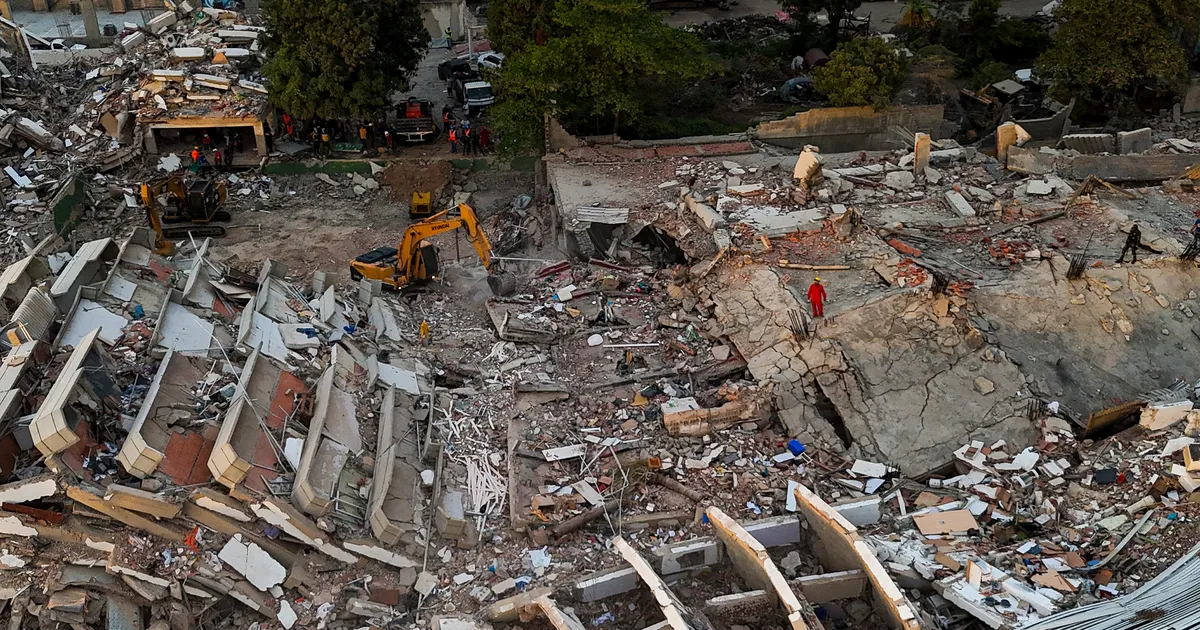
It is almost impossible, at the moment, to quantify an amount for reconstruction or to know how long it may take for an area to recover, if it can be done at all.
The Chamber of Construction of Venezuela, which has this mission, at the moment, due to the emergency, is not making calculations about how much reconstruction costs in the country or how long it may take. They are dedicated to providing aid to first responders.
One of its directors only commented: “We have not entered into the dimension of calculating reconstruction estimates because it is premature. Because it is a very large area, it is very difficult to quantify.”
This reconstruction involves not only building homes but also recovering communication routes, basic services, shops and vehicles. An endless number of things that make coexistence in a place possible.
A builder, affiliated with the Construction Chamber of Carabobo state, another of the affected entities, stated that reconstruction could take years. “Some areas may be unrecoverable. Now, there will be special impositions that, due to costs, will make it impossible to build in many of those places.”
He stressed that the amount of monetary resources to be spent is unthinkable, since “there are many bills to be drawn up and it would be necessary to see if they allow construction there again or not.”
It states that some of the devastated places in the state of La Guaira, the most affected by the earthquakes, will most likely be converted into holy fields.
New earthquake-resistant structures
It must be taken into consideration that building new earthquake-resistant structures or relocating entire communities (as in the state of La Guaira) requires international financing and massive tenders that will take years to complete.
The magnitude and complexity of the disaster have generated intense debate over funding and mitigation strategies.
Joaquín Benítez, member of the National Academy of Habitat Engineering, stated that what comes next is to try to understand what happened and why those consequences.
“And that will mean a lot of analysis, study and review of information on everything that has to do with seismic events, their characteristics, their power. The relationship of seismic waves with the type of soil, with the position where the buildings were. Of course, also trying to understand how the structures that collapsed were designed and built.”
The director of Environmental Sustainability of the Catholic University, Andrés Bello, also questions “how these spaces are going to be occupied and in what way, in addition to the updating and renewal of the standards for earthquake-resistant constructions.”
He also explains that it is a long-term job. Reconstruction in terms of infrastructure, basic services, roads, water supply, electricity, but it has to be addressed immediately.
He recommends learning from other experiences that highlight that, in highly seismic areas, spaces continue to be occupied. Where very large earthquakes have occurred and with many consequences, that experience is learned. It is rebuilt, adopting measures and strategies to be able to continue living and acting there.
He highlights that at this time it is not possible to make calculations of how much the reconstruction of these areas will cost, although the $200 million created by the interim for such purposes seems very insufficient.
“It’s a lot of money. Obviously, a fund like the one that was announced right now is preliminary. I’m sure that no one is thinking that this is going to solve all the investment demands that are necessary.”
The professor measures the catastrophe with different aspects. He admits that, while it is true that many buildings of Chávez’s Housing Mission collapsed, others did not. And also many buildings that did not belong to this social program collapsed.
However, he warns that it is very important to consider how reconstruction will be approached and under what policies.
“Obviously, any reconstruction, anything that is going to be done and especially in social housing, must be done considering the experiences of this seismic event. It has to be assumed with all the responsibility and seriousness possible to guarantee that the new social housing is built with the latest, the most innovative and the best in seismic resistance.”
He notes that, in La Guaira, perhaps in some areas it will not be possible to build again because it is impossible and there will be places that, effectively, will not have obstacles, that will be manageable.
If it is about magnitudes
When talking about magnitudes, there are examples that serve for comparisons and to have a clearer perception of the damage caused by twin earthquakes. NASA estimated approximately 58,870 buildings damaged.
The PND preliminarily estimated the economic losses at 6,700,000 dollars, close to 6% of the national GDP, and the UN estimates that the affected people are 6,800,000, a figure similar to that of the Venezuelan exodus.
Alejandro Peña Esclusa, mechanical engineer and international consultant, believes that recovery must come with a Marshall Plan for Venezuela, given the degree of devastation suffered.
This plan was approved by the US for the recovery of Western Europe (1948-1951) after World War II for an amount of 13,200,000 dollars, which was equivalent to more than 5% of that country’s GDP. Today that figure represents close to 130,000,000 dollars.
Emergency government with experts
Peña Esclusa reasons that the earthquakes dramatically changed the situation in the country.
Venezuela is another. And, in that change, inserts the need to put aside the three-phase plan for Venezuela that the Trump administration had ordered.
He argues that, among other things, Venezuelans are very upset by the way the interim government is handling the crisis due to the tragedy. “The people blame the regime for the catastrophe, because many of those buildings fell due to being poorly built. So, that is a genocide, because state aid never arrived.”
It proposes a change in the protection of Americans that consists of appointing an emergency government made up of reconstruction experts in all areas: civil, electrical, roads, telecommunications, among others.
Without this type of administration, he warns that foreign investment will not reach Venezuela.
He points out that the new plan led by Marco Rubio, US Secretary of State, must be: reconstruction, transition and recovery. “But reconstruction in the hands of other people and not the regime.”
Why do you ask for a Marshall Plan for the South American country? Because although “They didn’t bomb us, what was there is finished. A third of the population left.”
He adds: “A gigantic investment is needed, similar to what was made to rebuild Europe. And I believe that this can be a joint force between the United States, as our main ally, Europe and the Ibero-American countries. With a great advantage, we can, in some way, finance all of this with the oil wealth that we have.”
He is sure that in Venezuela there are experts trained to forge the reconstruction of the Andean nation.
The regime’s ridiculous figures
The interim president, Delcy Rodríguez, announced on June 25, the creation of an initial emergency fund of 200 million dollars for the reconstruction of homes and hospital infrastructure.
The specific measures focused on those affected by the earthquakes are:
- Reconstruction Fund: financed with resources from the World Monetary Fund (IMF).
- Support credits: Public and private lines of credit were established for people who lost their economic activity.
- Housing Staff: On June 28, this commission was formalized for the construction of transitional camps and housing projects in the short term.
He did not offer details of how these measures will be applied and when they will come into force.
Rodríguez also indicated that, through the Patria System, “the national government will allocate special economic aid for those who lost their jobs as a result of the earthquake.”
He announced this Sunday, June 28, the immediate creation of a commission to inspect the homes that were affected by the double earthquake on Wednesday. And evaluate other types of infrastructure, including road infrastructure, and will be made up of public institutions, engineering organizations and universities.
The head of the regime also said that a high delegation will be formed in charge of creating “transitional camps for those who lost their homes” and planning real estate construction projects in “a very short period of time.”
This commission will be chaired by his brother, the president of Parliament, Jorge Rodríguez, and will be made up of ministries such as Habitat and Housing and regional and local authorities of Caracas and the states of La Guaira, Aragua, Miranda, Carabobo and Falcón.
The balance of destruction
From the outset, when evaluating the interim president’s figures, it is observed that they are insufficient to address the magnitude of the damage.
What will be the quality of those homes to be built with the plan? Will the social urban planning of the Chavista Housing Mission be like that? The construction of which has always been in doubt in Venezuela due to long-standing complaints about the poor quality of the materials and the corruption that was fostered in those businesses.
There is no consolidated number of these collapsed urban developments nor of those that were left uninhabitable or those that suffered other damage.
Diosdado Cabello, Minister of Interior Relations, reported that 100 buildings in the state of La Guaira collapsed.
To this we must add those that completely collapsed in other states of Venezuela and whose exact quantification has not been reported by the regime.
Other unofficial figures indicate that the collapsed condominiums are between 300 and 400 between Macuto and Caraballeda, in the state of La Guaira.
A future full of uncertainty awaits the survivors of this tragedy who were left homeless.
