
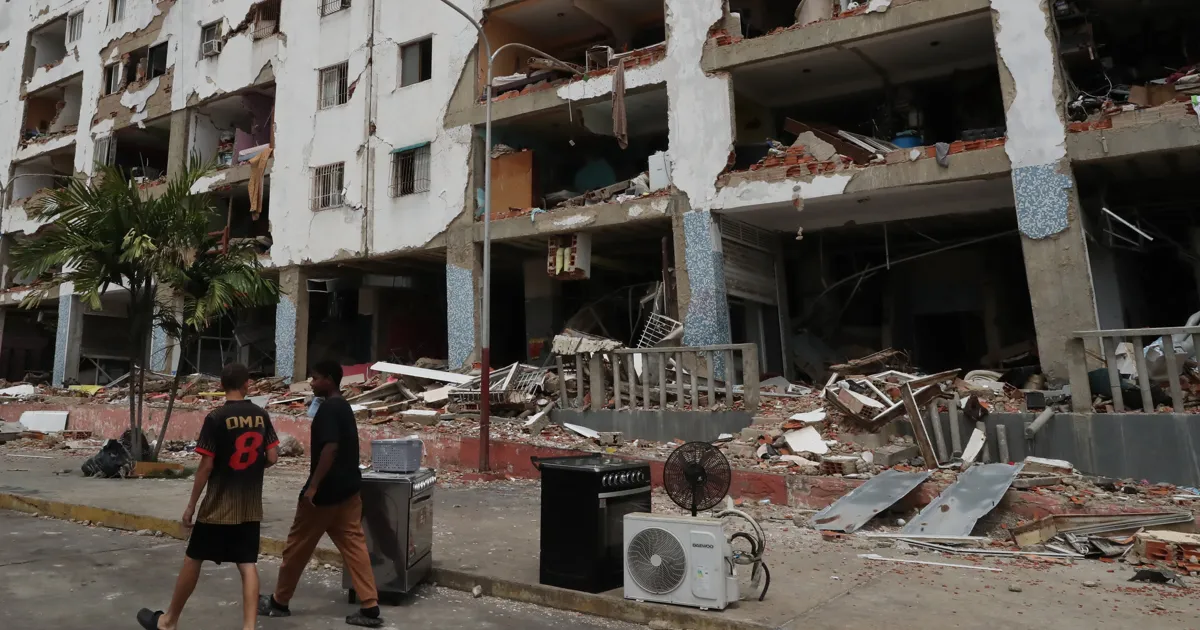
CARACAS. The United Nations Office for Disaster Risk Reduction, in a preliminary study, estimated the damage caused by the two June 24 earthquakes in Venezuela at $37 billion.
This first quantitative estimate of the direct physical damage caused by both earthquakes shows that damage to buildings (residences, businesses, schools, health, institutions and industry) is estimated at around 3% of the total exposed stock, which represents around 24 billion dollars.
While water and sanitation, telecommunications, roads, transportation and oil and gas sectors are equivalent to 4% of the total exposed stock that reaches 13 billion dollars.
The UN calculations do not include indirect economic losses, interruptions of productive activities and services, emergency care costs, effects on supply chains, social, environmental or macroeconomic impacts, nor the costs associated with comprehensive recovery, reinforcement of structures and reconstruction.
“For this reason, the total economic impact of the disaster will foreseeably be higher than the value of the estimated damages.”
The UN noted that “this is a damage figure that, according to the country’s earthquake risk profile, has a return period of 180 years.”
Almost double the national budget
The $37 billion in damages estimated by the UN are almost double Venezuela’s 2026 budget, which reached $19 billion.
In the estimated income and expenses of the Caribbean country, of course, there is no provision for disasters of this nature and for now, the interim president, Delcy Rodríguez, announced a fund of 200 million dollars for the reconstruction of buildings. Resources that come from the money that Venezuela has in the IMF
Oil resources for recovery
The Charge d’Affaires of the United States Embassy in Venezuela, John Barrett, highlighted that, although Venezuela will require a high financial investment to pay for the reconstruction work in the country, oil and gas production remains stable.
Barrett indicated that the damage caused by the earthquakes did not reach the oil and gas sector, which will allow both sectors to promote national economic reconstruction.
“The economic recovery has already begun, so these income continue to arrive through specialized accounts that the United States Treasury controls,” he stated.
In this sense, he pointed out that production will be maintained through investment from the United States and private sectors from multiple parts of the world.
According to official figures, the death toll exceeds 2,600 and more than 12,000 injured people.
