
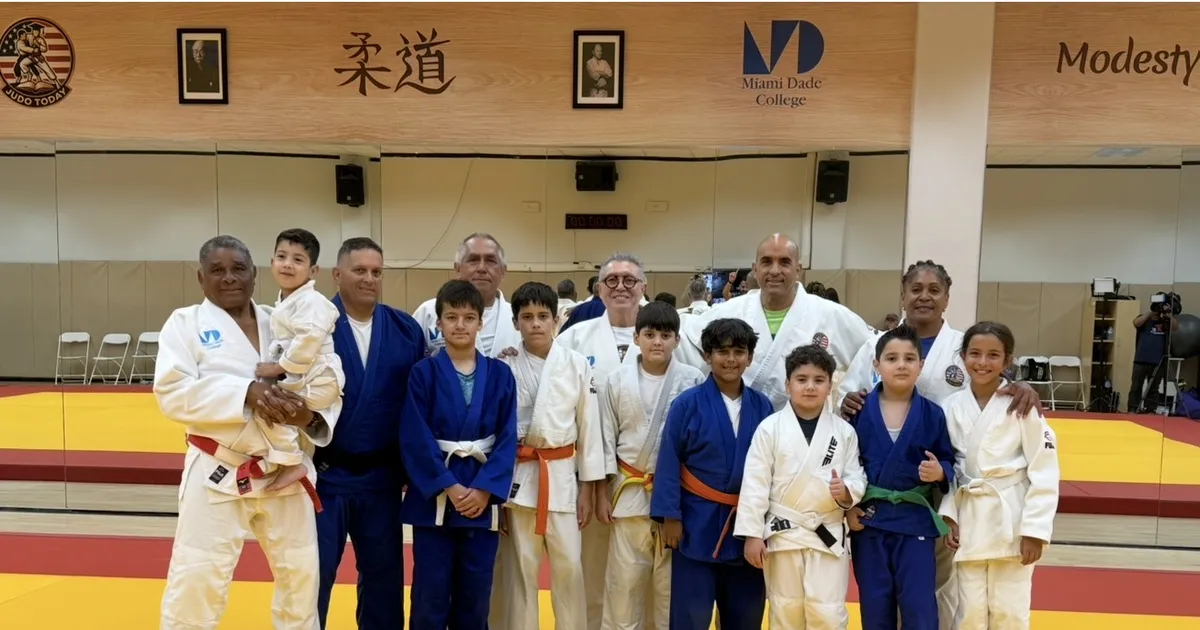
The two are part of Judo Today, an initiative that brings together dozens of students at the Kendall Campus of Miami Dade College (MDC) with a purpose that goes far beyond teaching defense movements and techniques.
While Andrea discovers that a defeat can become a learning opportunity, Mauro dreams of one day becoming a champion. They are different stories, but they reflect the essence of a project that seeks to promote healthy habits, strengthen self-esteem and transmit tools for life in a key stage of growth.
“If you don’t win a fight, it doesn’t mean the world ends. You always have to learn more things,” commented Andrea, 11 years old, in an interview with DIARIO LAS AMÉRICAS.
The student came to the project inspired by the experience of her father, who also practiced judo. With just a few weeks of participation, she says she has gained self-confidence and learned that girls can stand out as much as boys.
“A woman can fight too. Not only men can do it. We also have a lot of fun here.”
Mauro, for his part, highlights the combination of learning and fun that he finds in each day.
“I like it because it’s fun. I learn to fall, attack and defend myself,” he explained.
Beyond the technical aspects, he assures that the classes have taught him to relate better to others and to build new friendships.
“You learn to respect people and make a lot of friends.”
When he talks about the future, he responds without hesitation.
“I want to be champion.”
And the path to try is now clear.
“I’m going to practice every day at home and here.”
Behind stories like those of Andrea and Mauro is Héctor Lans, teacher, promoter of this discipline in South Florida and main promoter of the initiative being developed at MDC.
With decades of experience linked to teaching and training athletes, he maintains that the true value of this practice far transcends competition and medals.
For the instructor, judo constitutes an especially valuable educational tool at a time when many minors spend long hours in front of phones, tablets and video games.
“Judo implicitly carries principles such as courtesy, courage, love, honor, modesty, respect, self-control and friendship,” he explained.
According to him, the philosophy that accompanies this activity helps to counteract some of the effects associated with a sedentary lifestyle and excess of technology.
“Computers increasingly accelerate our social and psychological stress. Judo helps us regain physical and mental balance.”
Created by Jigoro Kano in Japan in 1882, judo is currently practiced in more than 200 countries and has been part of the Olympic program since 1964. Beyond competition, it is internationally recognized for promoting the physical, emotional and social development of those who practice it.
“We want to educate respectful young people, capable of facing life’s challenges and becoming good people,” added Lans.
The results are also visible for families.
Guido López decided to enroll his son Mauro, initially motivated by the quality of the team of instructors, but he assures that the changes observed in a few weeks convinced him.
“Children spend too much time with technology. In just one month he lost many fears, improved coordination and learned techniques that he did not know before. The change has been impressive,” he said.
Although he recognizes that attending several times a week means reorganizing schedules and making family sacrifices, he is convinced that the decision has been worth it.
“If he is happy and wants to come every day, that shows you that the atmosphere is good and that he feels like family.”
One of the main attractions of the year-round program is the possibility of learning directly from figures who left a mark on Cuban and international judo.
A good part of the coaching staff is made up of exponents trained in the renowned Cuban school, one of the most successful in Latin America and responsible for producing Olympic, world and Pan American champions for decades.
Lans is part of a generation of teachers who have worked for years to keep that legacy alive outside the island and bring it closer to students and families in the United States.
For many of the students, the experience has a value that is difficult to find in other programs: receiving teachings directly from athletes who reached the world elite and who today dedicate part of their time to sharing knowledge with new generations.
Among them, Driulis González stands out, considered one of the most successful judokas that Cuba has produced and one of the greatest exponents of women’s judo at an international level.
Throughout his career he won four Olympic medals: one silver and three bronze; in addition to multiple titles in world championships, Pan American and other international competitions, achievements that made her a reference on and off the island.
With more than two decades linked to this sport, the coach continues to pass on to the youngest players the lessons that marked her career on and off the tatami.
“It was a path of great resilience and that is precisely what I try to teach the children,” he told our newspaper.
Since his arrival in the United States, he has maintained the commitment to transmit the knowledge accumulated during a career developed in the world elite.
“My goal is for them to be able to face and overcome every obstacle that comes their way, like I had to do in my time.”
In his opinion, the impact of this practice also reaches the family environment.
“It is an activity that helps the training and growth of each child. It also strengthens the relationship between family and sport.”
The participation of Héctor Rodríguez added additional value to the project.
Winner of the gold medal at the 1976 Montreal Olympic Games and considered one of the most important figures in the history of Cuban judo, Rodríguez shared knowledge and experiences accumulated during decades of work in high performance and the training of talents in different countries.
“Judo for children is valued by UNESCO as one of the sports that should be practiced due to its training and the principles it transmits,” he noted.
The former athlete, based in Spain, highlighted that this type of initiative favors the development of self-esteem and confidence from an early age.
“It’s a great honor to work with these guys. Watching them train reminded me of when I was their age.”
In addition, he praised the dedication demonstrated by the participants during the sessions.
“I am very surprised by how they train and how they sacrifice themselves these days. I hope someone wins a world or Olympic medal.”
For Lans, however, true success is not measured by the competitive results that students can achieve in the future.
“Judo helps boys learn to defend themselves, respect others and not become victims of bullying.”
While adults talk about effort, personal improvement and growth, Andrea has a much simpler explanation for returning to the tatami every week.
“I have a lot of fun here,” he says before running again with his teammates.
Perhaps therein lies the greatest achievement of initiatives like this: leaving traces that can accompany a person throughout their lives without children ceasing to feel like children.
