
China It’s not exactly the most obvious place for fanaticism to flourish. Japan: The historical animosity between the two Asian giants is never far from refloating.
In fact, relations have been strained since Japan’s hardline prime minister, Sanae Takaichitook office last year.
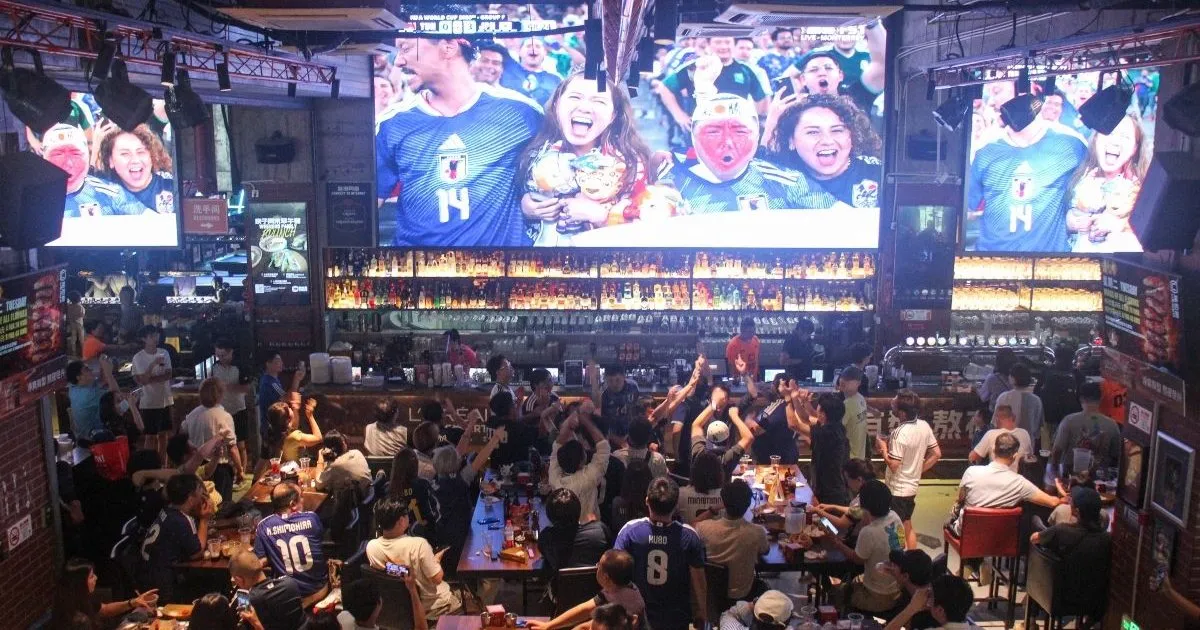
But for the dozens of Chinese fans in blue shirts who were in the bar on Sunday afternoon, watching Japan’s every move on the giant screens, their love for the national team has a long personal history, completely unrelated to politics.
“For our generation — the 90s — most of us basically grew up watching a lot of Japanese anime, including ‘Captain Tsubasa,'” the English name of the well-known series “Super Champions,” acknowledged Fan, the group’s main organizer, who only gave his last name.
“More importantly, since we are both part of Asia“You could say that Japan now represents the pride and glory of Asian football,” he concluded.
China has only qualified once for the Worldin 2002, when they lost their three games without scoring a goal.
It is ranked 91st in the world ranking of the FIFAwhile Japan is the best Asian team, in 16th place.
Fu Jinyu, a long-time fan from Japan who has written a book on the subject, noted that the Asian archipelago has a modern football ecosystem, which supports the development of new generations and fan culture.
His team, he ventured to say, is now at a “European level of competitiveness.”
In contrast, “the Chinese continue to have difficulties (…), not knowing which is the right path,” he said.
Chinese football “has become increasingly isolated and it’s just not as open as it used to be,” Jasper Sun, another member of Fan’s group, told AFP.
“Relatively open-minded”
On Sunday, as the final whistle blew, the group brought out a huge team flag and posed in front of the bar, jumping and shouting with joy.
When asked if they had ever encountered hostility from other Chinese, both Fan and Sun shrugged.
“I’m sure there are people like that, but personally, I don’t pay much attention to that kind of thing,” Fan downplayed.
Sun said he could understand why fans in other regions have concerns, but that Shanghai is “relatively open-minded and inclusive.”
When he traveled, for example, to watch a match between Japan and China in Xiamen in 2024, he said he had had no problems.
“Honestly, there wasn’t much conflict (…). At that time, we all took the bus together,” he added.
On the Internet the story can be different, as Aki Yang discovered.
The 30-year-old, originally from eastern China, runs a social media fan page dedicated to the Japanese national team.
It has attracted an increasing number of followers. And, at the same time, an increasing amount of insults, to which, he said, he had already “got used to.”
“Some Internet users say things like, ‘What kind of traitor or lackey are you?'” she said.
In Xiaohongshua platform similar to instagrama recent post offered tips on how to hide the flag from Japanese t-shirts to “avoid embarrassment.”
“Wear a helmet when you go out,” another user posted.
“Bridge of Friendship”
Student Julie Wang told AFP that the comments she sees online make her hesitant to publicly express her support for Japan.
“I have noticed that some consider supporting the Japanese team at this time to be unpatriotic,” he said.
Relations have been particularly strained since Prime Minister Takaichi suggested that Tokyo could intervene militarily if Beijing would invade Taiwanan autonomous island with a democratic regime that China claims as its own.
“Honestly, especially now that relations are more strained, I feel like it’s even more necessary for people like us to stand firm,” Fan defended.
“My greatest ideal—my greatest dream—is to help build a bridge of friendship between our two countries,” he said.
Despite the insults he has received, Yang, for his part, continues to believe that football can “break barriers.”
“The world is so turbulent today that football can put aside political identities and nationality and simply become a source of joy,” he said.
