
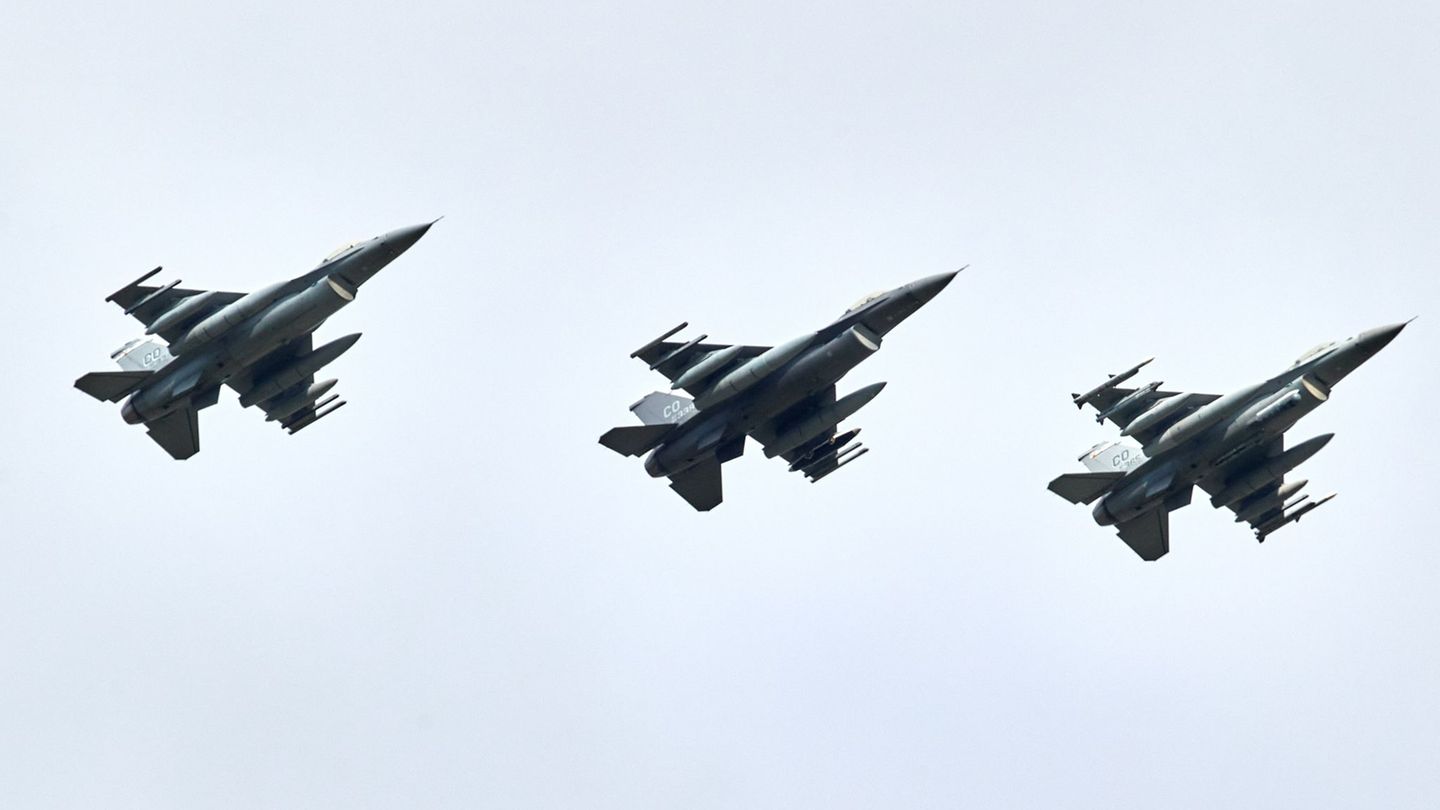
Despite a ceasefire and ongoing negotiations to end the war, the US military has attacked targets in Iran. Missile positions were hit in the south of the country and boats intended to lay mines in the strait were attacked in the area of the Strait of Hormuz, the US military said. Meanwhile, with a view to the negotiations, US President Donald Trump brought up a possible compromise solution for dealing with Iran’s enriched uranium. US Secretary of State Marco Rubio said during a visit to India that finalizing the exact wording in the deal with Iran would probably take a few more days.
A spokesman for the US Middle East Regional Command (Centcom) said the recent “self-defense attacks” were aimed at protecting troops from threats from the Iranian military. The US Army is exercising restraint within the framework of the current ceasefire, but is defending its own units.
Iranian media reported that there were several deaths after a US attack in the area of Larak island in the Strait of Hormuz. The US military initially did not provide any information about possible victims and did not provide any further details about the attacks on Iranian targets.
Strait as a bone of contention
Although the ceasefire in the Iran war is largely holding, there have been several mutual attacks around the Strait of Hormuz. At the beginning of May, for example, Iran attacked US military ships in the strait with missiles and speedboats, and the USA attacked targets on the Iranian mainland.
After US-Israeli attacks on Iran began in late February, Tehran brought shipping in the Strait of Hormuz to a virtual standstill with attacks and threats. The Iranians are also said to have mined the strait. The passage is crucial for the export of fertilizer, oil and liquefied natural gas from the Persian Gulf states. As a result of the blockade, world market prices rose rapidly. The US military responded by blocking Iranian ports – primarily to prevent Iran from exporting oil.
In negotiations with Iran, the US government is demanding an unconditional opening of the strait to shipping. Iran, on the other hand, claims control over the passage for itself and wants to charge fees for the passage in the future.
Trump: Enriched uranium will be destroyed
The declared war goal of the USA and Israel is to stop Iran from developing nuclear bombs. The US government is particularly critical of Iran’s enrichment of uranium, which could be used as a raw material for making bombs. Trump stated on social media that Iran must either “immediately” hand over its previously enriched uranium to the USA for destruction or agree to its destruction under supervision in Iran.
The process should be monitored by nuclear energy experts, Trump wrote, referring to the “Atomic Energy Commission.” It was initially unclear whether he meant a US authority or possibly the International Atomic Energy Agency (IAEA), based in Vienna.
Iran has more than 400 kilograms of highly enriched uranium that could be relatively easily converted into weapons-grade material. The radioactive material is said to be buried deep under rubble as a result of US attacks on underground deposits. Trump did not make it clear whether when he called for the destruction of enriched uranium he meant only this stockpile or also uranium stocks with a lower level of enrichment.
Nuclear program as a point of contention in negotiations
Dealing with Iran’s nuclear program is one of the sticking points in the current negotiations to resolve the war. The Iranian leadership has so far insisted on its right to enrich uranium for civilian purposes and says it is not seeking nuclear weapons.
At the weekend, Trump announced that a framework agreement with Iran had been “largely” negotiated. But later he hit the brakes again. An Iranian delegation traveled to the Qatari capital Doha for talks. As the Iranian news agency Irib reported, negotiators Mohammed Bagher Ghalibaf and Foreign Minister Abbas Araghchi want to inform the Qatari leadership about the negotiations.
Until the ceasefire came into force at the beginning of April, Iran had repeatedly attacked targets in Qatar in retaliation for the US attacks.
Rubio: Trump ‘either makes a good deal or no deal’
On Monday, Iran’s foreign ministry spokesman Ismail Baghai said that a so-called memorandum of understanding with 14 points was being discussed. He confirmed media reports that this was about a 60-day framework agreement to end the war. There are currently no discussions about the nuclear program, said Baghai. Discussions can only take place within the 60-day period. According to reports, the first framework agreement will also regulate the opening of the Strait of Hormuz.
US Secretary of State Rubio commented on the talks in Qatar on Tuesday on the sidelines of his visit to India. It remains to be seen whether progress will be made, he said, according to consistent media reports. “There’s a lot of back and forth at the moment about certain wording in the original document, so that will take a few days,” the New York Times quoted him as saying. President Trump will “either make a good deal or no deal.” Rubio is also Trump’s national security advisor.
Billion payments to Iran for signature?
The head of the Iranian central bank, Abdolnasser Hemmati, was also present in Doha to examine the release of Iranian foreign assets. Assets from the Iranian oil business have been frozen in Qatari financial institutions for years. A release of these funds could represent a first step toward lifting sanctions against Tehran and possibly be part of an agreement to end the war.
Meanwhile, the Foreign Ministry spokesman in Doha contradicted reports that the Gulf state had offered Iran $12 billion to sign an agreement. Such rumors were spread by those who wanted to undermine diplomatic efforts, Qatar said.
