
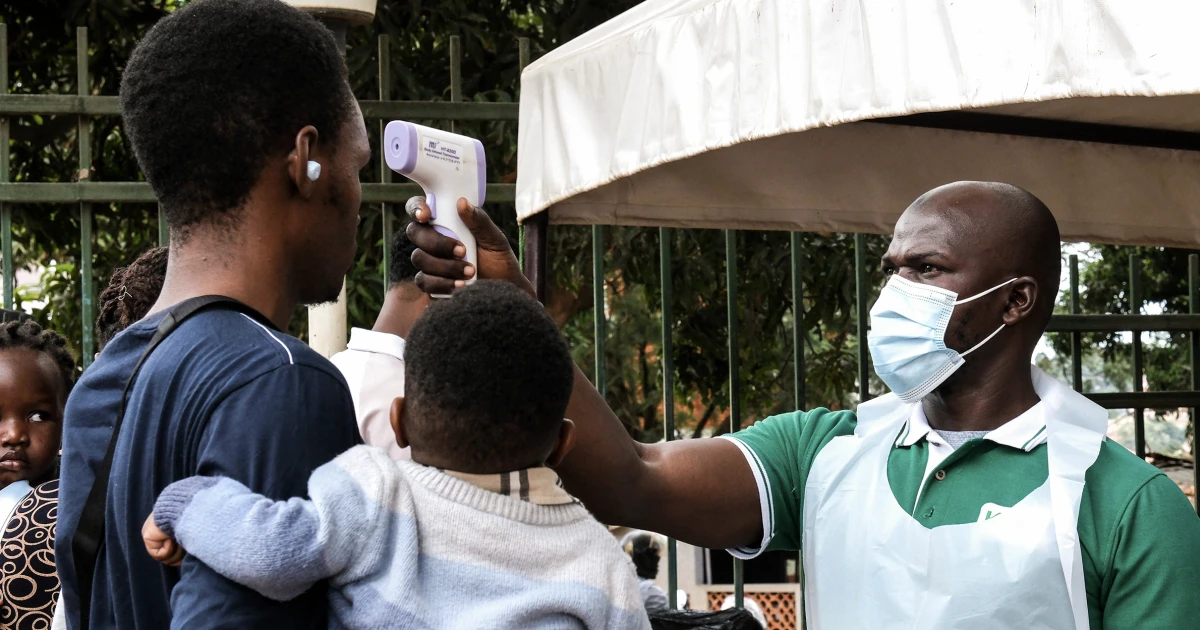
The World Health Organization decreed this Sunday that a new outbreak of Ebola in the Democratic Republic of the Congo and Uganda represents a public emergency of international concern.
The first case confirmed by official diagnostic tests was reported on Friday, in the province of Ituri, in the Congo. By Saturday there was suspicion of 336 cases and 88 people dead.
(Scientists are already working on a hantavirus vaccine. Why has it taken so long?)
Health authorities indicate that the current outbreak is being caused by the Bundibugyo strain of the virus, a rare variant of Ebola for which there are no approved vaccines or treatmentmaking it especially difficult to combat.
This is only the third time in modern history that an outbreak of the Bundibugyo strain has been reported, although Congo and Uganda have suffered more than 20 Ebola outbreaks since the disease was first detected in 1976.
Here’s what you should know about this emergency:
What does the WHO statement mean?
The world health organization, of which Donald Trump’s US government ceased to be a part in January, says that the Ebola outbreak cannot yet be classified as a pandemic, just as COVID-19 was, which did present endemic infections in several parts of the world.
Therefore, it is not yet necessary to take measures such as closing borders.
(Climate change worsens mosquito disease transmission. Experts give advice on how to protect yourself)
The declaration that it is an emergency seeks rather than donors to the WHO, countries around the planet and health organizations Take note so that there are timely reactions.
However, WHO emergency declarations in recent years have not prompted everyone to take action.
When the organization declared monkeypox (mpox) as a public emergency of global concern, which occurred in several African countries in 2024, it was difficult to mobilize groups with funds to obtain diagnostic tests, medicines or vaccines for the affected nations, according to specialists.
(Marburg, the lethal Ebola-like virus that worries the US after outbreaks in African countries)
Last year when there was another Ebola outbreak, the WHO also initially struggled to provide enough vaccines (that strain is preventable in this way) in part because it did not have the necessary funds after the US made cuts to the funding it used to give to the global agency both directly and through USAID, a humanitarian aid organization that Trump disappeared.
This Friday, the WHO said it has already released $500,000 to support the response to the current Bundibugyo Ebola outbreak, and the disease prevention centers for the African continent (Africa CDC) also said they have mobilized the equivalent of $2 million.
However, these health groups said that those Funds do not come close to the amount that is urgently required.
An unusual strain
The Bundibugyo-type virus to which the current outbreak is attributed is very rare, and different from the strain that has occurred in almost all Ebola outbreaks in the Congo, the Zaire virus.
The current strain was first detected in the Ugandan district that gives it its name between 2007 and 2008, in an outbreak that left 37 people dead out of 149 cases of infection.
The second Bundibugyo outbreak reported in recent history was in 2012, where there were 57 confirmed cases and 29 deaths as a result.
The WHO says that Ebola can be caused by a group of several viruses, and that three of them usually cause the worst outbreaks in terms of infection numbers. One of them is Bundibugyo.
Normally to try to contain outbreaks, health authorities try to treat the symptoms of Ebola, according to mer Gabriel Nsakala.
Initially, these symptoms are very similar to those of other viral diseases: fever, headache, muscle discomfort or sore throat. It is not until the infection progresses that more serious symptoms characteristic of Ebola appear, such as bleeding from the nose or eyes.
(Is it true what Trump boasts that with him the US has the lowest drug prices “in the world”? We checked it)
Nsakala said that in the Democratic Republic of the Congo they already have experience managing some Ebola outbreaks by treating the symptoms, but that the current outbreak is with a lesser-known strain that spreads infections more quickly can complicate that strategy.
Risk of infections in remote areas
So far all but two of the cases have been on Congolese lands, since the outbreak began in Ituri, a remote area of the Congo that is difficult to access to be able to bring medical supplies quickly.
This causes concern because, according to the CDC for Africa, infections could spread soon without tracking tools so that possibly infected people do not travel.
And many people usually move from Ituri to Uganda, since it is close to the Congolese border.
In these areas there is also a strong presence of armed groups, whose attacks cause people to have to leave their homes, which means that there are continuous movements of people who could have the virus without knowing it.
To try to avoid this, as soon as the first case was confirmed on Friday, the centers for disease control and prevention of the African continent called an emergency meeting attended by authorities from the Congo, Uganda and South Sudan, as well as representatives of UN agencies and other organizations.
At that meeting it was agreed to prioritize the coordination of border crossings, health surveillance and actions so that there are timely funerals for those who die (the bodies of people who died from Ebola are very contagious). But the African agency stressed that these graves must also be dignified, given that in the past some countries have burned piled corpses.
How is Ebola transmitted?
This virus is highly contagious and can be transmitted from wild animals to humans, and then between people. among humans transmitted through contact with saliva, blood or semen, or through contact with materials or surfaces that have had these fluids, such as sheets or clothing.
The disease is rare, but very severe because it can be very deadly.
