
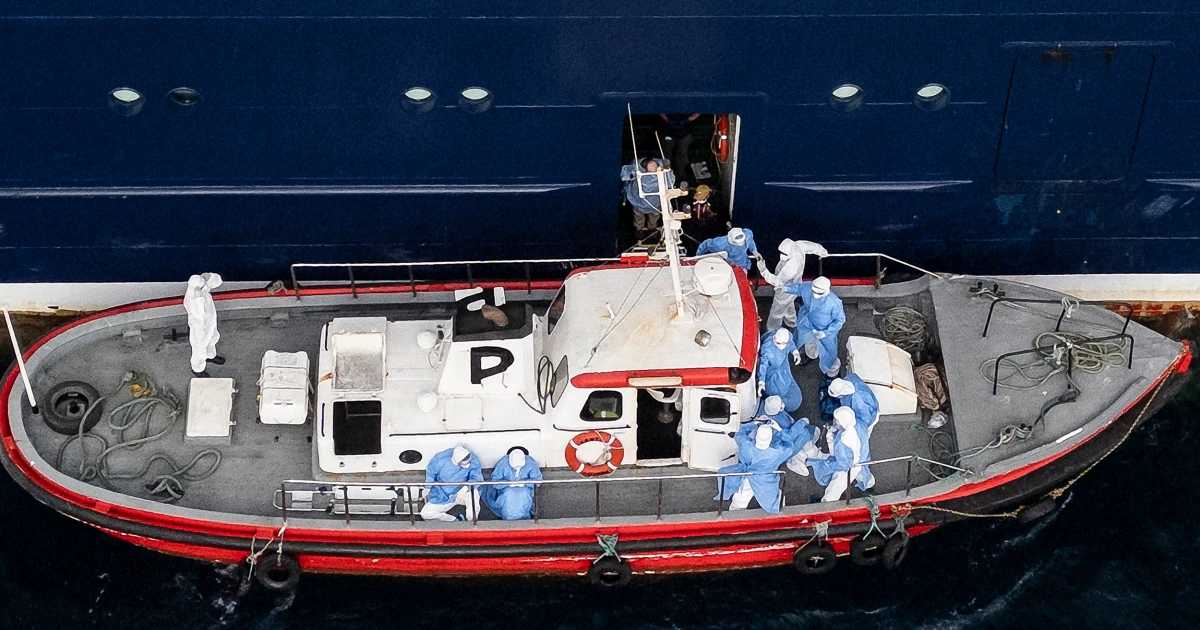
The hantavirus variant that has so far killed three people on board a cruise ship, and from which at least five more have been infected, is known as the Andean strain and has usually occurred in places in South America such as Argentina, from where the affected luxury ship, MV Hondius, set sail.
The strain is capable of causing the worst type of illness of this virus and is the only one known It can be transmitted from person to person. At the moment there are eight cases, five of which have already been confirmed by laboratory tests, according to the World Health Organization said this Thursday. They include the deceased – a Dutch couple and a woman – as well as a British man who is receiving intensive care in a South African hospital.
Only between 2% and 5% of cases of the Andean strain are caused by transmission between humans
Abraar Karan, an infectious disease doctor at Stanford University, said the woman’s death, the third death, “is a sign of how quickly” the hantavirus can progress. That woman, unlike the Dutch couple, did not die while on the cruise, but after leaving the ship and boarding a plane during which she did not appear to present symptoms.
The health investigation regarding this outbreak continues, although this Thursday WHO authorities emphasized that the disease on the cruise ship does not pose a global pandemic threat to the public as was the coronavirus.
How is the Andean strain spread?
There are approximately 40 strains of hantavirus globally, and different types cause different diseases, according to the Centers for Disease Control and Prevention (CDC).
The virus usually spreads through contact with rodents such as rats or mice, especially by inhaling germs that come into the air from the urine or feces of those animals.
In the case of the Andean strain, it is known that it usually spreads through contact with the pygmy rice rat, which is present in the Americas.
Emily Abdoler, an infectious diseases doctor at the University of Michigan, says that the Andean strain is so far the only one that has been proven to be transmitted from human to human and that, unlike other types of hantaviruscan be spread through respiratory droplets such as those expelled by someone when sneezing, coughing or talking, or through intimate contact by exchanging saliva.
When there is hantavirus infection in humans, the mortality rate reaches 50% because key organs, such as the lungs, are affected
However, this contagion between humans does not happen through casual contact, explained specialist Lucille Blumberg, part of the National Institute of Communicable Diseases of South Africa.
In fact, only between 2% and 5% of cases of the Andean strain are caused by person-to-person transmissionaccording to Pablo Vial, a doctor who studies the hantavirus at the Institute of Sciences and Innovation in Medicine of Santiago, Chile.
(See how to differentiate allergy symptoms from respiratory illnesses like the flu)
“In previous outbreaks there have been cases of human-to-human transmission, but it has been through very close and repeated contact, either from people who were providing medical care or from people who were continually next to each other,” said Maria Van Kerkhove, a WHO epidemiologist.
“This is not like COVID, it is not like the flu,” he said. “It spreads very differently.”
Although there have been at least an instance documented of widespread infectionsdetected in 2018 in Epuyén, Argentina.
That outbreak was traced to three symptomatic people who attended crowded social events, including a birthday party. In total 34 cases of infection were confirmed and there were 11 deaths.
“Some people may be superspreaders for biological reasons,” said Stanford’s Abraar Karan. “In the sense that they emit more of the virus than other people” when talking or sneezing.
(Four deaths and 30 hospitalized reported due to ingestion of a mushroom in California)
The highest point at which virus is transmissible between people is at the beginning of the infectionbefore the immune system has prepared its reaction, according to Vial, the Chilean doctor.
The hantavirus incubation period, the time between when you are exposed and when symptoms develop, can last from nine to 40 days.
Therefore, Karan said that, if there are more cases linked to the cruise, they could occur next week.
The infection is more likely to spread secondarily, that is, from person to person rather than through rodents, if there is sexual contact between people, according to Vial.
“The fact that this happens does not mean that it is a sexually transmitted disease, but rather that there is greater intimate contact or that the partner is the one who most often cares for the infected person,” he said.
What tests are there to detect hantavirus?
There are several ways to confirm an infection.
With a blood test, the levels of IgM and IgG antibodies are measured, which respectively are the first immunoglobulins generated by the immune system and those that develop a little later. Another way is a PCR (polymerase chain reaction) test that looks for certain traces of a virus’s genetic material and whose results can be available within a few hours in high-priority situations.
During the coronavirus pandemic, for example, PCR tests were widely used and the WHO has said that hantavirus cases are currently confirmed by these analyses.
There are still about 150 people on board the MV Hondius, the company behind the cruise, Oceanwide Expeditions, said Thursday. However, as the incubation period can last up to eight weeks, it is still unclear how long these passengers would have to remain without disembarking even if the cruise ship docks in the Canary Islands in a few days, as planned.
It is a “delicate situation,” according to Karan, because there may be people incubating the virus but not having symptoms or testing positive at the moment.
“An exposed person may not yet be shedding enough of the virus to make it detectable,” he said.
Why is the Andean strain of hantavirus so deadly?
Hantavirus infections in humans are rare, but when they do affect people the mortality rate can be up to 50% (one in two cases) because the virus usually affects key organs, such as the lungs and kidneys.
Vial, from the Chilean institute, said he has observed cases in which the Andean strain of hantavirus affects even healthy young people.
(This dad exercised and ate healthy but suffered a heart attack at age 38. His case is part of a worrying trend)
However, not all cases will result in severe illness. 40% of people who become infected develop a mild infection and 60% suffer from the more severe form, known as cardiopulmonary syndrome, which can cause respiratory failure or cardiogenic shock. It is estimated that between 30% and 40% of hantavirus patients with this strain die, according to Vial.
What are the symptoms of hantavirus in its Andean strain?
Experts say that cases of this type may be undetectable at first because the symptoms are unclear.
“There are symptoms that can be from many types of infections or diseases, such as headache or abdominal pain,” said Abdoler, of the University of Michigan.
This is how the virus presents in humans during the first three days of symptoms.
“Then it can progress to a more critical phase where there are respiratory problems or a collapse of the cardiac system,” he added. “The body systems that are key to surviving second by second collapse.”
The virus can also present with different symptoms regionally. In parts of Asia or Europe, hemorrhagic fever is seen in patients, which can trigger kidney failure and therefore death. In the Western Hemisphere, where the Andean strain is present, hantavirus pulmonary syndrome is usually seen instead, which causes a feeling of shortness of breath and can lead to respiratory failure.
“Many times these types of viruses end up killing someone not because of the infection itself but because the immune response is strong,” said Stanford’s Karan.
There are no specific treatments for hantavirusaccording to Abdoler, and patients normally receive care directed at symptoms such as intravenous fluids to prevent dehydration or medicines to stop fever.
Respiratory ventilators or ECMO systems (extracorporeal membrane oxygenation) are also used, a machine that does the work of the heart or lungs when there is failure.
Vasopressors can also be used to promote blood pressure so that organs such as the brain and kidneys continue to get enough oxygen.
