
WASHINGTON — U.S. President Donald Trump said Wednesday he was not yet satisfied with Iran’s offers for a deal, after Iranian state television aired details of what it said was a draft of the pact.
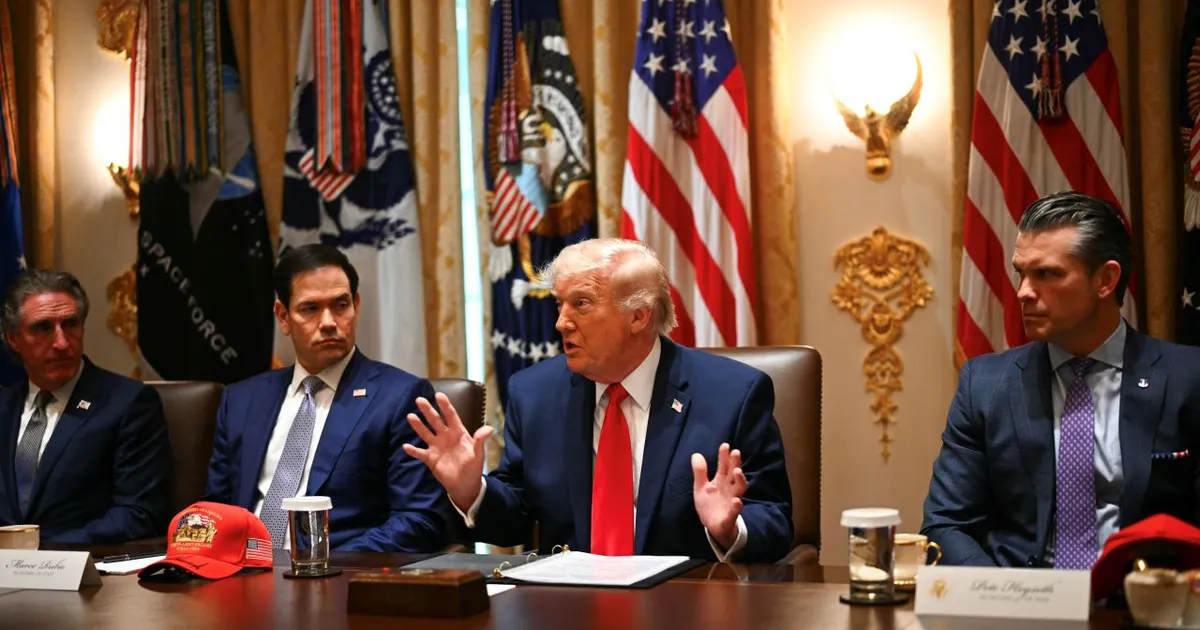
Speaking at a Cabinet meeting at the White House, Trump added that he was in no rush to reach a deal, despite saying over the weekend that it was close.
“Iran is hell-bent, they really want to make a deal. So far they haven’t gotten it. We’re not satisfied with it yet, but we will be,” Trump said.
“Either that, or we’ll just have to finish the job,” he said, referring to threats to resume military operations that the United States and Israel launched on February 28 and suspended in April.
He will not have control of Hormuz
Trump ruled out the possibility of closing an agreement with Iran that would allow the Islamic Republic to exercise any control over the Strait of Hormuz, key to the global oil trade.
“They are international waters, no one is going to control them. We are going to monitor them. We will monitor them, but no one is going to control them,” he declared during a cabinet meeting at the White House.
The president gave these statements after Iranian state television broadcast a pre-agreement, denied by the White House, according to which Tehran would commit to restoring traffic in the strait to pre-war levels within a month, in coordination with Oman.
“They would like to control them. Nobody is going to control them. They are international waters and Oman will behave like the others,” added the Republican leader.
Trump also denied that a possible relief of sanctions or the unblocking of frozen Iranian funds is being negotiated, as press reports have pointed out in recent days.
“No, we are not talking about any sanctions relief or giving money. No sanctions, no money, no anything,” he said.
Negotiations advance
The president assured that negotiations with Iran are “going very well” and once again threatened to resume the military offensive, suspended since April after a ceasefire, if the dialogue fails.
“We’re doing very well. I think they’re starting to give us the things they need to give us, and if they do, it’ll be great; and if they don’t, then the man to my left (Defense Secretary Pete Hegseth) is going to finish them off,” he said.
In the last week, the United States and Iran have intensified contacts, mediated by Pakistan, to try to close an agreement that will end the war that began on February 28 and unblock the Strait of Hormuz.
According to leaks published in the press, the pre-agreement would not include a nuclear pact, but rather the extension of the truce for 60 days to negotiate the limitation of uranium enrichment by Tehran.
Iran says they are not discussing nuclear program
A definitive agreement should be ratified within 60 days in a binding resolution of the United Nations Security Council, adds information published by Iranian state media, which emphasizes that the Islamic Republic will not take any measure without “tangible verification.”
Tehran claims that the focus of the talks with Washington “is to end the war” and at this stage of the negotiations “details about the nuclear program” are not discussed. According to Iranian Foreign Ministry spokesman Esmaeil Baqaei, the United States and Iran have reached a conclusion on “many of the issues under discussion,” but he has ruled out that negotiations can conclude immediately.
Encouraged by expectations of progress in negotiations, North Sea Brent oil prices lost 3.2% this Wednesday around 3:45 p.m. GMT, to $93.48 a barrel. The US WTI, meanwhile, fell 3.8% at the same time, to $93.48 a barrel.
