
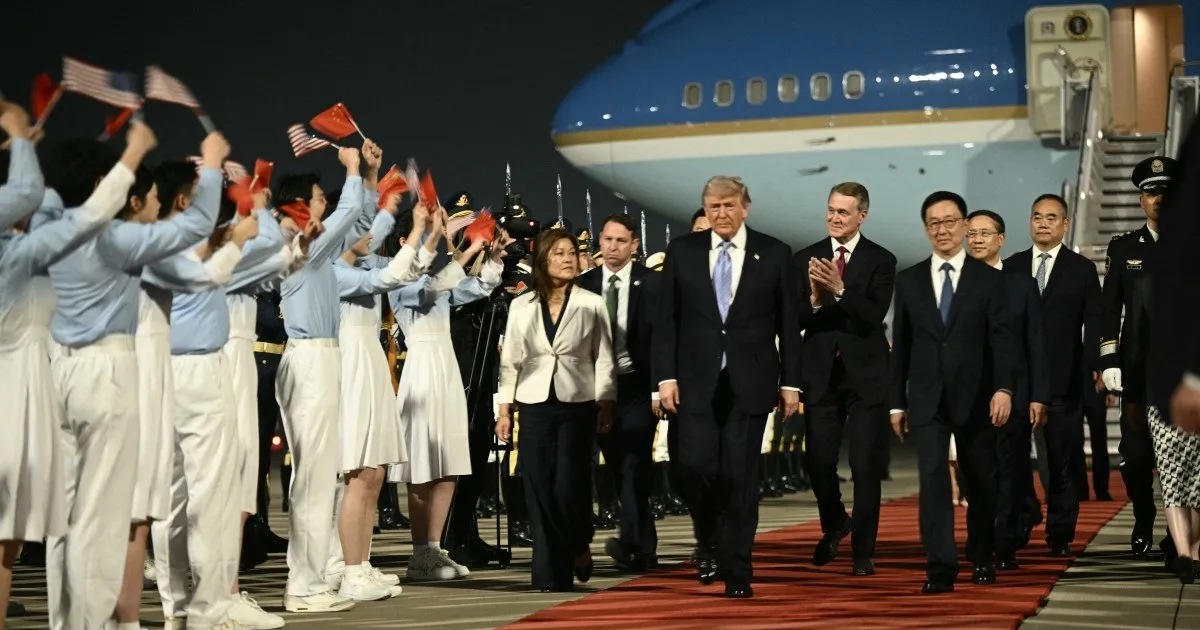
BEIJING.- The president of the United States, Donald Trump, arrived in China this Wednesday with a view to a summit with his counterpart Xi Jinping, in which burning issues such as international trade, the war in Iran and the future of Taiwan will be addressed, AFP journalists confirmed.
Trump, who is traveling accompanied by the Secretary of State, Marco Rubio, and a delegation of senior American executives such as Elon Musk (Tesla), Jensen Huang (Nvidia) and Tim Cook (Apple), will meet this Thursday with his Chinese counterpart, Xi Jinping, in a visit marked by the trade truce between both powers, technological tensions, Taiwan and the war in Iran.
The American president was received at the foot of the tarmac by the Chinese vice president, Han Zheng, along with the Chinese ambassador to the United States, Xie Feng, and the Chinese vice foreign minister Ma Zhaoxu, in a welcome ceremony in which some 300 young Chinese participated, as well as a military band and an honor guard.
More than 2 million users followed the landing of Air Force One in Beijing live on CCTV this Wednesday, according to broadcasts from the Chinese state channel.
Trump will have an agenda concentrated in just two days that will include bilateral meetings with Xi, a state dinner and formal activities in emblematic spaces of Chinese power such as the Great Hall of the People and Zhongnanhai, headquarters of the leadership of the Chinese Communist Party (CCP).
The visit comes nine years after Trump’s previous trip to China, in November 2017, when he participated with Xi in events in the Forbidden City in Beijing.
Both sides are now seeking to consolidate the trade truce reached after months of tariff war, although disputes persist over technology, rare earths and access to the Chinese market.
Before arriving in Beijing, delegations led by US Treasury Secretary Scott Bessent and Chinese Vice Premier He Lifeng held “constructive” economic consultations in Seoul on Wednesday to advance the resolution of their tariff tensions, the Chinese news agency Xinhua stated.
Trump also announced before leaving for Beijing that he will address with Xi the situation in Taiwan – a self-governed island to which Washington sells weapons and Beijing does not rule out invading – and the war in Iran, while Washington pressures China to contribute to promoting a de-escalation in the Middle East.
Hours before Trump’s landing, the Chinese government urged the United States on Wednesday to “handle the Taiwan issue with caution” and to “stop” the shipment of weapons to the island. For his part, the Republican leader said he will ask China to “open” the country to American companies.
Express request
“I will ask President Xi, a leader of extraordinary stature, to ‘open up’ China so that these brilliant people can deploy all their talents and help take the People’s Republic to an even higher level,” Trump wrote on his Truth Social social network.
“China welcomes President Trump on his state visit to China,” declared a spokesperson for the Chinese Foreign Ministry, Guo Jiakun, assuring that Beijing is willing to collaborate with the United States “to expand cooperation and manage differences.”
“Long conversation” about Iran
The war with Iran, unleashed on February 28 by the joint attack on the country by Israel and the United States, has shaken the world economy and the energy market in particular.
According to the US administration, Trump wants to pressure Beijing, a key strategic and economic partner of the Iranians, to use its influence and contribute to a solution to the crisis in the Gulf.
The US president has already tried to end China’s purchases of Iranian oil with sanctions. A maneuver condemned by Beijing, which, however, has not caused an open diplomatic crisis.
“We’re going to have a long conversation” about Iran, they told reporters at the White House. Shortly afterward, however, he added that he “doesn’t need help with Iran.”
According to Trump, China, the main importer of Iranian oil, has not caused “problems” since the United States imposed a blockade of Iranian ports in mid-April.
“We get along well” with Xi Jinping, he declared. “I think you’ll see that good things are going to happen.”
The day before his arrival, Chinese Foreign Minister Wang Yi urged Pakistan to “intensify” its mediation efforts between Tehran and Washington, according to the Xinhua agency.
The United States and China have for years maintained fierce competition in the strategic, technological and economic spheres.
“The summit will seem polite on the surface, but tactically it will be a rugby match in which each side will want to take advantage,” says Melanie Hart, a China expert at the Atlantic Council.
In 2025, after Donald Trump returned to the White House, the two superpowers waged a bitter trade war with global repercussions, mutually applying exorbitant tariffs and multiple restrictions.
In parallel to the summit in China, Treasury Secretary Scott Bessent and Chinese Vice Premier He Lifeng met in South Korea to hold “economic and trade consultations,” Chinese media reported.
Both sides had “a frank, in-depth and constructive exchange on resolving economic and trade issues of mutual interest and expanding practical cooperation,” Xinhua noted.
