
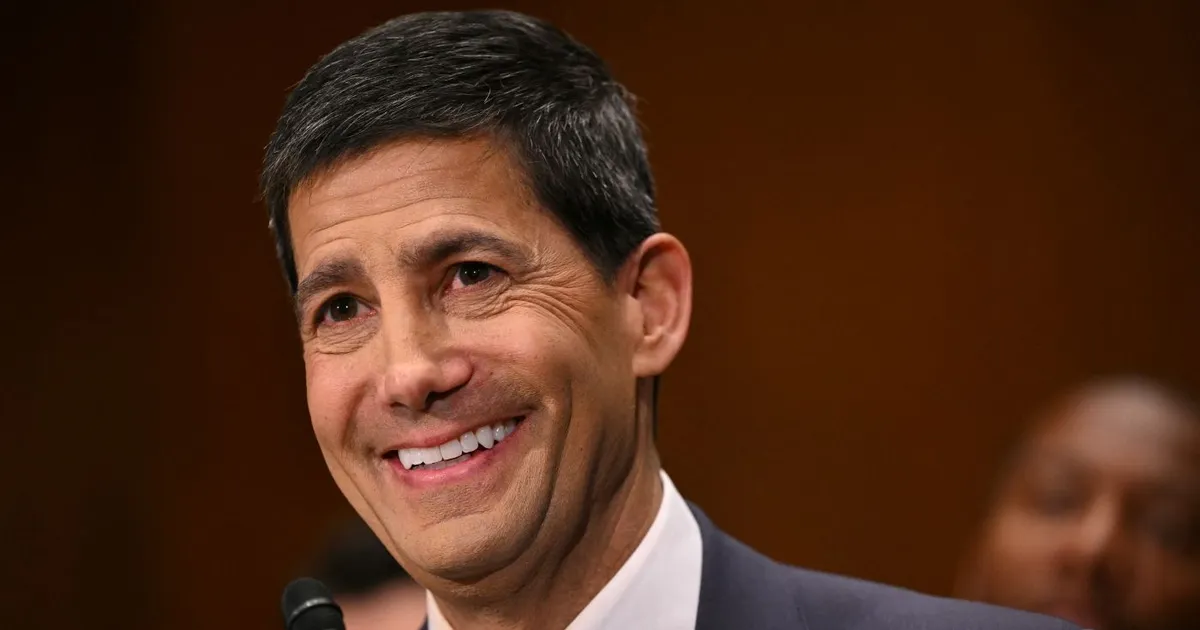
The Senate of the United States Congress confirmed this Wednesday Kevin Warsh as the new president of the Federal Reserve for a four-year term.
Warsh inherits a Central Bank with a policy that needs urgent changes to adjust to current economic times and with a recent inflation of 3.8%, driven by the situation in the Middle East against the Iranian terrorist regime.
The Senate voted 54 in favor and 45 against to confirm Warsh, who advocates for lower interest rates and an institution that supports policies in favor of economic growth, not just regulation.
A native of New York state, this 56-year-old jurist, trained financier and former White House economic policy advisor prematurely left his first term on the board in 2011, after expressing his differences on monetary policy under the government of Barack Hussein Obama.
Warsh’s return
Now he returns to lead the Federal Reserve, charged, among other things, with controlling inflation in the United States and guaranteeing maximum employment, but also boosting the American economy, something for which his predecessor was questioned in his eight-year term.
Trump frequently criticized the poor management of Warsh’s predecessor, Jerome Powell, for his slowness and his decoupling from the economic reality of the United States.
The Trump administration also put Powell in the crosshairs of a criminal investigation for the excessive or enormous cost in repairing the three buildings that make up the Federal Reserve in Washington. Legal action is pending against Fed Governor Lisa Cook for corruption and for lying and committing fraud in the acquisition of property.
In his confirmation hearing before the Senate Banking Committee, Warsh promised to preserve the independence of the Fed, when in the four years of Biden the head of the Central Bank, Powell, intrinsically defended the progressive agenda of the Democrats and the failed policies that caused the worst inflation in the last 50 years.
“I am honored that the president nominated me for the position and will be an independent player if my appointment as chairman of the Federal Reserve is confirmed,” Warsh said.
Criticism of the Fed
Born in Albany, the capital of New York State, Warsh holds degrees from Stanford University and Harvard Law School.
He is married to Jane Lauder, granddaughter of legendary cosmetics magnate Estée Lauder.
Warsh began his career at investment giant Morgan Stanley, specializing in mergers and acquisitions.
He later joined the administration of then-US President George W. Bush, where he served as White House economic policy advisor from 2002 to 2006, before being nominated to the Federal Reserve Board.
Warsh served on the board during the global financial crisis and finally left in 2011 over disagreements over how the central bank should deal with it during the Obama administration.
Since then he has worked on Wall Street and on the boards of various companies, including UPS courier.
“I saw the Fed and its people at their best, but I also witnessed an institution tempted to play a broader role in the economy and society,” Warsh said at his confirmation hearing.
That language fits with the arguments of Trump, whose administration has asked that the Federal Reserve act in accordance with the needs of the United States to grow the American economy, which should be the fundamental objective of the country’s financial institutions and not put on the brakes and create crises as Powell did during his eight-year term.
The renewed “hawk” of the Central Bank
In his first stint at the Fed, Warsh was considered a “hawk,” that is, a monetary policymaker inclined to address the inflation side of the mandate, usually by raising interest rates.
In recent years, Warsh has taken a position in line with the times of change that the world is going through and the financial and economic processes in North America and in line with President Donald J. Trump’s platform of Make America Great Again.
Warsh attributes historically high inflation to “policy errors” by the Fed in 2021 and 2022, during the Biden administration.
He has called for “regime change” in policymaking, including modify the data on which the Fed bases its decisionseliminate forward-looking guidance from its communications and encourage more vigorous discussions at its board of governors meetings.
(email protected)
