
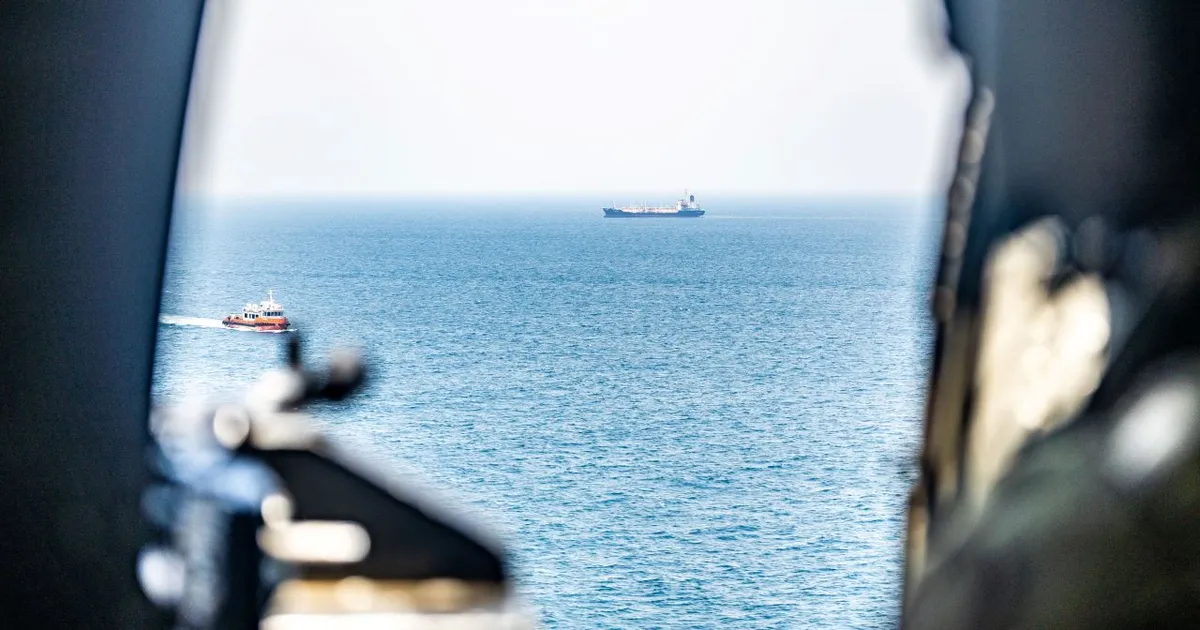
But Trump later clarified that the Strait of Hormuz would reopen after the signing of the peace deal with Iran on Friday, in an apparent contradiction to his first statement that the sea passage would open immediately.
The American president made the announcement shortly after Pakistani Prime Minister Shehbaz Sharif reported that the United States and Iran have reached what he called a Peace Agreement that includes a ceasefire on all fronts, including Lebanon.
“Both parties have declared the immediate and permanent termination of military operations on all fronts, including Lebanon,” he explained.
“The two sides have declared an immediate and permanent end to military operations on all fronts, including Lebanon,” Sharif explained in a message posted on social media.
“The deal with the Islamic Republic of Iran is now complete. Congratulations everyone!” Trump wrote on his Truth Social network, shortly after Pakistan’s mediator said the two sides had reached an agreement.
“I fully authorize the toll-free opening of the Strait of Hormuz and, simultaneously, I authorize the immediate lifting of the United States naval blockade. Ships of the world, start your engines. Let the oil flow!” Trump wrote, without offering further details of the agreement.
According to Trump, this great agreement will bring peace and security to the entire region. “Many presidents have tried to make peace with Iran, and they have all failed before me. The leaders of the region have found, for the first time, a president who can help them achieve real peace,” the president wrote on his social network.
With the opening of the Strait of Hormuz after the signing of the agreement, for demining purposes, oil will once again flow at both ends for the region and the world.
When is the official signature?
The official ceremony of signing of the agreement will be on Friday, June 19 in Switzerlandsaid Sharif, who took the opportunity to express his gratitude to the United States and Iran “for their commitment to achieving a diplomatic solution to the conflict.”
“We also want to value our brothers in the mediation,” said Sharif, referring to Qatar “for its support in achieving this agreement”, Saudi Arabia for its “visionary leadership” and Turkey “for its immense contributions.”
“With the agreement now in place, mediators will facilitate a series of meetings this week. These pre-implementation discussions will lay the groundwork for technical talks and the official signing ceremony,” Pakistani Prime Minister Shehbaz Sharif, a key mediator in the Middle East war, wrote in X.
Iranian regime confirms
Iran’s deputy foreign minister, Kazem Gharibabadi, declared late Sunday that the agreement with the United States “immediately ends the war.”
“First of all, the immediate and definitive end of the war and military operations on the different fronts, including Lebanon,” listed the diplomat, a specialist in legal issues, on state television.
“Negotiations will begin within 60 days with the aim of reaching a final agreement,” Kazem Gharibabadi told state television. He added that “distrust of the United States still exists.”
Iran declared itself the “winner” in the war unleashed by Israel and the United States, despite the destruction of its naval and air force, the elimination of the main leader, Ayatollah Ali Khamenei, the military leadership and the economic crisis faced by that regime, the main sponsor of terrorism.
“The enemy, who attacked to carry out his malicious designs, has seen all his objectives reduced to nothing, and the Islamic Republic of Iran has achieved great victories in this war,” according to Kazem Gharibabadi, on Iranian state television.
Blockade
The official added that the lifting of the naval blockade constitutes another element of the agreement reached.
The vice minister anticipated the publication of the text of the memorandum: “We will soon publish the text of the understanding agreement and the people will see how many achievements we have obtained and how many commitments we have assumed.”
He also specified that “the commitments in relation to the achievements are not comparable,” in reference to the terms obtained by Tehran in the negotiation.
The official also said that “today’s military power has contributed to advancing our affairs and finalizing the agreement.”
He warned that “wherever there is a breach of commitments by the counterparty,” they will take the “corresponding specific action.”
The agreement was brokered by Pakistan with the support of Qatar, Saudi Arabia and Türkiye. Pakistani Prime Minister Shehbaz Sharif confirmed the end of the conflict on his social networks. Like US President Donald Trump, who also did not offer more details of the agreement.
The agreement seeks to end the war that began on February 28, after the offensive launched by the United States and Israel against Iran, which resulted in the death of the supreme leader of the Islamic Republic, Ayatollah Ali Khamenei, in power since 1989.
Tehran, which appointed the Ayatollah’s son, Mojtaba Khamenei, as its new leader, responded with attacks against Israel and countries in the region that host US bases, in addition to blocking the Strait of Hormuz. This closure has caused serious economic disruptions, given that around 20% of the world’s oil transits through this route.
The United States and Iran, which agreed to a ceasefire last April, have negotiated in recent months a pact to end hostilities and reopen the Strait of Hormuz.
