
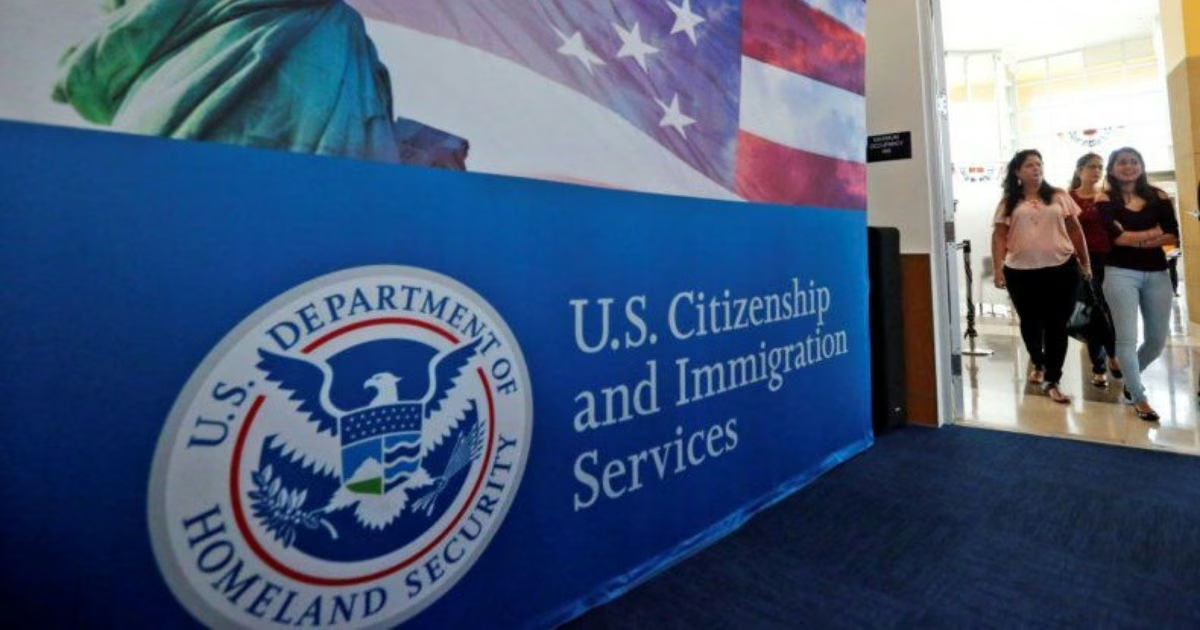
LOS ANGELES.- This September 9, the Temporary Protected Status (TPS) that protects some 170 thousand Salvadorans ends in the US. lProtection will come to an end and will not be renewed. Those who depend on this immigration protection will be forced to return to El Salvadora nation that for many is foreign, that they barely know or of which they even have no memories.
“I have practically been in the United States my entire life: I grew up here, I went to school, I bought my house, and I am pursuing a career,” Alma, a Salvadoran covered by the benefit since 2001, told EFE, who did not want to reveal her last name for fear of reprisals.
The immigrant, 30 years old and resident in Missouri, was granted TPS when she was barely five years old, after her mother requested immigration protection for both of them.
Alma assures that she has no memories of El Salvador, but she does have memories of immigration protection. “I grew up with TPS,” insists the immigrant, who arrived in the US in the arms of her mother when she was barely 18 months old.
“Once the immigration officers put me on a chair to take my fingerprints, I thought it was a game. Now as an adult I know it was biometric data,” says the woman, who has been protected by TPS since its designation in 2001.
Alma wanted to draw the public’s attention to immigrants like her, who came to the US as children and have been in the crosshairs of the Administration of President Donald Trump, who since his first government has aimed to end TPS and the Deferred Action program (DACA).
“I grew up with an American life, with American values, why do they want to remove us?” he asks. “As a child I did not have the opportunity to choose where to live my life,” she adds.
The White House has ended TPS for several countries including Haiti, Venezuela and Afghanistan.
In the case of El Salvador, a country with which Trump currently maintains good relations, the Executive will let the protection that expires this September 9 expire for some 170,000 immigrants, according to data from The National Immigration Forum.
These Salvadorans will lose their work permit and their status to legally reside in the country, putting them at imminent risk of deportation.
One factory, several affected
Alma works at a company in Missouri, where she has reached the rank of supervisor. He says that the company, which has plants outside the United States, is preparing to lose “very hard-working people,” some of them employed since 2001.
“It hurts to see how life will continue to flow and they will be replaced, when those affected (those protected by TPS) leave with nothing,” he reflects.
For Alma and her colleagues, the picture is even more complicated by living in a Republican state, where the same federal congressmen she should turn to to advocate in her favor want TPS to end and immigrants to return to their country.
“When people tell me ‘go back’ (to El Salvador), for me it is not returning to a life because I did not live there. Thinking about that is very powerful,” he warns.
In Miami, dozens of families affected
Carlos (who asked not to reveal his last name) has a story similar to that of many. He has been in the United States for more than 20 years, a country he arrived when he was just 3 years old, after his parents sought refuge. Although he speaks Spanish, his accent no longer matches that of his country of origin; and prefers to converse in English, the language in which he completed his entire academic training until graduating from Florida International University.
“I have nothing in El Salvador, only the memories of my mom and dad. They arrived when I was very little and started working on building and remodeling houses. With that they managed to create a home, they gave me education and now I provide them with financial support. My wife is also in the same condition as me. Our children, ages 4 and 2, were born here. It is a very complicated situation. We don’t know what we are going to do.”
He says that, since the operations against migrants began, he has seen an increase in police and federal presence in areas like Doral. “ICE is there every day. I no longer visit that area to avoid being detained in the middle of the road. This whole situation is distressing.”
A temporary life
An idea shared by José Palma, coordinator of the TPS Alliance, an initiative formed since 2017 to defend protection, and which brings together pro-immigrant organizations that advocate for the approval of a law that allows them to access permanent residence.
Palma, 48, told EFE that the uncertainty about his future has forced him to stop the projects he had, such as construction on his home.
The activist, who is the father of four US citizens, has also made cuts in his expenses, in an effort to save before the termination of the protection, which would leave him without authorization to work.
However, he still hopes that the US Congress will find a way to stay. Like Alma, he highlights that in these 25 years they have not been offered a solution.
“We would have requested it a long time ago. Who wants to live without knowing what will happen to their future?” says Palma.
In Alma’s case, her mother died hoping to find a way to residency. She continues to hope that the country where she grew up will give her a chance to stay.
