
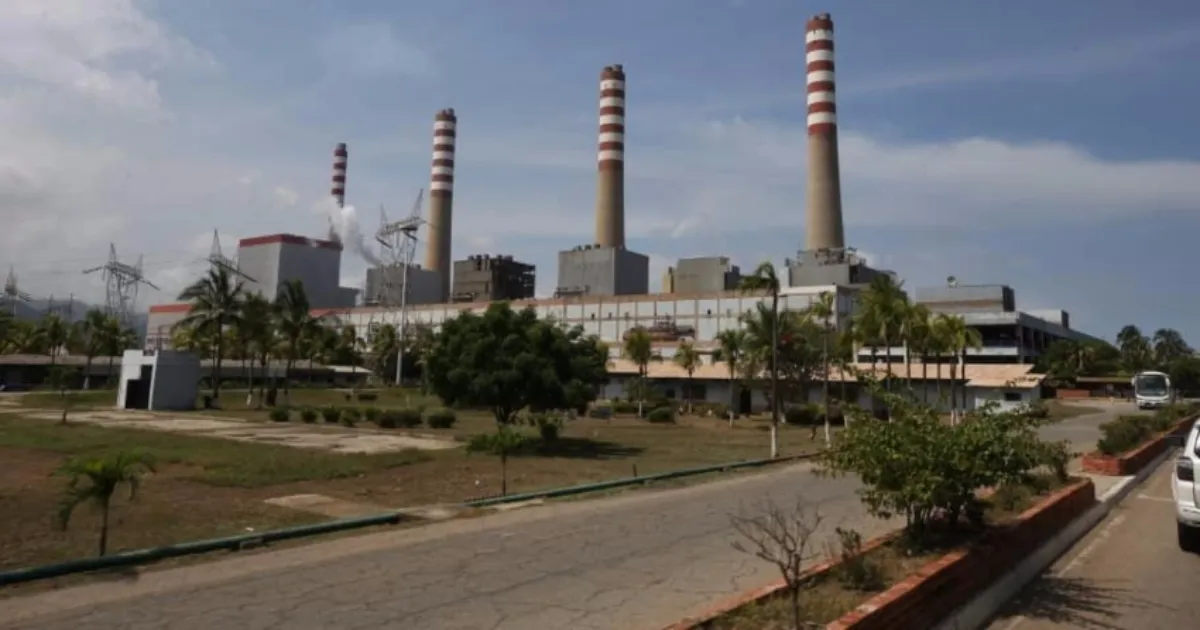
“A general blackout cannot be ruled out, although it would not be responsible to predict it,” warns engineer José Aguilar, international consultant on electrical issues. But he sees it possible.
“It costs the system a world, integratedly, to be able to go beyond 13,000 megawatts, and if it does, it does so at great risk that the operation will become very unstable and in the event of an unforeseen failure, there may be a wide-spectrum blackout,” he explains.
And given this “serious risk” that short-circuits “the official media matrix protected by the information blackout,” as he says, it is imperative that the US government demand “total transparency” from the Venezuelan authorities. A request that he considers indispensable, just as the IMF has made to the Central Bank of Venezuela (BCV). For the benefit of Venezuelans and potential investors.
“Here we must tell the truth to the entire country. Also the US government, which is the one that protects the Venezuelan management, should demand the end of the information blackout on the National Electric System (SEN). If we want oil, we must demand ipsofacto “Total transparency, to be able to generate and satisfy the requirements,” he emphasizes. It is the urgency of the moment.
“The electrical system is very bad and could get worse,” warns Aguilar who, together with a team of Venezuelan and foreign experts, has been constantly monitoring the electrical energy of the South American country for more than 17 years.
Venezuela on the verge of a blackout
Although the Venezuelan electrical system has been in progressive deterioration for years due to laziness and waste of resources, in addition to lack of investment, for approximately three months more regions of the country have suffered repeated – and sometimes long – power interruptions that affect homes and the commercial sector. Caracas, center of power, is one of them.
Authorities have argued that the blackouts are due to an increase in demand to more than 15,000 megawatts and that there is no capacity to satisfy it, they said in a statement. Meanwhile, they ask the private sector to appeal to “self-generation” (power plants) under the promise of a new plan for the use of electrical service.
The scenario is a new sign that the service is getting worse and that “the truth is not being told,” according to the engineer.
“The barely functioning infrastructure is not enough to cover the country’s demand. The problems cover the entire electrical chain: generation, transmission, distribution, local networks and marketing,” he points out.
Added to this, he says, is the deprofessionalization of the sector, the shortage of fuel, the lack of timely maintenance and “anarchic and corrupt management.”
Lack of fuel
Aguilar assures that the biggest problem with the electrical service at the moment is focused on the lack of fuel for the thermal plants that contribute to hydroelectric generation in the country.
“The operation is inefficient due to lack of maintenance and training, and even if that were corrected, the lines and substations remain in poor condition, aggravated by the country’s socioeconomic distortions, which aggravate the crisis.”
Given this, it dismisses that the increase in demand and a supposed economic growth indicated by the authorities are the true reason for the new manifestation of the electricity crisis, while relations between the head of the regime, Delcy Rodríguez, and President Donald Trump are strengthened.
“That figure of increased demand may be true, perhaps in 2017 it occurred when the country was already in electrical decline, but it is worth remembering that this was the demand 20 years ago.”
He notes that in any case, this requires an operation prepared to serve users “and that has not been possible in Venezuela since 2007.”
Darkening opacity
According to Aguilar, the SEV could worsen due to “a failed management that only offers excuses for demands it must face.”
He says that after the major electricity crises that occurred in Venezuela in 2010 and 2016 when the Guri reservoir fell to critical levels, thermoelectricity “has to show its face and it doesn’t.” But that is hidden from the country, in the midst of severe rationing, he asserts.
“The Venezuelan economy remains precarious; there is no such strength. What is credible here is that the SEV is besieged by opacity, shady management and lack of long-standing maintenance, which makes it more vulnerable to high temperatures.”
“The electricity company (Corpoelec) owes the country 5,659 daily reports on the situation of the electricity service since December 17, 2010, which must be updated every five seconds for all actors in a modern electricity sector, and they do not do so,” he says.
“It means that these gentlemen hide the information that should be known more than six million times a year, without makeup,” he adds and contrasts it with the information transparency that existed before the electrical emergency began in 2009.
This would include the status of the distribution, the lines that are out of service and those available. “Not knowing this is unacceptable, but they deliberately hide it to impose their media story,” he insists.
Oil production between the crisis
Due to the lack of information, it is not possible to know if the critical electrical situation is directly affecting oil production and how many megawatts would have to be secured for the sector.
“In a country without reliable figures due to official opacity, the only traceable reference is that of 2013. On that occasion, with an average production of 2.89 million barrels per day, the oil sector consumed about 4.17 kWh per barrel from the SEV. There must also have been self-generation by the oil industry, but I do not know that figure,” he points out.
“What could decouple the quality of life and the economic relaunch of Venezuela is the sufficient availability of fuels for the electricity industry and other productive sectors, including industrial and commercial self-generation,” he adds.
For the expert, “crypto mining and all illegal activities” that operate with the country’s electrical service “must be stopped immediately” through the application of the law to counteract any increase in demand.
The lack of fuel stands out as another problem that must be addressed in the sector.
“It may also happen that there is no fuel, the demand from the oil sector is static, so it has to be made to appear. Venezuela, the country with the largest electrical reserves of hydrocarbons in the world, is going to have to import fuel; there is no other way.”
He warns that in the country “there is no turbo steam unit that is fed with fuel oil to displace gas, the system has been destroyed, first because it was not maintained, second because it has been scrapped and all this is hidden by the information blackout that leaves citizens defenseless.”
Light for electrical service
After highlighting that without electricity no country in the world achieves development or progress, the need to transparently know the current situation of the Venezuelan electrical system must prevail to restore its effectiveness and reliability.
“The only thing that is clear is that we have a high possibility that there could be a major blackout, because the operators are forcing the system and it no longer gives any more,” warns Aguilar.
He considers that one of the possible solutions for the recovery of electricity service is a “realistic” and “transparent” tariff structure that is well below the fuel rate that exceeded a billion dollars in 2025.
But for the expert, the transparency of the figures that indicate the current situation of the system must be a priority, “a requirement of the US government.”
“This system must be intervened and those responsible for the electricity company must be left out, as is done when faced with an irresponsible driver behind the wheel. If we are going to protect, we are going to protect. If not, this is going to be chaos,” asserts the expert.
