
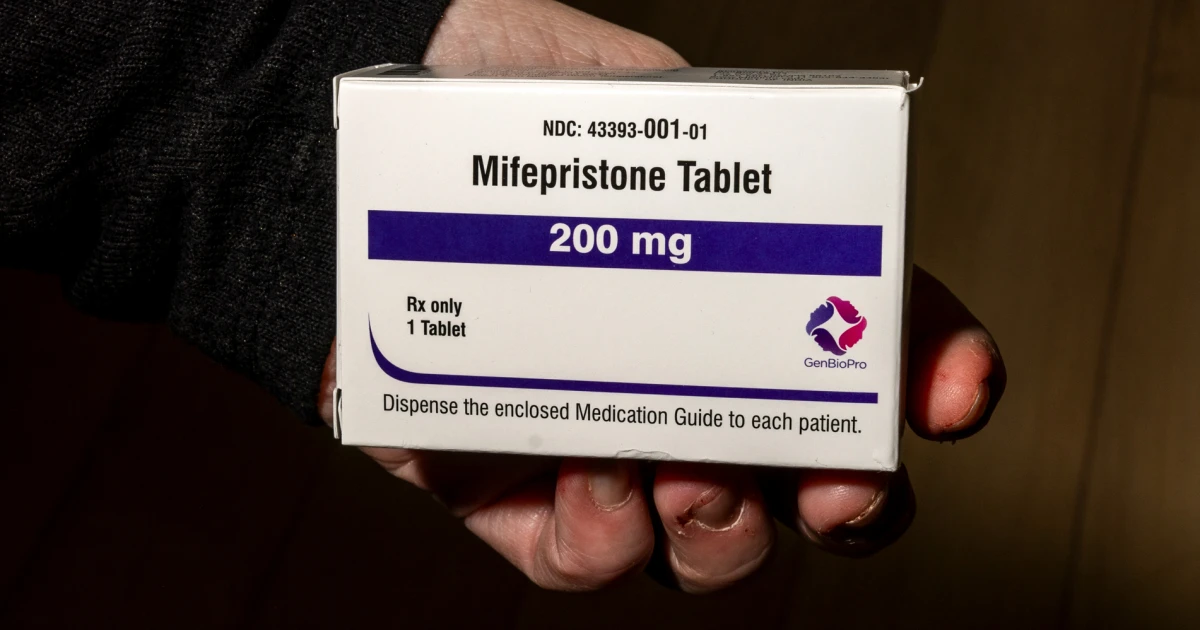
The Supreme Court guaranteed this Thursday that the abortion pill mifepristone can continue to be dispensed by mail without the need for an in-person appointment with a health professional.
A ruling handed down on May 1 by the United States Court of Appeals for the Fifth Circuit, based in New Orleans, had endangered widespread access to the pill. Now, the Supreme Court has accepted emergency requests filed by drug makers Danco Laboratories and GenBioPro, which sought to block that ruling.
The decision, a defeat for the state of Louisiana, ensures that there will be no interruption in the availability of the drug while the litigation continues. On May 4, in an order issued by conservative Justice Samuel Alito, the court had provisionally stayed the appeals court ruling while the justices considered their next steps.
Two conservative members of the court, Justice Clarence Thomas and Justice Samuel Alito, expressed their dissent.
Thomas, noting that mailing mifepristone is illegal in Louisiana, criticized the drug’s makers, saying they had no right to block a court order “based on the loss of profits from their criminal enterprise.”
In a separate opinion, Alito stated that the Biden Administration’s decision to make mifepristone available by mail in 2023 was an attempt to “undermine” the court’s 2022 ruling that overturned the landmark case on abortion rights Roe v. Wade.
(Trump claims that thanks to him the US has the lowest drug prices “in the world”. We review how true this is)
“Louisiana’s efforts have been thwarted by certain healthcare providers, private organizations and states that abhor laws like Louisiana’s and seek to undermine their enforcement,” Alito added.
The case in question concerns Louisiana’s challenge to the decision made by the Food and Drug Administration (FDA) during the Biden Administration, which allows the administration of mifepristone without the need for an in-person consultation, facilitating access to the drug even in states where abortion is prohibited.
Anti-abortion groups have been pushing to reinstate the in-person consultation requirement, arguing that taking mifepristone at home can be dangerous, even though studies have shown it to be safe and effective.
In asking the Supreme Court not to intervene, Louisiana Attorney General Liz Murrill of the Republican Party wrote in court papers that although abortion is almost entirely banned in the state, up to 1,000 abortions are being performed per month because mifepristone pills are mailed to women in the state.
(A new therapy for HIV suppresses the virus for years in people who have it.)
Mifepristone is used as part of an FDA-approved two-drug treatment that is currently the most common form of abortion in the United States. It is also used in the care of spontaneous abortions.
Danco makes Mifeprex, the brand-name version of mifepristone, while GenBioPro makes the generic version.
The companies argued that Louisiana’s request lacked standing, citing the Supreme Court’s 2024 decision that rejected a similar challenge to the FDA’s approvals of mifepristone on the grounds that the plaintiffs could not prove they had suffered any harm.
In an unusual move, the Trump Administration did not file a brief with the Supreme Court, even though the FDA is technically a defendant in the case.
The government did file a brief in the case with the appeals court, urging the court to rule in favor of the pharmaceutical companies on the basis that Louisiana did not have standing to bring its claims.
The FDA is currently reviewing the safety protocols for mifepristone, which means that availability by mail could still be revoked. Louisiana’s lawsuit “would not only disrupt the FDA’s ongoing review and usurp its scientific function, but would also cause chaos,” the Justice Department declared before the appeals court.
abortion is effectively banned entirely in 13 stateswhile several others have strict restrictions, according to the Guttmacher Institute, a research group that supports abortion rights.
