
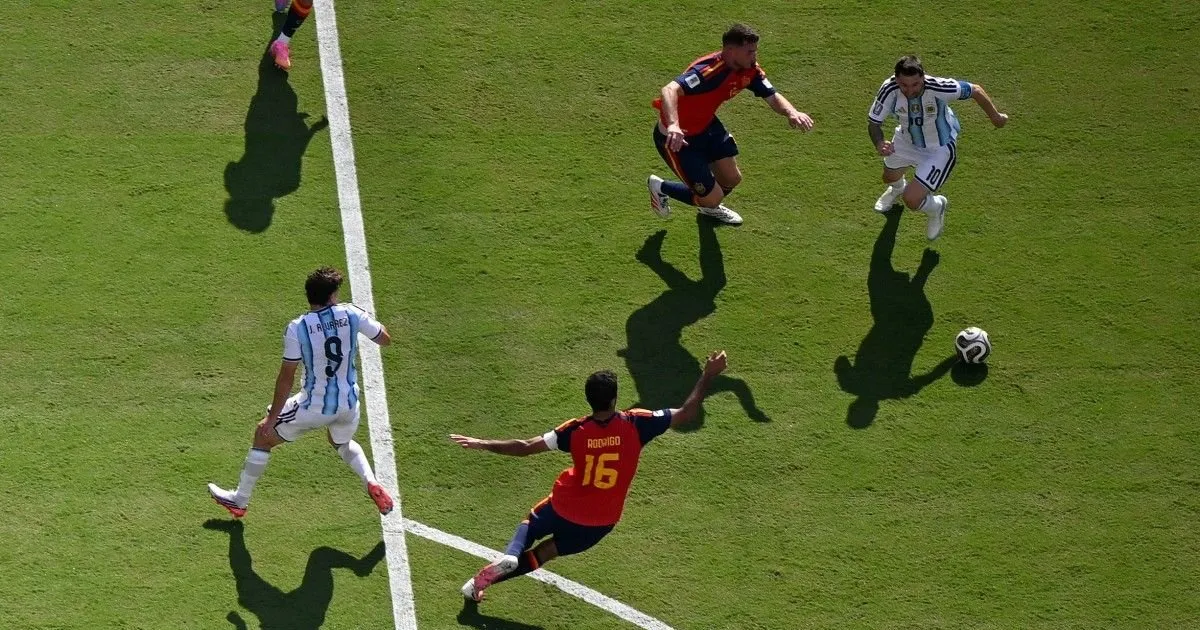
When the referee signaled the end and Spain lifted the World Cup, the score was no longer the only important thing. For ninety minutes, the planet saw two teams united by something deeper than football: the same language.
It was not just a final between Spain and Argentina.
It was the Spanish speaking through the ball.
He spoke the language of the squares, the ports, the fields without grass, the neighborhoods where a child learns to dribble between stones and pursue a dream with a worn-out ball.
He spoke with a Madrid accent and with the cadence of the Río de la Plata; with the “che” from the corners, the “vamos” from the stands, the Andalusian, Castilian and Buenos Aires shouts. That’s our way of turning pain into courage and difficulties into hope.
Spain conquered the world with a football of patience, precision and intelligence. With a generation that made possession a virtue and the ball an extension of thought.
Argentina responded with the rebellion that has made it an eternal power. With the pride of the neighborhood, the conviction of its footballers and the faith of a champion who defended the title until the last minute.
The ball rolled and with it rolled the memories of millions of people who once played in a narrow street, against a broken wall or under the yellow light of a pole.
Because before the big stadiums there was the neighborhood.
Before the hymns, the street.
Before glory, a child’s dream.
The World Cup final was followed from Mexico to Chile, from the Caribbean to the Andes, by millions of people who speak the same language with different accents, but with the same passion for soccer.
Spain wrote a new golden page by conquering its second star. Argentina fell on their feet after another memorable tournament. And beyond the result, both demonstrated why soccer in Spanish occupies a privileged place on the world stage.
Because there are truths that survive the scoreboard.
And one of them was confirmed in the 2026 World Cup:
football speaks Spanish.
