
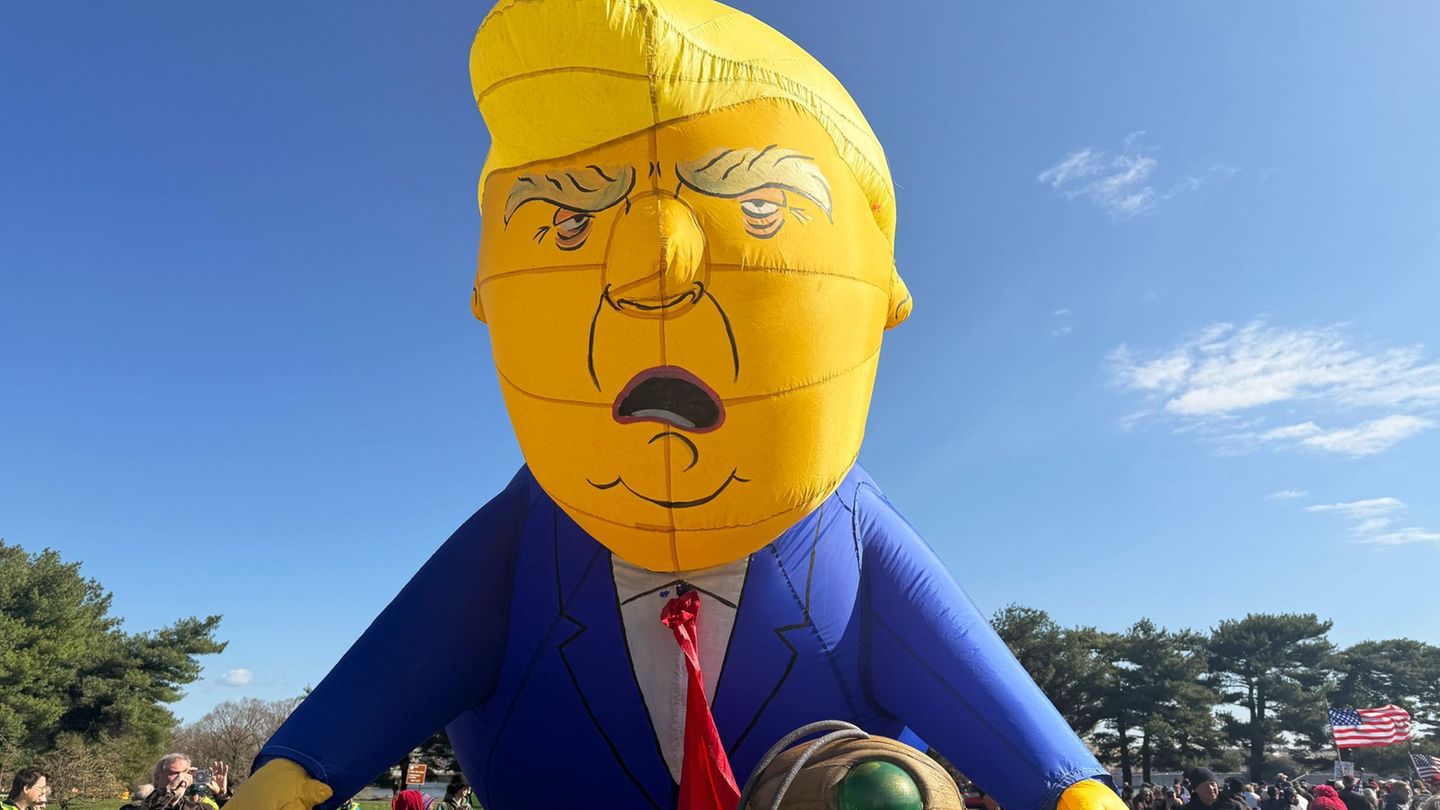
No war against Iran, no raids in US cities and a no to rising prices: In the US, citizens have taken to the streets in numerous cities against the government of US President Donald Trump. According to media reports, protests took place in all 50 states on Saturday under the motto “No Kings”. The organizers spoke in the evening (local time) of an estimated eight million participants, the numbers have not yet been independently confirmed. Resistance also formed internationally, including several German cities.
Accusation of fascism
In addition to large protests in New York, tens of thousands of demonstrators marched across the Memorial Bridge towards the city center in the US capital Washington this morning, according to a dpa reporter.
According to media reports, the organizers, an alliance of civil society groups, spoke of around 3,300 rallies nationwide at the end. Last year, similar actions brought millions of people onto the streets.
Protesters in Washington chanted warnings about “fascists in the White House.” A cardboard cutout that was supposed to represent Trump’s deputy chief of staff and right-wing hardliner Stephen Miller had the name tag “Adolf” for Adolf Hitler hanging around it.
Many demonstrators also came to set an example internationally. A demonstrator who took to the streets against Trump’s plans to temporarily close Washington’s famous Kennedy Center cultural venue told the dpa that people in Germany should see that there is protest against the Trump administration in America.
Various reasons for protest
In addition to the US government’s migration policy, the protests are also directed against foreign policy decisions and rising costs of living. According to a Reuters/Ipsos poll, Trump’s approval rating is now just 36 percent – the lowest level since he returned to the White House. Only 35 percent of those surveyed supported the US air strikes on Iran.
The war led to a sharp rise in gasoline prices in the United States. Food prices also remain high. Critics also accuse Trump of undermining democratic principles such as freedom of expression, civil rights and the right to vote.
White House: left-wing networks
The White House criticized the protests. According to media reports, a spokeswoman described the events as meetings of a small group supported by left-wing networks without broad support among the population: “The only people who are interested in these therapy sessions against Trump are the reporters who are paid to report on them.” Trump himself had described previous demonstrations under the same motto as a “joke” and dismissed participants as “crazy”.
Central event in Minnesota
The central event of the nationwide protests was a large rally in St. Paul in the US state of Minnesota in the north of the USA, where a huge crowd of demonstrators gathered. The background to this is, among other things, controversial operations by federal authorities in the wake of stricter measures against migrants, which had previously led to weeks of protests in the region. During the operations, two US citizens were also killed by shots fired by federal officers.
The announced participants in St. Paul included prominent supporters from culture and politics. US rock legend Bruce Springsteen was among those who spoke to the demonstrators. After the deaths of the two US citizens, he created a protest anthem (“Streets of Minneapolis”) that was directed against the controversial deportation raids by federal officials, some of whom were masked. In the song, Springsteen refers to them as “King Trump’s private army.”
There were also demonstrations in numerous other cities – from large metropolises to smaller towns. Protests took place in the US states of Michigan, Texas, Idaho, Florida and North Carolina. Likewise, people took to the streets in San Francisco and Los Angeles on the West Coast. According to the organizers in US media reports, a larger proportion of registrations also come from conservative rural regions and suburbs, not just from classic Democratic strongholds.
Also protest in Germany
There were also solidarity rallies outside the USA – from Australia to Latin America to Europe. In Germany, demonstrations took place in Hamburg, Munich, Frankfurt am Main and Düsseldorf, among others. On posters, a few hundred demonstrators in Berlin accused Trump of attacks on democracy, criticized the immigration agency ICE or demanded the complete release of the so-called Epstein files, which revolve around the scandal surrounding the sex offender Jeffrey Epstein. According to police reports, up to 600 people gathered on Odeonsplatz in Munich. According to dpa information, around 120 participants came together in Frankfurt.
