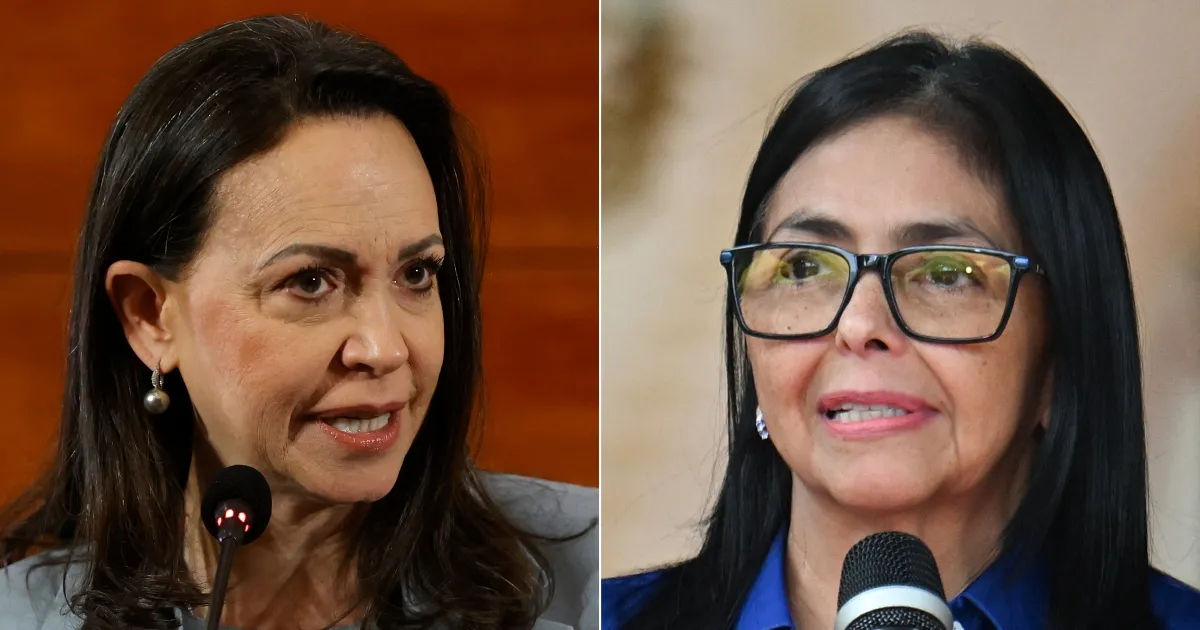
“A country that emerges from repression, institutional destruction and economic collapse needs order. It needs a transition that is peaceful, credible and disciplined. That is why we recognize the strategic value of the framework promoted by the US government, focused on institutional stabilization, economic and social reconstruction, and democratic transition,” said Machado, days later, in his speech at the Oslo Freedom Forum, defending the document.
But the agreement that grants the Venezuelan political leader the conduct of the talks by virtue of her leadership constitutes not only a list of good wishes of uncertain fulfillment, but also an effort that may involve serious risks, even political instability, according to analysts from the US and Venezuela, after evaluating the text’s approaches.
They do not identify, internally, any interest on the part of the Rodríguezes in negotiating or in allowing Machado to return to the country from which she left exile in 2025, nor in leading an eventual political agreement as a valid interlocutor, to make the Manifesto possible.
Nor do they observe a coherent position in the Trump government regarding the role of the opposition leader in promoting the requested changes.
For experts, the opposition’s purpose, which Machado’s supporters defend as the realization of the “historical responsibility” of rescuing democracy, “is very complicated” in light of the facts.
And it is a delicate dilemma for Washington.
On May 26, Delcy Rodríguez stated in an official event that Chavismo will defend the permanence of the system promoted by Hugo Chávez and Nicolás Maduro, and that they will respond to “any threat against the stability of the country.”
Manifesto in the light of signs
“There are conflicting and forceful signals from Washington” that may affect the immediate implementation of the Panama Manifesto, says expert Eduardo Gamarra, professor at Florida International University (USA) and expert in Political Science, when analyzing the indisputable leadership of Machado “increasingly marginalized” in search of a transition against a regime that refuses to direct the country towards democratic objectives.
Last week, the Trump administration ordered the Florida Attorney General’s Office to drop any charges against Rodríguez in the state justice system, a decision that Gamarra interprets as “a very important signal that shows that Washington is not in the least interested in accusing her or involving her with anything, although we know of real things that have been there.”
Among the cases that would implicate the head in charge of Venezuela, according to Gamarra, is not only the case against former president José Luis Rodríguez Zapatero for money laundering operations in Spain, but also the case of the Colombian Alex Saab, “front man” of Nicolás Maduro and prosecuted in Florida, “one of the Rodríguez cronies,” as he says.
It also draws attention to the inaction of the US justice system against the Chavista ministers Diosdado Cabello and Vladimir Padrino, with charges linked to drug trafficking and collaborators of Maduro, and now integrated into the regime of the head in charge.
For Gamarra, these “strong signals” affect an eventual political transition process from which Machado has been excluded, while her re-entry into Venezuelan territory depends on the US and the Rodríguezes. This, although he mentions that the return of opponents, persecuted in the past, can be interpreted as a positive step in the country.
Uncertain transition
“I don’t think the opposition plan can lead to a real transition,” says Gamarra, commenting on the difficulties for that possibility, which is the initial objective of the Trump government’s three-phase plan, but which in Caracas they evade with the same intensity as they do with possible elections.
However, he maintains that we must wait for a response from Caracas and Washington.
“What María Corina Machado and her group are promoting in the Manifesto is a bit of what democratic movements throughout the region proposed when trying to eliminate military dictatorships in the past,” she warns.
Furthermore, he explains that the US is currently committed “to authoritarian stability”, as it did in the past during the Cold War when it pressured right-wing military governments to lead their countries to democracy, although “there was not much talk about the country’s interests, but now they do,” he notes.
“At this moment, Washington has defined working with Delcy Rodríguez and promoting US interests linked, of course, to the oil industry and they say this without the need to hide it as they did during the Cold War.”
He details that when North American foreign policy has placed democracy and human rights as its central point, it privileged political transition over authoritarianism to achieve stability and reconstruction, “but here the equation has been reversed,” he says.
“Here there is an inverted equation. So, the first thing is stability, then reconstruction and eventually the transition to democracy,” he points out, which means that there is no coincidence between Machado’s strategy and that of the Trump government and, consequently, places the transition in a climate of uncertainty.
Furthermore, the transition “is not the cure of the evil or the pathologies that violate and prostrate Venezuela,” points out lawyer Nelson Chitty La Roche, Venezuelan professor and constitutionalist.
“It is therapy to move towards improvement, healing, regeneration of the sick, the gradual dismantling of the walls that stagnate and enervate us as a nation and prevent the regular flow of the dignity of the human person, which is the genuine purpose of the social and public organization of the republic and its implementation, the constitutional, democratic and social state, of law and justice,” he clarifies.
Risk of instability
After emphasizing that the Panama Manifesto “is a list of wishes that I think we all identify with,” given the changes that are proposed there, but that are difficult to achieve, the expert emphasizes the possibility that it may increase political instability in the country.
He agrees with political analysts in Venezuela who see the negotiation and even the acceptance of Machado’s leadership in the country as “unviable,” as established in the opposition document, but Gamarra warns about possible reservations in Washington.
“I think they are going to see the proposal as a risk, as a measure that would increase political instability; the great fear is opening political floodgates at this time,” he asserts.
“It can create destabilization, because beyond Chevron and even the increase in oil, the economic situation in Venezuela is very bad. Harvard professor Sam Huntington spoke precisely that when there is a great political mobilization and there is an absence of institutions, the result is extreme and uncontrolled political participation,” he adds.
And the lack of institutionality and the risk in Venezuela stands out.
“In this context, it is going to be very difficult because there is no institutionality in Venezuela that is not linked to Chavismo.” And he adds: “Not only from the point of view of Delcy Rodríguez, who would lose control, but also from Washington’s point of view.”
Gamarra emphatically states that Machado is currently “the rock in the shoe”, which is why he considers it far from possible for the Manifesto to be executed.
“That is not going to happen, I think. Surely there will be a statement from Marco Rubio, as we have already heard, that María Corina Machado is a great person, we love her very much, but she cannot be a disturbing factor at this moment, while she only asks for patience.”
