
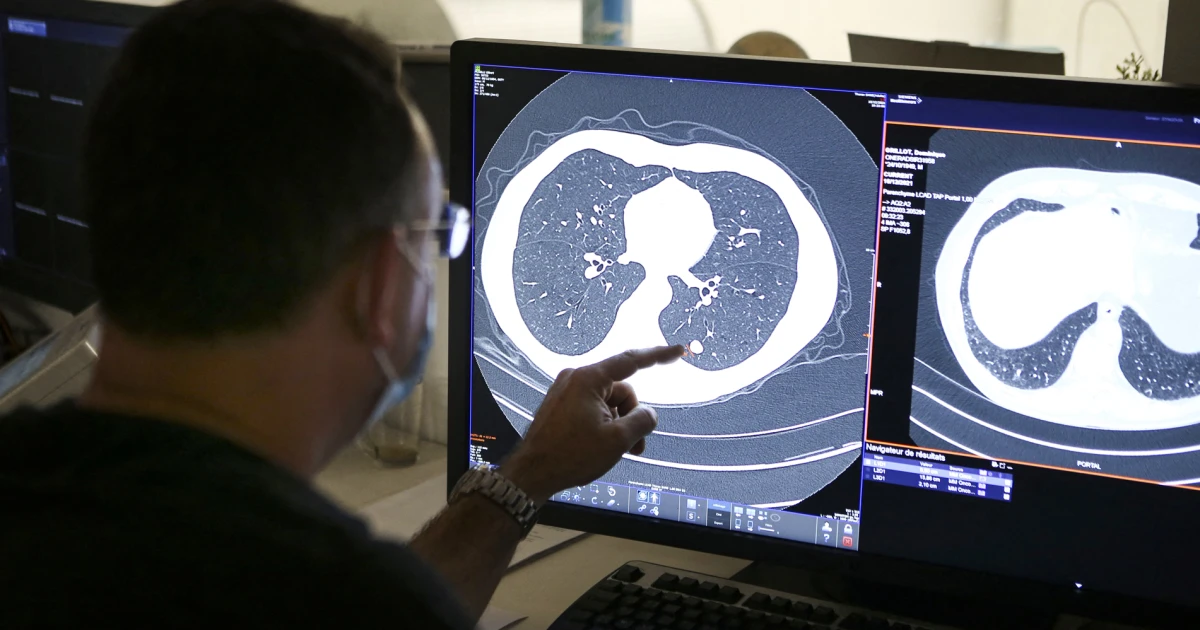
An innovative pancreatic cancer drug shows promise against the most common form of lung cancer, according to clinical trial results published Wednesday in the New England Journal of Medicine.
The drug, called daraxonrasib, from Revolution Medicines, was approved last week by the Food and Drug Administration (FDA) for advanced pancreatic cancer after it was shown to nearly double patients’ life expectancy.
It works by targeting a mutation present in several tumors called KRAS, which controls the growth of cells in the body. The mutation forces the gene to remain permanently “on,” allowing cells to grow uncontrollably.
Before the advent of daraxonrasib, the mutation was long considered “untreatable with drugs,” said the lung cancer study’s lead author, Dr. Kathryn Arbour, a medical oncologist at Memorial Sloan Kettering Cancer Center.
The trial results, Arbor noted, are a good sign that daraxonrasib could treat more than just pancreatic cancer.
(Messenger RNA pancreatic cancer treatment shows lasting effects)
“This is an exciting time for (KRAS) therapies in lung cancer patients, just as it is for many other diseases,” he said. KRAS mutations are also seen in colorectal and ovarian cancers.
The new trial focused on 136 patients with advanced-stage non-small cell lung cancer who had already received other standard treatments, including chemotherapy.
Non-small cell lung cancer is the most common type of lung cancer, and mutations in the KRAS gene are detected in about 30% of such patients, including people who have never smoked cigarettes.
In the trial, about a third of patients taking daraxonrasib found that their tumors shrank. For those patients, that also meant an improvement in symptoms, including less pain and less intensity of cough, Arbor said. The drug will still need to be tested in larger, later-stage trials, including trials that compare its effectiveness with that of existing treatments.
(“Deaths of despair”: why preventable deaths among Latinos in the US are skyrocketing)
Virtually all patients in the trial reported side effects. Rashes, diarrhea, nausea, vomiting, and mouth sores were observed in 30% of patients. The rash caused by daraxonrasib can be painful: Former Sen. Ben Sasse, R-Neb., who takes the drug to treat pancreatic cancer, described it as “nuclear.”
Channing Der, a pharmacologist at the University of North Carolina at Chapel Hill, said daraxonrasib, however, represents a “significant improvement” over what is currently used as a second-line treatment for lung cancer when chemotherapy has stopped working.
That drug, called docetaxel, can cause people to have very low levels of white blood cells and can have serious side effects, including stomach or intestinal problems, which can be life-threatening, according to the Mayo Clinic.
Patients in the lung cancer trial also reported pneumonia as a side effectwhich was not observed in the pancreatic cancer trial.
Dr. Rachna Shroff, chief of the division of hematology and oncology at the University of Arizona Cancer Center in Tucson, who was not involved in the trial, said that may not be unusual, noting that lung cancer patients may be more susceptible to infections.
Shroff called the results “significant” and “further proof of principle” that targeting the KRAS gene mutation works beyond pancreatic cancer.
“We have now shown that This not only works in pancreatic cancerbut also in other types of tumor,” he said. “Given the incidence of lung cancer, this is a significant number of patients.”
