
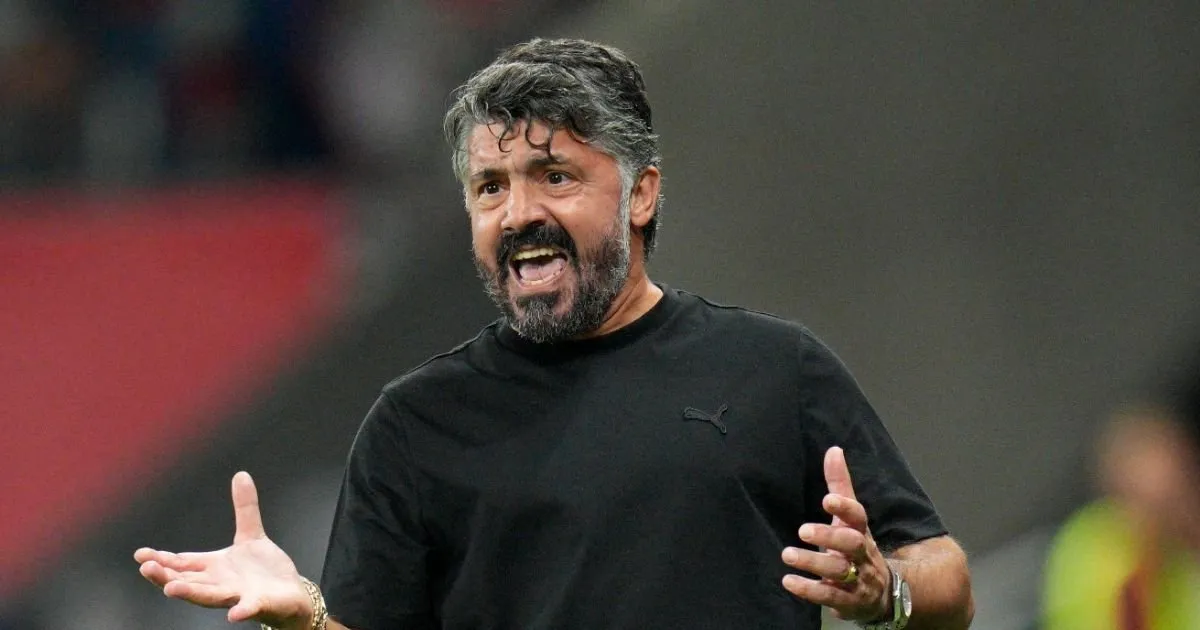
Italy is once again experiencing one of the toughest crises in its football history. The Italian Federation of Soccer (FIGC) confirmed this Friday the resignation of Gennaro Gattuso as national coach, after the failure that left the Azzurra out of the 2026 World Cup.
The departure of the former world champion midfielder in 2006 marks the beginning of a total reconstruction within Italian football, hit by a historic elimination: it will be the third consecutive World Cup that Italy will miss, after absences in Russia 2018, Qatar 2022 and now also in the United States, Mexico and Canada 2026.
Gattuso resigned after the coup against Bosnia
Gattuso’s cycle at the head of the national team ended after the painful loss in the playoffs against Bosnia-Herzegovina, a series that ended 1-1 and was resolved on penalties with a 4-1 Bosnian victory.
The elimination unleashed a new earthquake in Italian football, which has failed to regain the international weight it had for decades.
In the statement released by the FIGC, Gattuso left a brief farewell message:
“An honor to have been able to lead the national team, thanks to all Italians for never stopping showing their love.”
Although the federation president Gabriele Gravina had asked him to continue after the elimination, the institutional and sporting context ended up pushing his departure.
Italy is experiencing a total collapse in its structure
Gattuso’s departure was not an isolated event. His resignation is added to the resignations of Gabriele Gravina himself, president of the FIGC, and Gianluigi Buffon, who served as manager of the national team.
The feeling in Italy is clear: failure is not limited to the bench, but affects the entire structure of national football.
The elimination against Bosnia revealed a deep crisis in a team that in the last two decades was clearly behind other European powers such as Spain and France, both in results and in generational renewal.
Added to this is another alarming fact: Italy also does not have representatives in the quarterfinals of the current Champions League, a sign of the competitive decline of its football at the club and national team level.
Gattuso’s numbers did not reach
Statistically, Gattuso’s time in the national team was not catastrophic. In fact, their numbers were relatively positive on paper:
8 matches directed
6 wins
1 tie
1 defeat
22 goals in favor
10 goals against
However, the real analysis was marked by the decisive match: the draw against Bosnia and the subsequent penalty shootout in which Italy collapsed again.
One of the most questioned moments was Gattuso’s decision to give the first penalty to young Pio Esposito, barely 20 years old, who ended up sending his shot over the crossbar.
That failure opened a series of errors that ended up sealing a new humiliation for the four-time world champion team.
Italy is looking for a new coach: Mancini and Conte, the great candidates
With Gattuso’s departure already confirmed, speculation about his replacement immediately began in Italy.
The two names that are gaining the most strength are those of Roberto Mancini, champion of Euro 2020, and Antonio Conte, one of the most prestigious Italian coaches and with the greatest personality in European football.
However, the FIGC will not make an immediate decision.
The new coach will not be announced until after June 22, the date on which the federation council vote will be held to elect the new president of the FIGC, after Gravina’s departure.
Meanwhile, La Nazionale will be led by an interim coach in June’s friendly against Greece.
Italian football, forced to start from scratch
The magnitude of the failure generated a strong reaction even from the political sphere. The Minister of Sports of Italy, Andrea Abodi, was blunt when referring to the present of the national team and the national football system.
“It is clear that Italian football needs to be rebuilt from the foundations,” he said after the elimination.
The phrase summarizes the moment of the Azzurra: a historical power that knew how to dominate world football, but that today faces a structural, sporting and institutional crisis of enormous depth.
Italy will have to reinvent itself if it wants to return to the place it once had among the great teams on the planet.
