
Updated Thursday 25. 8:10 pm Miami Time
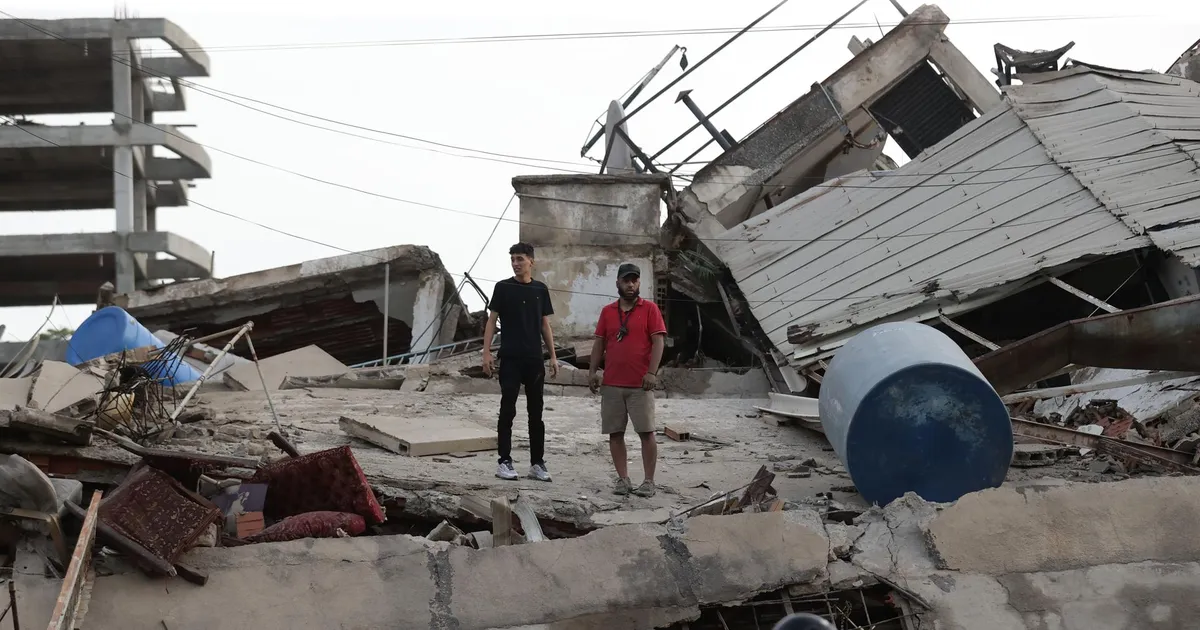
So far, more than 100 buildings have completely collapsed. “It is estimated that there are more than 70,000 families. Let your colleagues who live in other places get an idea of the dimensions of the impact of these earthquakes here in La Guaira,” said Interior Minister Diosdado Cabello, without completing the idea, in a broadcast on the state channel Venezolana de Televisión.
The most affected sectors of this state are Macuto, Caraballeda and Catia La Mar, Cabello indicated. In La Guaira there is the Maiquetía Airport, the main airport in the country that serves Caracas, which remains temporarily inoperative due to damage resulting from the earthquakes.
The number of deaths in Venezuela due to the two earthquakes on Wednesday rose to 188 and the number of injured to 1,520, while it is estimated that at least 346 buildings, such as buildings, hospitals and shopping centers, were affected, according to official information.
There are at least 2,927 families affected, 157 reported missing, 200 people trapped, 250 buildings damaged and eight hospitals affected, some of which “have had to be evacuated,” according to the Government.
Several countries have announced the deployment of relief personnel in Venezuela, including the United States, where the State Department works in close coordination with the Pentagon on logistics and transfer tasks, given that the Maiquetía airport was closed due to damage.
Against the clock
Night falls and the search for survivors continues in Venezuela after more than 24 hours of the two strong earthquakes that shook the oil country this Wednesday, and which have left at least 188 dead and 1,520 injured, as well as hundreds of collapsed structures.
Given the magnitude of the damage and the lack of personnel, dozens of volunteers have joined the rescue efforts.
In La Guaira they claim that the help is very little, and relatives of the people who are still under the rubble are crying out for the arrival of specialized people.
“My brother is in a building in the Macuto area. We don’t know anything about him. They managed to get his son out, but not them. We don’t know if they are alive. Help has arrived but it is little. We ask for more help to try to recover someone alive,” cried a man, who is looking for his relatives from the Residencias Punto Piedra building, in Macuto.
Two strong earthquakes
A first earthquake of magnitude 7.2 had its epicenter 21 km west of Morón and was followed almost a minute later by another stronger one of magnitude 7.5 a few kilometers away, indicated the United States Geological Survey (USGS) in X. The tremors were felt as far as Colombia. Due to the magnitude of both earthquakes, the damage is recorded throughout the country.
The scenes in Caracas were one of destruction and panic, according to an AFP journalist, who saw a 22-story building completely destroyed in the Altamira urbanization. People outside shouted the names of their relatives and some volunteers climbed into the rubble. “We need flashlights,” said one of them, as night fell.
Half an hour from Caracas
The territory, the second smallest in the regional divisions of Venezuela, is located north of the capital – about 30 kilometers – and registers an average temperature of 27 degrees throughout the year, so its beaches are visited by thousands of Caracas residents, who only need to travel a highway for half an hour to reach the coastal area.
The earthquake occurred on a non-working day – when the country commemorates the Battle of Carabobo, which marked independence from Spain – which means a greater presence of visitors in the area. Many were at home watching the World Cup match.
A source from the humanitarian sector told EFE that there are reports of victims that include “a considerable number” of deaths in this region, where there have also been numerous injuries and damage to infrastructure.
The same source announced that the authorities will convert the Jorge Luis García Carneiro baseball stadium, the largest in the region, into a temporary shelter, while they plan to treat some injured there.
Videos circulating on social networks show injured people in the streets or outside a hospital, while the number of collapsed buildings increases, according to local media.
The Vargas tragedy
The region – known until 2019 as Vargas – represents for Venezuelans the largest natural disaster recorded in the country in the last 200 years, as it was the scene in 1999 of a meteorological phenomenon that unleashed unprecedented rains, floods and avalanches that claimed the lives of thousands of people.
Entire buildings and vehicles were then covered under the rubble, which prevented – according to authorities – from establishing precise numbers of deaths and gave way to estimates that estimated between 10,000 and 30,000 deaths and the displacement of thousands of people who were left homeless.
Then, the incipient government of the late Hugo Chávez (1999-2013) accepted help from numerous countries and began a slow process of reconstruction in the region, in which the majority of the population lives in poverty, according to the national ENCOVI survey, carried out by the Andrés Bello Catholic University (UCAB).
The door to Venezuela
La Guaira is the main entry point to the country, as it is home to the Simón Bolívar International Airport, which serves Caracas, and which registers the largest number of international routes, now suspended.
The interim president declared the temporary closure of the airport due to “serious damage” to its infrastructure, shaken by the earthquakes, and from which parts of walls and ceilings fell off, according to images shown by the state channel VTV.
The region – along with Puerto Cabello, located about 200 kilometers away – also leads port activity in a country highly dependent on imports. Until now, the state of these customs infrastructures after the earthquakes is unknown.
This state made up of a single municipality depends heavily on tourism, which is why it has exploited its location facing the Caribbean to attract visitors, attracted by large buildings overlooking the sea, several of which have been reduced to rubble.
