
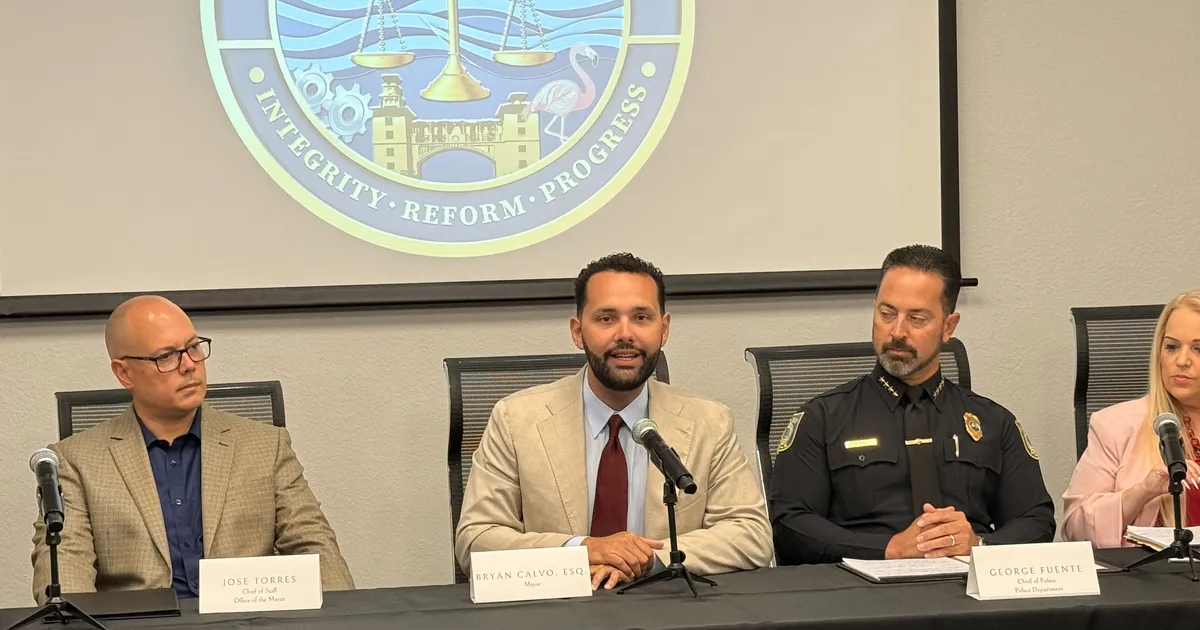
The open meeting, held this Wednesday, May 27, was presented by Calvo as a new model of transparency that aims to be repeated every three or four months.
“The word transparency is used a lot, but this is what transparency really means: opening the city’s internal discussions so that residents understand exactly what we are doing with the money they pay in taxes,” said the mayor at the beginning of the meeting.
Throughout the meeting, those responsible for construction, emergencies, urban planning, infrastructure, finance, firefighters, police, human resources, parks, housing and constituent services paraded. They all presented specific figures, projects in development and pending problems while the mayor intervened to contextualize priorities and answer questions from the press.
Faster permissions
One of the topics that aroused the most interest was the speed in processing construction permits. Alexis Riveron, director of the Department of Construction, said the city is trying to further speed up approval times, particularly on small residential projects such as windows, roofs, entrances or doors.
Riverón explained that minor permits currently take between one and three days, while more complex projects take between three and seven days in the city-controlled phase. The official clarified that some delays depend on external agencies such as firefighters or other regulatory entities.
In addition, he announced that the city is evaluating incorporating artificial intelligence to streamline planning and inspection processes, as well as the possible creation of a mobile office or permit bus that can travel through different sectors of Hialeah to bring municipal services closer to residents.
Emergencies, Cuba and World
The meeting also allowed us to learn details about Hialeah’s preparation for an eventual political change in Cuba, an especially sensitive issue in a city deeply linked to the Cuban exile.
Paul García, head of Emergency Management, explained that the municipality maintains constant coordination with federal agencies, Miami-Dade County and private organizations to respond to any scenario related to the island.
“We don’t know what the day Cuba is free will be like, but we know it will severely impact our local area,” he said.
The official pointed out that the city works on constant monitoring, inter-agency coordination, humanitarian preparation and public information management. He added that the presence of the 2026 FIFA World Cup in South Florida has facilitated early access to emergency resources that would normally take longer to arrive.
Calvo confirmed that there are different operational plans prepared depending on the magnitude of the events.
“It doesn’t matter if it is a small event or a much larger one, we are prepared,” he assured.
Transportation and reviews
Another issue discussed was the transportation system and the constant complaints related to the Freebee service. Claudia Hasbun, director of Planning and Zoning, explained that the transportation area was reorganized to be integrated under strategic planning with the objective of improving regional connectivity. Not only within the city without the connection with other municipalities.
The official indicated that the city is looking to hire a transportation manager to help better coordinate the system with Miami-Dade Transit, Tri-Rail and other regional services.
Regarding Freebee, he acknowledged that the administration has received numerous criticisms for wait times and changes implemented in routes.
Hasbun explained that the system was born to cover the so-called “first and last mile” of connection with other regional transportation services, but admitted that there are currently operational problems that make it difficult to quickly get from point A to point B.
The mayor maintained that this free taxi service costs one million a year and made it clear that he is reviewing possible modifications to improve efficiency and reduce waiting times currently from 50 minutes to three hours.
Signageones
Road infrastructure was another of the central axes of the meeting. José Sánchez, director of Infrastructure and Streets Division, explained that Hialeah is developing an extensive road signage and painting program aimed at improving safety and nighttime visibility.
The city has already completed work on nine major corridors, including East 10th Avenue, Palm Avenue and West 8th Avenue.
Sánchez revealed that the municipality must sign about 370 linear miles of roads and that the goal is to complete the program in about a year.
Finance and efficiency
Meanwhile, financial director Pedro De Faria explained how the new administration completely reorganized the financial functioning of the municipality. The official explained that the city is going through an intense stage of internal audits and technological modernization through the new Workday system.
De Faria maintained that the municipal government is not seeking to cut services, but rather to find administrative efficiencies and new sources of income. Among the examples he mentioned the tax relief program for people over 65 years of age, implemented without increasing taxes or touching reserves.
As he explained, the advance of payments from the pension system allowed millions of dollars to be saved that were later allocated to community benefits. Mayor Calvo said the city is preparing for a possible tax cut from Tallahassee.
Hydrants out of service
One of the most delicate moments of the meeting came when discussing the status of the fire stations and the infrastructure of the Fire Department.
The issue arose after journalistic questions related to internal complaints about mold, leaks, sanitary problems and mechanical defects in some rescue stations and vehicles.
The mayor rejected that a critical situation exists.
“I have visited the stations personally and I did not see a critical situation,” he responded.
Calvo acknowledged that there are pending repairs, but maintained that these are minor problems that are already being addressed by the Department of Construction and Maintenance. Among the solutions he mentioned the recent purchase of laundry and drying equipment, as well as work related to leaks and temporary structures at some stations.
The mayor also compared Hialeah’s situation to the $450 million bond proposal currently being analyzed by the city of Miami for public safety infrastructure.
“We are not going to do that here in Hialeah,” he stated and said that he had no problem with the press visiting the fire stations.
Fire Chief Humfredo Pérez presented worrying figures about the state of the city’s hydrant system.
As of May 25, 1,792 hydrants had been inspected out of approximately 3,300 in Hialeah. Of them, 312 were out of service and 222 had already been repaired.
Pérez explained that the goal is to ensure that the hydrants are working properly before any emergency. The program seeks to ensure that hydrants are operational before an emergency.
“We don’t want to have an emergency during another emergency,” Perez said.
The mayor, who complained about the state of the hydrants since his time as a councilman, recalled the recent fire in Opa-locka where there were problems with access to water.
Quality of life
The chief of the Hialeah Police Department, George Fuente, warned that residents should not park vehicles on sidewalks or commercial trucks in residential areas, as the city intensified enforcement operations due to the growing number of neighborhood complaints.
Fuente reported that in two weeks, 395 fines were issued for vehicles parked on sidewalks and 117 citations were issued to commercial vehicles in residential areas.
Additionally, 26 cases were referred to the Codes Department involving commercial vehicles illegally parked on private property.
Fuente also highlighted the modernization of police equipment, including the purchase of 58 new vehicles, Glock 47 pistols, ballistic helmets and bicycles for special units.
In terms of emergencies, the performance of the 911 system stood out. According to the figures presented, 95.8% of calls were answered in less than 10 seconds and more than 98% in less than 20 seconds.
Debts with the city
The meeting also addressed the magnitude of debts accumulated by hospitals and residential associations to the city.
Barbara Govea, municipal attorney, revealed that the local government is intensifying legal actions to recover millions of dollars owed for water consumption and fines.
As explained by the administration, Palmetto General Hospital and
Hialeah Hospital accumulates approximately $2.5 million in debt, while condominiums and associations owe an additional $1.2 million. The total uncollected amount is currently around 4.5 million.
Calvo confirmed that if debts are not paid by May 30, the city could impose liens and even proceed with water shutoffs.
We need staff
Meanwhile, Elsa Jaramillo Vélez, director of Human Resources, explained that the city currently has 1,427 employees, including 317 police officers and 226 firefighters.
The city has more than 30 active vacancies, including assistant attorneys, inspectors, planners and administrative directors.
Pools open
In the recreational area, William Sánchez explained that the city is developing multiple modernization projects for swimming pools and public parks, including improvements at Bucky Dent Water Park, Milander Pool and other aquatic complexes.
The official also admitted the urgent need to hire certified lifeguards for the summer season.
Social programs
For her part, Daniela Tamayo detailed municipal programs aimed at helping vulnerable residents through state and federal funds. The city offers home repair assistance, foreclosure prevention and support for first-time buyers.
The city lights up
Jorge Martínez, director of Construction and Maintenance, explained that the city is currently working simultaneously on 21 infrastructure and maintenance projects, many of them linked to parks, swimming pools, roofs, renovations and improvements for the Police and Fire departments.
The official also highlighted the ambitious LED lighting program that seeks to replace some 5,000 lamps throughout the city before October to improve safety and energy efficiency.
The mayor defended the new lights against some neighborhood criticism.
“Before the complaint was that it was too dark. Now they say they light too much,” he commented.
Resident care
Finally, Jonathan Martínez, director of Constituent Services, assured that the mayor’s office has handled between 600 and 700 calls and in-person meetings since January, managing to resolve approximately 250 cases.
Legacy themes
During the question session, Calvo also confirmed that the city faces litigation related to an $18 million water and sewer system dispute with Miami-Dade County. The mayor indicated that the city hired specialized outside lawyers to handle the case.
He also acknowledged that Hialeah faces decades of deteriorating underground infrastructure and that completely replacing the water system would cost more than $200 million.
As part of the modernization, the city is promoting the installation of smart meters capable of detecting leaks before major pipe breaks occur.
At the end of the meeting, Calvo insisted that the main objective of opening the doors of the cabinet was to bring the internal functioning of the municipal government closer to the residents.
“For me this is transparency: that residents know who manages the departments and what initiatives we are developing,” he concluded.
(email protected)
