
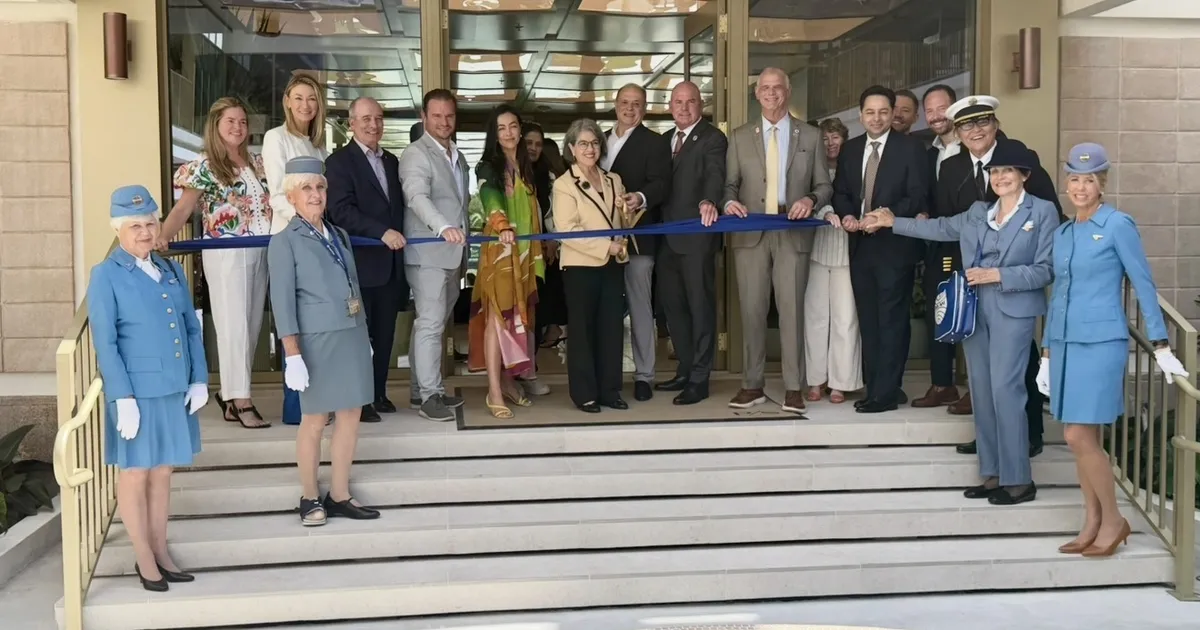
The event brought together the mayor of Miami-Dade County, Daniella Levine Cava; Congressman Carlos Giménez; the executive director of Miami International Airport (MIA), Ralph Cutié; as well as brand executives and representatives of the aeronautical sector.
Located in the 5000 NW 36 Streetthe property occupies the former regional headquarters of Pan Am, considered for decades one of the most influential organizations in global air transport and a key player in the development of connections between the United States, Latin America and Europe.
The 34,000 square foot space incorporates five suites for exclusive use, a lounge for individual and corporate passengers, rest areas, gastronomic proposals, unlimited drinks and direct access to security and immigration controls, with the purpose of reducing waiting times and simplifying pre-boarding procedures.
During the ceremony, Ralph Cutié highlighted that the city becomes part of the small group of American airports that have a facility of these characteristics.
“We are one of only four airports in the entire United States that has a facility like this,” he said.
The recovery of the structure also coincides with the approach of the centenary of MIA, scheduled for 2028, a date that the authorities consider key to rescue part of the heritage linked to the evolution of air transport in the region.
“In addition to offering a great experience for passengers, this project allows us to preserve and maintain part of our history. The airport will turn 100 years old in 2028 and preserving this building is an important part of that legacy,” he said.
A new model for those who fly on commercial airlines
Felipe Murcia, general director of PS Miami, explained that the initiative seeks to position itself between the characteristic attention of executive aviation and the traditional operation of airlines.
“PS bridges the gap between traveling on a private plane and traveling on a commercial airline,” he said.
As detailed, customers continue to use companies such as American Airlines, Air France and other carriers, but carry out pre-flight procedures from PS facilities, avoiding conventional terminals.
The proposal includes assistance with luggage, internal transportation, preferential access to security checkpoints and direct coordination with airlines and government agencies.
“Instead of facing traffic, lines and the usual stress of an airport, the passenger arrives here, we take care of everything and take them directly to their plane,” explained Murcia.
For those who opt for the suites, the program incorporates individually designed spaces, included food and beverages, spa treatments and other personalized attention.
“Each suite has its own personality. The idea is that the client always has the same level of attention, but a different proposal on each visit,” he commented.
When it’s time to board, customers are escorted through special access coordinated with the Transportation Security Administration (TSA).
“As we have a unique process, the security check usually takes between one and two minutes,” he said.
Subsequently, they are transferred in BMW vehicles directly to the aircraft.
Less time in immigration and customs
One of the main attractions of the concept is aimed at those arriving from abroad.
According to Murcia, the system includes picking up people directly from the plane and facilitating the procedures for entering the country within the facility itself.
“Instead of having to walk to immigration and customs, we pick up the passenger directly from the plane and process their entry into the country through our own immigration and security team,” he said.
The organization hopes to soon complete the necessary certifications to fully expand this modality in this region.
A new stage for an aviation icon
The selection of the former headquarters of the historic carrier added a symbolic component to the initiative.
The renovation respected original elements of the construction, recognized as a Miami-Dade County historic site, including insignia of the defunct airline company, decorative panels and reflecting pools that were part of the property’s original design.
“Pan Am was one of the first airlines to fly to Latin America, the first to cross the Atlantic and also the Pacific. Being in this building, with so much history and symbolism, is something incredible,” said Murcia.
The restoration also incorporated works by artists with ties to South Florida, integrating local cultural references to a place that for decades was part of the city’s aeronautical development.
Expansion in a strategic market
The landing in Florida represents PS’s fourth location in the United States, after Los Angeles, Atlanta and Dallas-Fort Worth.
Murcia recalled that the initiative began in California and required several years of coordination with airport authorities and federal agencies before becoming operational.
“Miami was a natural step for us due to its international importance and its connection with Latin America,” he said.
Currently, the terminal employs around 100 people and has the capacity to manage between 120 and 140 daily movements, although the company plans to expand the number of suites in the coming months.
The brand also plans to launch PS Direct later this year, a door-to-door program that will connect its customers to their residences or hotels through coordinated transfers to and from the aircraft.
For airport authorities, the arrival of PS represents much more than a new alternative for those seeking greater comfort and privacy when traveling. It also involves the recovery of a structure that remained underused for years and is now once again integrated into the city’s aerial activity.
With the reopening of one of the most representative spaces of South Florida’s aeronautical legacy, the firm is committed to combining heritage, personalized attention and operational efficiency in a terminal that continues to expand its international reach.
