
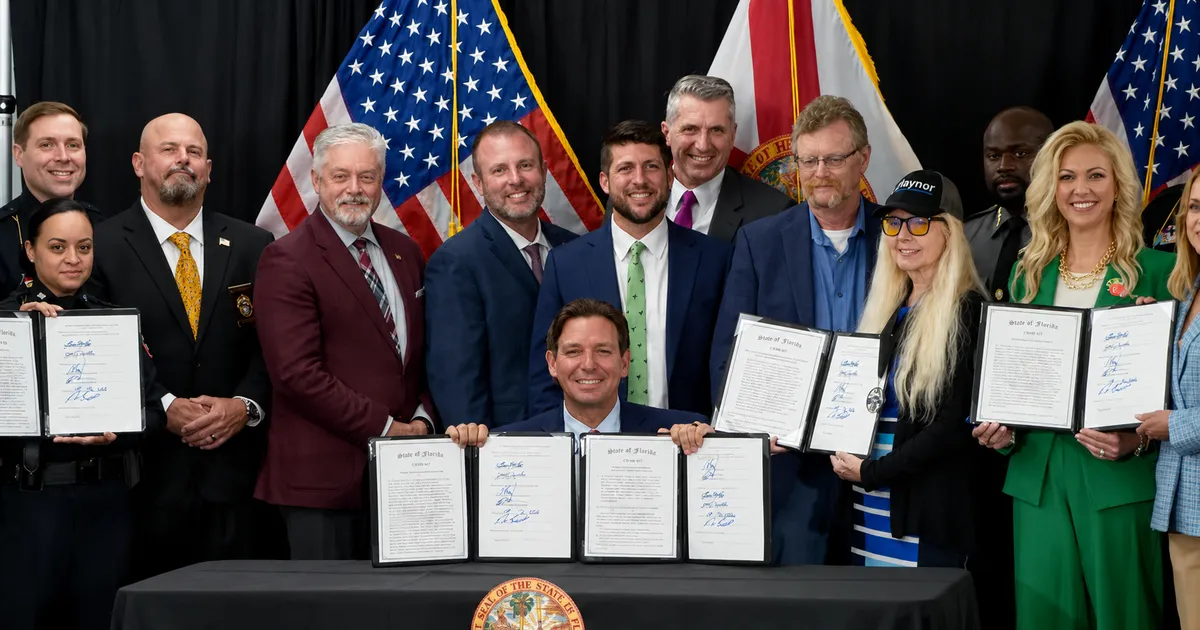
MIAMI.- Florida Governor Ron DeSantissigned five bills aimed at strengthening public safety, toughening penalties against repeat offenders, combating new drug-related threats and providing greater tools to the state’s law enforcement agencies.
During a ceremony held this Tuesday in Winter Haven, Central Florida, DeSantis said the new rules reinforce the “law and order” policy that has characterized Florida during his administration.
“Today I am proud to sign five laws to improve public safety and support law enforcement,” the governor stated. “These measures combat dangerous drugs, strengthen supervision of repeat offenders, dismantle criminal gangs, support police and ensure violent criminals face serious consequences.”
DeSantis argued that Florida has reached the lowest crime levels in half a century and attributed those results to a combination of increased resources for police, recruitment incentives and stricter laws against those who commit violent crimes.
New penalties against xylazine and nitrous oxide
One of the initiatives signed was SB 432, which establishes penalties for trafficking in xylazine, a substance known on the streets as “tranq,” increasingly used to adulterate illegal narcotics.
The governor explained that the legislation also toughens penalties for those who market drugs using packaging or presentations designed to attract minors.
In addition, it incorporates provisions known as “Meg’s Law,” in honor of a young Floridian who died after battling an addiction to nitrous oxide.
“We have led the nation in taking decisive action against new drug-related threats, and we continue to do so with this law,” DeSantis said.
Greater surveillance on repeat offenders
SB 1332, another of the regulations signed by the governor, strengthens Florida’s Habitual Offender Registration Law and requires the most dangerous repeat offenders to register in person with the sheriff’s office in their jurisdiction.
The rule requires reporting changes in residence, employment, vehicles and telephone numbers, in addition to completing annual in-person records.
“Some offenders simply commit crimes again. This legislation requires them to provide more complete information and improves coordination between law enforcement agencies and the Department of Corrections,” the governor explained.
According to the state administration, the measure seeks to ensure that information about these violators is more accurate and increase penalties for non-compliance.
Update anti-gang laws
Another law enacted was HB 429, which modernizes the state’s criminal gang statutes.
The new legislation allows social media posts, online admissions and other digital evidence to be used to demonstrate membership or active participation in criminal organizations during judicial proceedings.
DeSantis said gang violence remains a significant threat and the law adapts investigative tools to today’s technological reality.
“This legislation updates the law to reflect how gang involvement is proven in the digital age,” he said.
The governor also mentioned international criminal organizations such as the Aragua Train when explaining the need to strengthen the mechanisms for identifying and prosecuting criminal groups.
Strengthens protection for law enforcement officers
SB 156, called the Officer Jason Raynor Act, honors the Daytona Beach police officer killed in the line of duty.
The law increases penalties for those who attack, injure or kill members of law enforcement and limits the possibility of justifying the use of force against agents who act in good faith during an arrest.
“If you attack a law enforcement officer in the state of Florida, be prepared to be held accountable,” DeSantis warned.
The legislation also increases penalties for assaulting police officers, violent resistance to arrest and involuntary manslaughter against officers and other public safety officials. “If someone believes an officer acted improperly, take them to court, don’t confront them.”
More severe punishments for repeat offenders
The fifth measure, SB 436, expands the provisions that allow certain assault crimes to be elevated to the category of felonies when there is a violent criminal record.
The law incorporates as an aggravating circumstance a previous conviction for violently resisting an officer, which will allow more severe punishments to be imposed on repeat offenders.
“These people will now be held accountable in a much more significant way,” the governor said.
Support from prosecutors and police forces
Florida Attorney General James Uthmeier called the measures critical tools to keep crime rates down.
“Keeping dangerous predators and drugs away from our children is common sense,” he said.
For his part, the commissioner of the Florida Department of Law Enforcement (FDLE), Mark Glass, assured that the new laws will provide agents with additional resources to confront criminal organizations and protect both residents and the millions of visitors who come to the state each year.
With these five new regulations, Florida continues to reinforce a legislative agenda focused on toughening sentences, supporting law enforcement and combating organized crime and criminal recidivism.
(email protected)
