
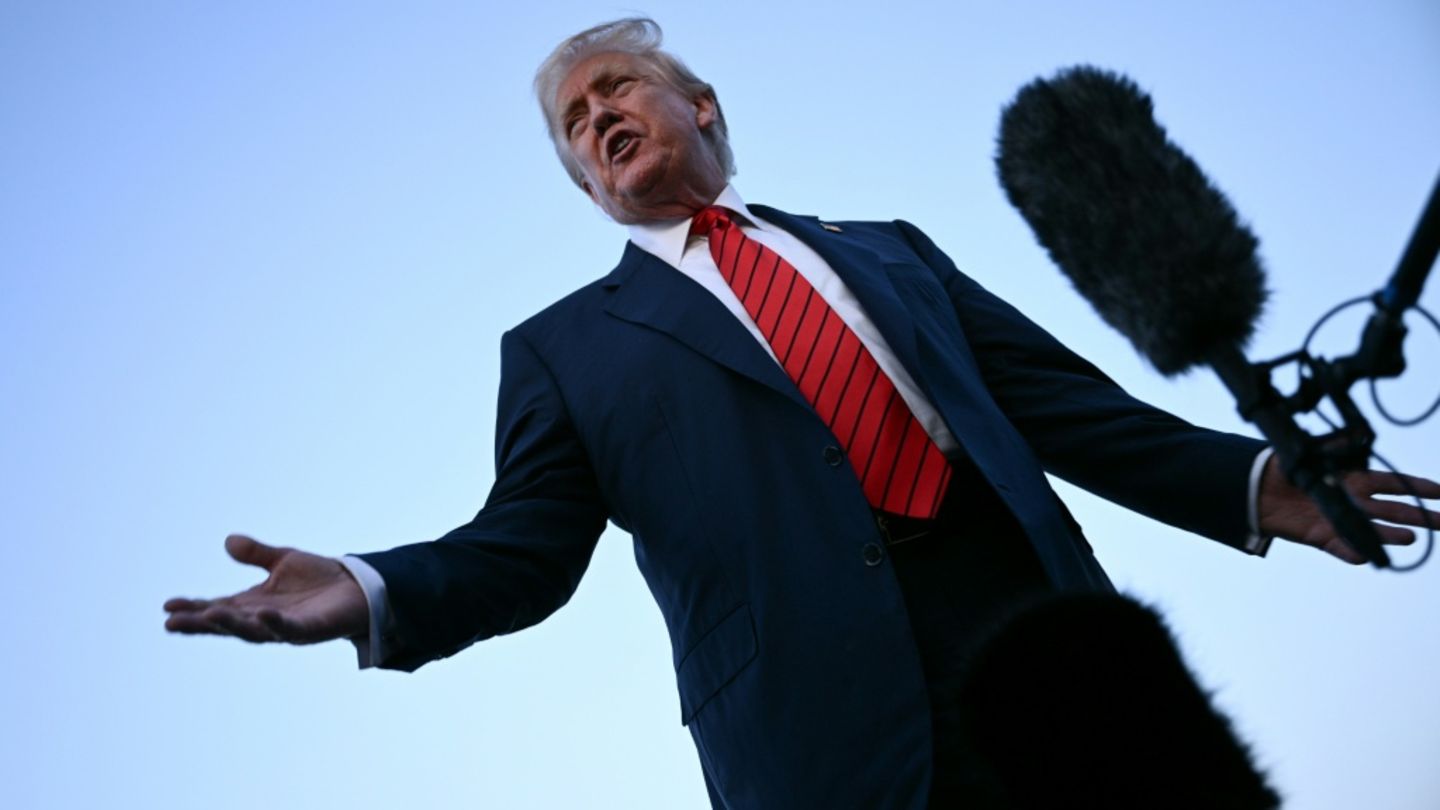
Trump said on Friday to reporters in the White House about the reporting of many media about his government: “You will take a great story and you will make them bad.” This concerns 97 percent of reporting on him and his government. However, Trump did not explain to what extent such critical reporting could be “illegal”.
In the area of military reporting, journalistic work in the USA is made massively more difficult: With the new guidelines of the Pentagon published on Friday, the publication of all information about the military must previously be approved by an official. This aims to prevent the publication of information that does not come from the official channels, but from anonymous sources.
The journalists accredited in the Pentagon must commit themselves to compliance with the new provisions in an affidavit – otherwise they are at risk of withdrawing their accreditation.
The Washington Journalist Association National Press Club criticized the new Pentagon guidelines as “direct attack on independent journalism exactly where an independent look is most important: in the US military”.
Trump has been going to the White House in January in an unprecedented manner on various fronts against critical media that, according to his presentation, spread lies and false information. A few days ago, he sued the New York Times newspaper due to alleged defamation for a compensation of $ 15 billion (around $ 12.7 billion).
The Organization Reporter Without Borders (RSF) complains of massive tightening of the procedure against Trump-critical journalists and media since the murder attack on ultra-right activists Charlie Kirk on September 10th. Since Trump’s taking office there has been “steps towards the restriction of freedom of the press”, “but since the murder of Charlie Kirk we have been seeing a real escalation,” said the RSF managing director of the German Section, Anja Osterhaus, in an interview with the AFP news agency.
So Trump not only celebrated the discontinuation of Jimmy Kimmel’s late night show, who had accused Trump’s Maga movement (makes America great again) to instrumentalize the murder of Kirks politically. “In addition, the president has proposed to check a license with practically all TV channels because he feels too strongly criticized. It is an extreme step for the government of a democratic state to make such suggestions,” said Osterhaus.
A few days ago, the ABC broadcaster had off the show of the satirist Kimmel and justified this with its statements about the Kirk attack. Trump praised Kirk as a “martyr”. A funeral service for Kirk will take place in Glendale in the US state of Arizona, to which Trump and his Vice JD Vance are expected.
In July, the broadcaster CBS had already announced the end of the “late show” of satirist Stephen Colbert. He is also a decisive Trump critic. Also in July, Trump submitted a billion dollar lawsuit against Medienmogul Rupert Murdoch and the “Wall Street Journal” after the paper reported on his previous relationships with the sex offender Jeffrey Epstein. The broadcasters ABC and CBS News also got into Trump’s visor and agreed to him in millions of payments.
Osterhaus said the wave of lawsuits against the media “can only be understood as an attempt at intimidation”. There are many indicators that the United States will continue to slip on the freedom of the press. The United States is currently in 57th place in the RSF ranking – well behind Germany, which is occupied by eleventh place.
Osterhaus also commented on the announcement of the US government to significantly restrict the Visadauer for foreign journalists. “We have to fear that this is also a conscious means of converting correspondents who critically report on the US government, because then they may not get an extension of their visas after eight months,” she said.
