
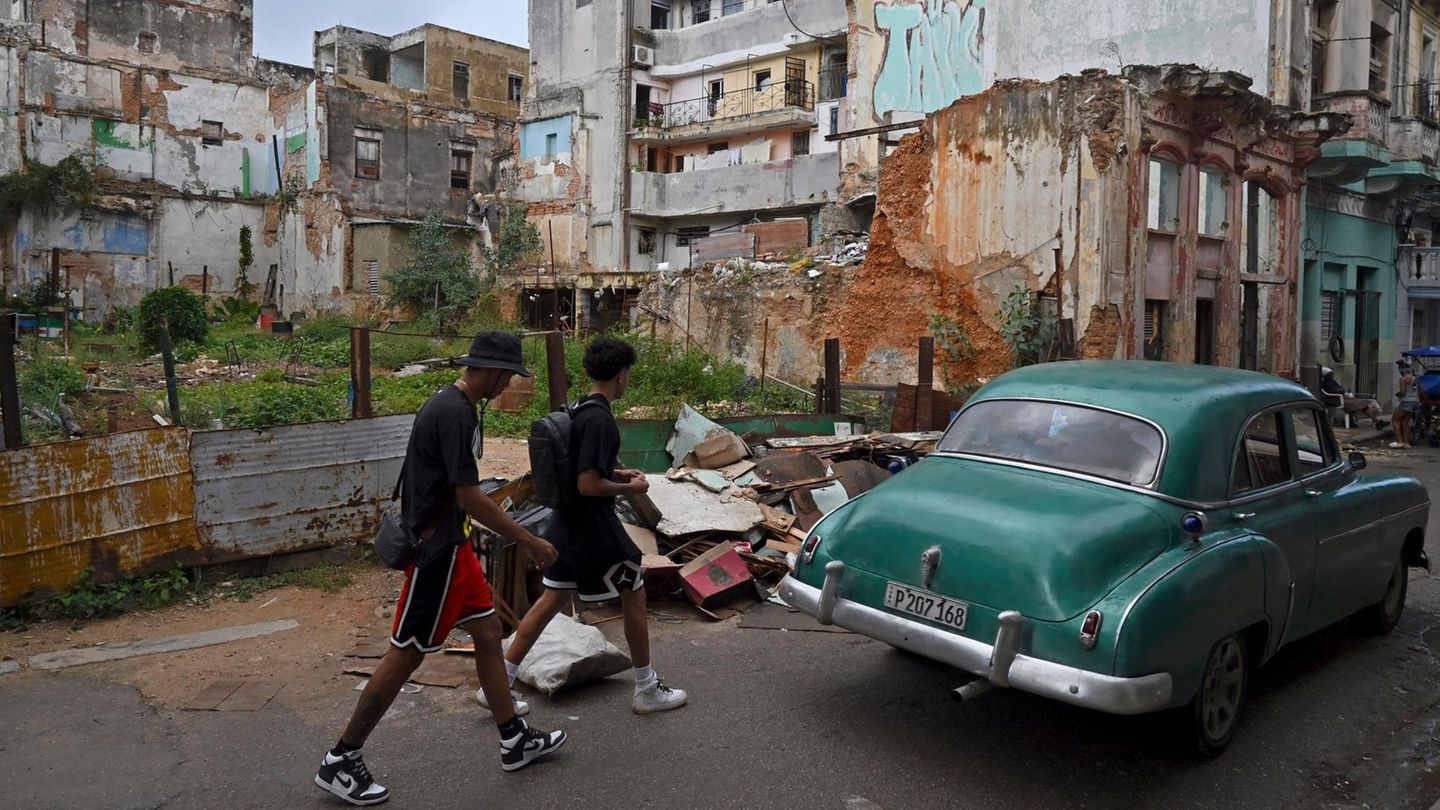
66 years after the revolution, the light goes out in Cuba. Every day. All over the country. When entire quarters of Santiago de Cuba turn into ghost towns in the evening, Camilo Garcia pulls his headlamp upside down, clapping and cheering – like his neighbors. Galgen humor in Cuban. In other quarters, they loudly clasp loudly with pots and pans as a sign of the protest. The 52-year-old grabs a bottle and meets with friends on the dark street, where they play domino in the weak glow of their funks. A piece of normality in all the chaos.
Sometimes the power failure takes a few hours, but usually more than half the day. The greater the distance to Havana, the more disastrous the care. And Santiago, the second largest city in the country, where Fidel Castro announced the victory of the revolution over the Batista regime on January 1, 1959-Santiago is almost 1000 kilometers from the capital. Garcia was also proud of the revolution, standing behind the slogans, which were emblazoned on huge posters next to the portrait of the “Comandante”. Even now, a good eight years after his death, they still shape the street scene: “Always until victory!”, “A better world is possible” or simply: “Cuba is fidel”. But the words are faded like the portraits.
“Since Fidel Castro has been dead, it has been going downhill with Cuba,” says Garcia bitterly, who in reality is called differently. “The economy is broken, the regime is corrupt. And the people notice that,” says Garcia, who has to fear that he is put into jail for sentences like this. When tens of thousands of Cubans took to the streets in July 2021, the regime had the protests stick down. There are still more than 1100 political prisoners. “Anyone who says something against the regime lives dangerously,” whisper Garcia, who works as a car mechanic, taxi driver and tourist leader. Like many Cubans, he also has several jobs to make ends meet. But another shoulder look – and then it just gushes out of it.
“There is hardly any food on the island. The subsidized foods are just enough for three days a month,” he complains. The state achievements would have halved, the prices multiplied. And sugar, even sugar, with which Cuba once supplied the world, had to be imported to horrendous prices. “One kilo costs 800 pesos,” he outraged. That corresponds to almost seven euros in the official exchange rate. The same applies to rice. “Most Cubans, including doctors and academics, earn less than $ 30 a month. How is that supposed to work?”
No oil, no electricity
Cuba has already experienced some crises. But this time it is different. Once the Sugardaddy Soviet Union was the nation, Cuba the alimented outpost at the gates of the United States. After the collapse of the Eastern Bloc, a decade of depression followed until the early 2000 Russia jumped into the breach and even the socialist brother state of Venezuela. But this time such help is not to be expected. Russia and Venezuela have their own problems. Havana has to find a way out of the crisis herself, the communist one -party system wants to survive. And the people are getting more and more angry.
