
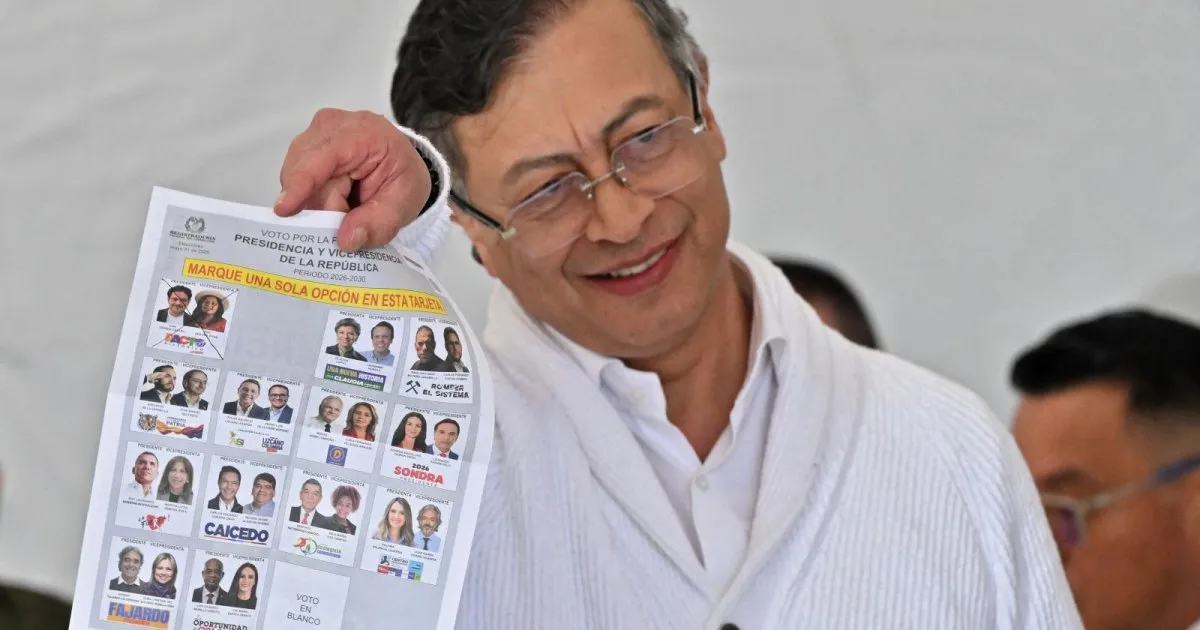
BOGOTA.- A strong controversy has broken out in Colombia regarding the decision of the president of the Commission of Investigation and Accusation of the House of Representatives, Gloria Arizabaleta, who ordered this Wednesday the “provisional suspension” of the Colombian president, Gustavo Petro, while she investigates him for his participation in the electoral campaign, but hours later she took a step back with the ordinance.
The congresswoman, a member of the Historical Pact, the same party as Petro, ordered the president to be “provisionally suspended from the exercise of office” until June 21 at 4:00 p.m. local time (9:00 p.m. GMT), when the polls for the second round of the presidential elections close. But then he backed down, which has caused a political and legal storm in Colombia, reports the Colombian newspaper El Tiempo.
Arizabaleta argued his decision that he can order the provisional suspension of the president “as long as serious evidence is evidenced that allows establishing that the permanence in the position, function or public service makes possible the interference of the author of the failure in the investigation process.”
The order dictated that, while the suspension lasted, Vice President Francia Márquez remained in office.
The first order filed by Representative Arizabaleta opened the door for the case to immediately reach the Senate, something that is not contemplated in the law, so it would be totally unconstitutional. Now, with the addition, it is made clear that the procedure is that the suspension measure is first discussed by the Commission of Accusations and, if it is successful there, it could reach the Senate, which would have the final say, the Colombian media points out.
Who can suspend a president?
Article 194 of the Colombian Constitution says that a president is only disqualified for “his death, his accepted resignation, dismissal decreed by sentence, permanent physical incapacity and abandonment of office, the latter two declared by the Senate.”
The House Impeachment Commission, made up of sixteen congressmen from different parties, is the only body that can investigate a president—and other members of the House of Representatives—. This commission receives complaints or preliminary investigations, collects evidence and decides whether to file charges and prepare a draft indictment.
If so, the Commission recommends impeaching the president or another senior official and the case goes to the House of Representatives (Lower), which has to vote and approve the accusation and from there it goes to the Senate (Upper), where it undergoes the same process. So, if he passes those two votes, the president is removed.
Legal arguments
The Public Law lawyer, Pablo Betancur, explained that the president in Colombia has jurisdiction and, therefore, cannot be sanctioned by the Attorney General’s Office or the Prosecutor’s Office and the body in charge of sanctioning a president is precisely the Investigation and Accusation Commission of the House of Representatives.
It is an unprecedented measure with a president, but the issue of suspensions is already known to Petro.
Betancur reported that when the current president was mayor of Bogotá he was suspended from office. “In 2014, he created an environmental crisis in the capital by replacing the companies that had the garbage collection service; the then Attorney General, Alejandro Ordóñez, dismissed him and disqualified him for 15 years.”
Due to the intervention of the Inter-American Commission on Human Rights, the suspension was lifted.
“That is why he was able to compete in the elections in which Iván Duque was president. As he came in second place in those elections, he secured a seat in the Senate where he would remain until 2022,” Betancur said.
Constitutional procedures
The jurist confirmed that in Colombia only the Impeachment Committee of the House of Representativesthat is, the Congress of the Republic, is the body that can direct the actions.
From the Impeachment Commission of the House of Representatives it passes to the Senate Instruction Commission and it is the Senate that ultimately makes the decision.
“It is a completely different and special regime for the president of the Republic and it is unprecedented in the sense that it is the first time that the president has been suspended,” Betancur said.
“A lot of smoke”
The former presidential candidate, Paloma Valencia, said on her social networks that “an order was filed to suspend Gustavo Petro, but the reality is that for it to move forward there would have to be a vote.”
He added that the Impeachment Commission cannot suspend the president. “A lot of noise and a lot of smoke, but the question is: who benefits from this?” questioned Valencia, who announced his support for the conservative candidate Abelardo de la Espriella for the second round of elections on June 21.
