
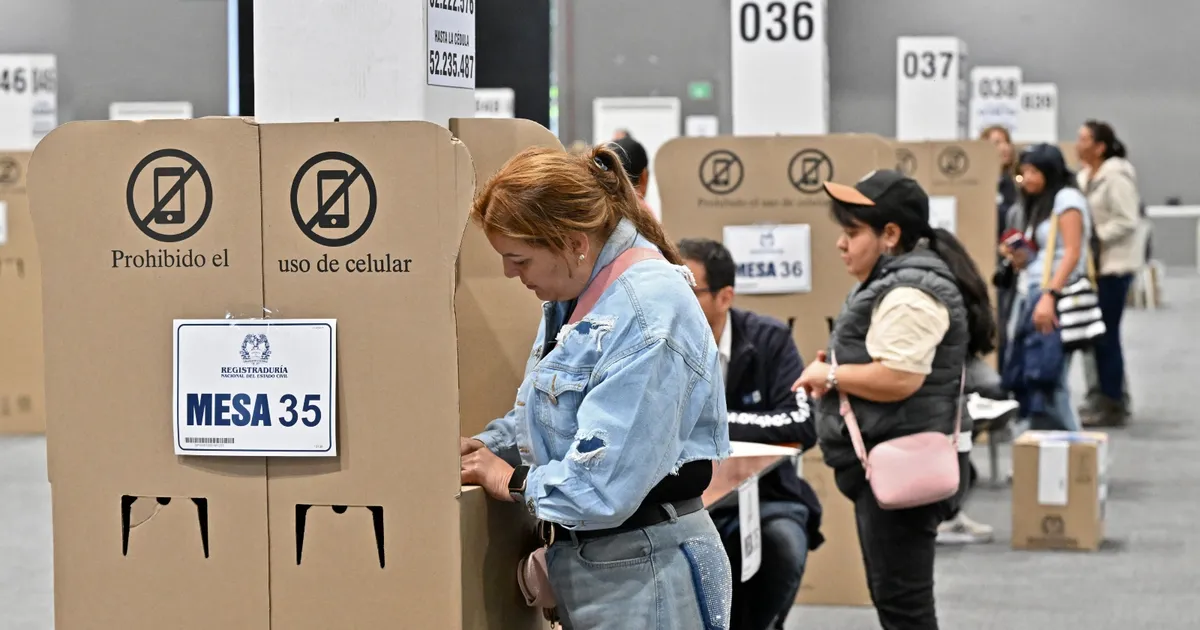
“The vote must be free and without pressure,” said Gustavo Peterthe first left-wing president in the history of Colombia.
Dressed in white and accompanied by one of his daughters, Petro opened the election day.
Without the possibility of re-election, Petro will leave power with high popularity among the lower classes after reducing rates of monetary poverty, hunger, unemployment and expanding social programs in one of the most unequal countries in the world.
The pro-government senator Iván Cepeda (Historical Pact), 63, leads the voting intention. It proposes giving continuity to Petro’s policies in the midst of a fiscal crisis and an upsurge in violence.
At the handsome pole is the confrontational voice against the left of Abelardo de la Espriella, an eccentric 47-year-old millionaire lawyer who calls himself “El Tigre”, whose symbol is the military salute and who promises death or jail for gangsters.
The right-wing Paloma Valencia, an opposition senator sponsored by the powerful former president Álvaro Uribe (2002-2010)appears in third place.
According to the polls, no candidate will get enough votes to win in the first round, so it is expected a runoff on June 21.
The next president “may help us (…) to have some tranquility, some peace, because as things are, we are very nervous, there is a lot, a lot of conflict,” he tells the AFP María Eugenia Motato, a 57-year-old housewife, in Suárez, a municipality in southwestern Colombia plagued by violence from guerrillas and drug traffickers.
Security in elections
Election day will last until 9:00 p.m. GMT. The electoral authority expects to have results a few hours after closing and aspires to a reduction in abstention, which usually exceeds 40%.
The government deployed 408,000 members of the public force to guarantee security in the country with the world’s largest cocaine production.
The campaign took place in the midst of a climate of polarization and fear, with deadly guerrilla attacks, the assassination of a presidential candidate and refusals of the main candidates to participate in debates.
Between “extremes”
Abelardo de la Espriella points out with an anti-system proposal. It promises bombings, the strengthening of public forces and eliminating the tribunal that emerged from the peace agreement.
An admirer of the presidents of the United States, Donald Trump, as well as the Salvadoran Nayib Bukele and the Argentine Javier Milei, he proposes building 10 megaprisons and reducing the State by 40%.
“I am here (…) so that the left never returns to power and destroys the country,” he said on Saturday.
His campaign events were shows with fireworks and videos with artificial intelligence, in which he exhibited singing skills and gave belligerent speeches locked in a bulletproof capsule.
“We are going to many extremes” with both candidates, says Samuel Forero, an 18-year-old university student.
The United States is closely watching the elections, after the constant clashes between Petro and Trump thatthat threatened the relationship between two historically allied countries.
Washington blames the government for the rise in drug trafficking.
Experts consider that the organizations took advantage of the peace negotiations to strengthen themselves, in the last country in the Western Hemisphere with an armed conflict.
“Disruptive” government
Petro is the main protagonist of an election divided between those who support him and those who reject him. His government represented a break in a country governed by conservative elites for two centuries.
The former guerrilla who signed the peace in 1990 faced Congress, the courts, the prosecutor’s office and the central bank over their refusal to accept his reforms.
He had a “disruptive position,” says Juan Camilo Lozano, professor of Political and Social Sciences at the National University.
For the elections, Petro’s electoral base turned to Cepeda, son of a murdered communist politician and trained since childhood, due to exile, in socialist countries such as Czechoslovakia, Bulgaria and Cuba.
The philosopher and defender of human rights is committed to the “excluded”: victims of the conflict, indigenous people and peasants.
“Definitely overcoming poverty and ending social inequality, this will be the essential priority of our second government,” he said on Saturday.
The opposition criticizes him for being one of the architects of “Total Peace”, the policy with which Petro unsuccessfully tried to negotiate with the organizations that remained in arms after the agreement with the FARC guerrilla in 2016.
“When you come to vote you have that hope that things can change,” says Cristina Peña in Bogotá, a 50-year-old merchant tired of the “war.”
