
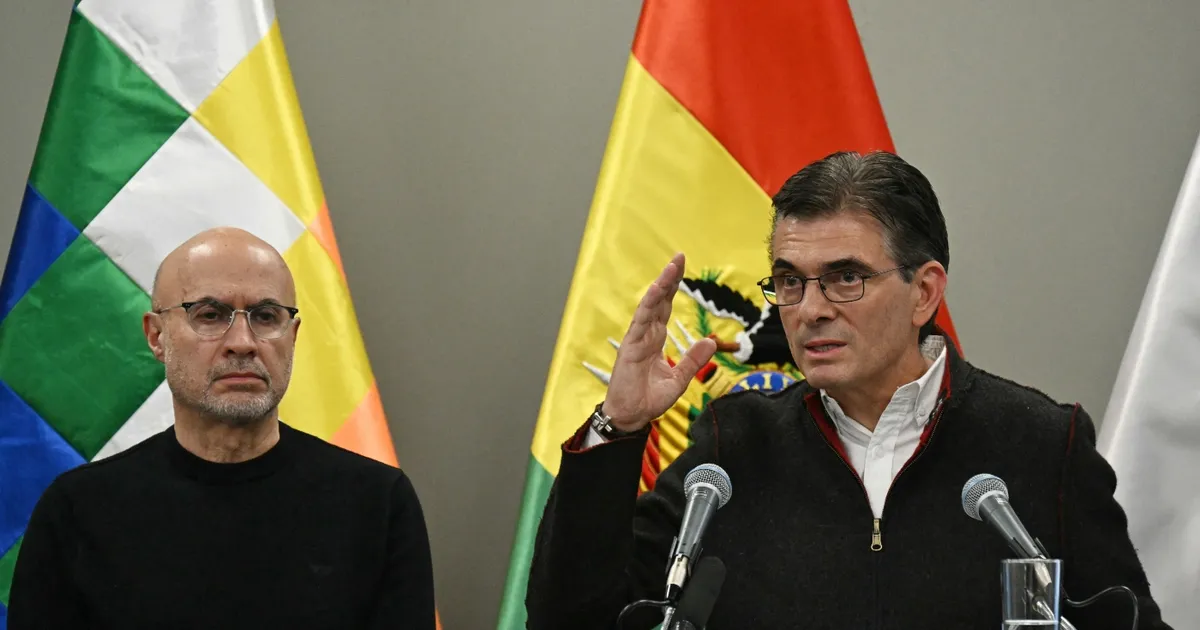
The situation that began as an uprising due to the decrease in the fuel subsidy, in recent weeks has spread to various unions, indigenous, social and mining groups, who express their discontent with the economic and political situation. The report is of more than a hundred detainees and a 24-year-old protester deceased.
The center-right president announced on May 25 a 50% reduction in his salary and that of the ministers. He said that the decision was made “as part of the effort and commitment to the country.” Paz earned 24,978 bolivianos, about 3,617 dollars.
“This is a problem about whether democracy in Bolivia is viable or not,” the president pointed out a few days ago. He asserted that “there are many internal and external interests in making this democracy fail and generating regional disorder.”
The leader rose to power after attracting working class citizens and sympathizers of the leftist Movement towards Socialism (MAS) who supported Evo Morales and Luis Arce at the time. In his election campaign, he promised “capitalism for all.”
The Bolivian Foreign Minister, Fernando Aramayo, denounced before the Permanent Council of the OAS that the protests seek the “alteration of the democratic order.”
According to the government, the demonstrations are organized by former socialist president Evo Morales, who is a fugitive from justice after being charged in a case for alleged trafficking of a minor.
Paz said, in an interview with Clarion, that Morales “is brutalized by power and will do everything possible to, beyond the deaths, beyond the confrontation, beyond destroying Bolivia, overthrow this democratic process, violate the constitutional order and generate a new favorable scenario for him and his organization.”
On May 26, the Bolivian Chamber of Deputies eliminated the rule that limited the president’s ability to apply states of emergency since 2020. The law had already been eliminated by the Senate.
The internationalist Elsa Cardozo emphasizes that the Paz government is at risk. “This is an extremely dangerous situation for democracy in Bolivia,” Cardozo tells DIARIO LAS AMERICAS.
He explains that governability in the country has been a complicated issue before 1982, when the democratic sequence began. He points out that Bolivia was a country with a long list of coups d’état, situations of instability and conflict.
He adds that after the return to democracy and, beginning this century, with the return of regimes far from liberalism, Evo Morales entered, who rose from Chapare with mobilizations, blocking roads, blocking roads, and the country, as is currently the case.
“Peace receives an economically complicated country, with a huge fiscal deficit without dollars, with problems financing social programs and subsidies. It is a difficult country to govern. He received a situation of material and institutional precariousness,” he points out.
In Cardozo’s opinion, the Bolivian president has not known how to handle the situation, he relied on his electoral victory and his slogans that seemed to clarify what he was going to do.
He indicates that there is a take advantage of radical groups “that do not have to be very large to cause major disasters.”
Cardozo considers that the compromised institutional situation requires the government and those elected as senators and deputies to ensure that the situation does not overflow. At the same time, he proposes, to ensure that policies respond constitutionally to the crisis.
He believes that, probably, “a mediation that is very committed to the tranquility of Bolivia and its governability is needed, which, by the way, does not involve Gustavo Petro or Colombia.”
He sees the mediation he refers as more oriented towards groups such as the Church or the Cross. The researcher also maintains that a clearer diagnosis of the situation and the options ahead must be presented, not an easy task in such an exacerbated climate.
At the same time, it speaks of the need for more balanced positions in which dialogue is encouraged.
Calls to dialogue
The Ombudsman’s Office, the Catholic Church and human rights activists called for dialogue between the government and workers.
“We have never won with confrontation. “The methodology of dialogue is much braver than the confrontation of weapons,” the president said.
Bolivian analyst Alex Contreras tells DIARIO LAS AMERICAS that the government talks with some leaders who have been with the governments in power and who do not solve the problem. “Beyond having called leaders who are leading these mobilizations, Rodrigo Paz has to have a true dialogue,” he maintains.
Contreras highlights that the main leaders of the organizations that called for the mobilization have an arrest warrant, among them from the Bolivian Workers’ Central (COB), which makes it impossible for them to talk.
On May 27, Paz headed the Economic and Social Council without mobilized sectors demanding his resignation. The Vice Minister of Autonomy, Adrián Oliva, stated that Around 250 social organizations were invited to the meeting.
“The government has to look for political solutions to a conflict that, unfortunately, has already become political, it has to seek dialogue with the democratically elected representatives of their sectors. Otherwise, the underground leaders are calling to continue and radicalize the mobilizations,” says Alex Contreras, who until 2008 was spokesperson for the Morales government.
Does not consider external mediation necessary. “I see that what has happened in these six months of Paz’s government is that, firstly, the campaign promises have not been fulfilled. Secondly, the sector that has supported him in the first and second rounds has betrayed him.”
“What is needed is the political will of the Bolivian government,” underlines.
The analyst emphasizes that the 19 years of MAS government left a country bankrupt, “but precisely regarding that crisis, economic and social measures had to be implemented in accordance with the national reality and with the Bolivian population in mind.”
For his part, Ernesto Estremadoiro, journalist for the newspaper The Duty of Bolivia, indicates that the origin of the protest is the march against Law 1720, which authorized the National Institute of Agrarian Reform to carry out the voluntary conversion of the category of titled small rural property to that of medium-sized property.
Estremadoiro tells DIARIO LAS AMERICAS that the law generated susceptibility in those who have community titles. “Credit to the agricultural sector is very limited in Bolivia. Producers have to obtain credit through commercial houses that sell inputs and seeds or with the same factories to which they sell the grain that finance their production. This is especially in the eastern area,” he points out.
The journalist affirms that in the country there is a very bureaucratic state system.
He maintains that, in the face of the economic crisis, “everyone expected there to be a change, everyone was even willing to make the sacrifice. Now they have said that the change is very gradual.”
Preserve democracy
Former President Evo Morales pointed out on May 24 that Paz “has two paths: a suicidal decision, militarization, or (…) pacification, transition, election in 90 days.”
Morales also accused the United States of “meddling.”
“What has to be preserved, beyond the government of any president, is democracy and what Evo Morales is proposing is totally unconstitutional,” emphasizes analyst Alex Contreras.
He highlights that the government of Rodrigo Paz “he still has four years left and a half to manage”.
The analyst also indicates that there is an urgent need for a change of direction in government management and a change in the political team, where the majority are technicians and technocrats. “It’s not bad, but we need a political team that can resolve conflicts and also prioritize the culture of peace,” he adds.
On May 21, President Paz appointed Williams Bascopé as the new Minister of Labor.
International support
The United States and 13 countries of the Shield of the Americas alliance expressed their “deep concern” about the protests on May 21.
“We support the government of Bolivia and urge protesters to express their demands peacefully and respect democratic institutions,” explained the signatories of a statement distributed by the State Department.
The statement also warned: “We cannot allow the overthrow of democratically elected leaders in our hemisphere.”
In addition to the United States and Bolivia, the signatory countries of the statement are Argentina, Chile, Costa Rica, Dominican Republic, Ecuador, El Salvador, Guyana, Honduras, Panama, Paraguay and Trinidad and Tobago.
For its part, the Democratic Initiative of Spain and the Americas (IDEA Group) expressed its concern on May 18 about the protests and blockades in Bolivia. They warned about possible risks to the democratic stability of the country in the midst of the indigenous, peasant and union mobilizations.
@snederr
