
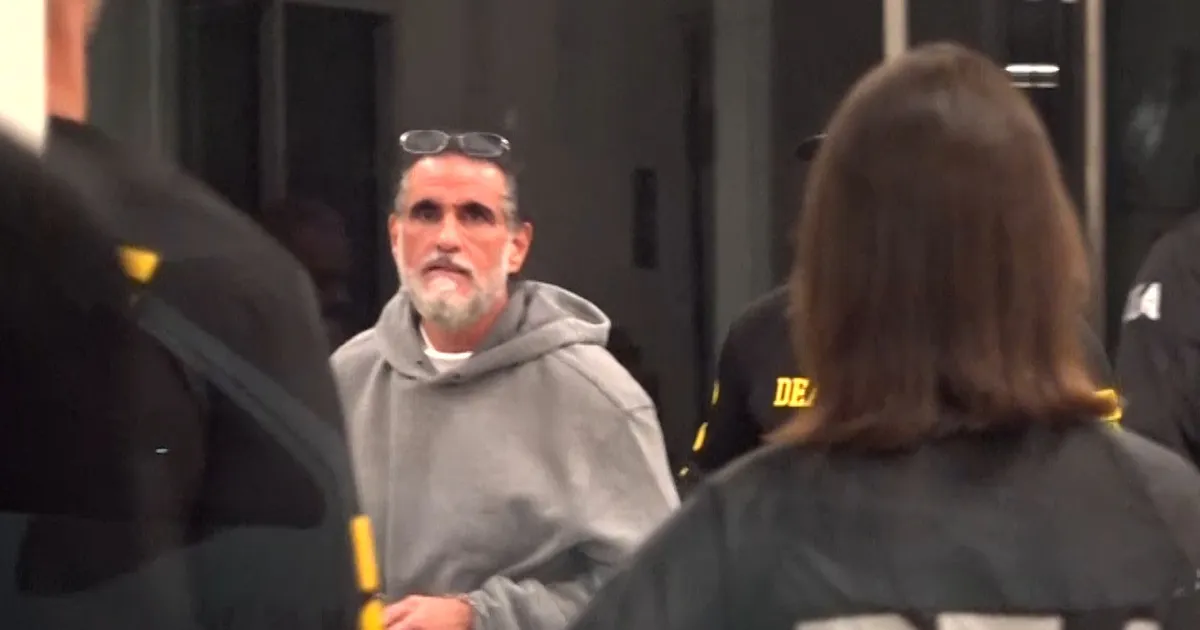
The transfer of Saab by US federal agents from Caracas to the Opa-locka airport, in Miami-Dade County, according to journalists, brings new contradictions to the table in the Chavista discourse about Saab.
It also raises questions about who could be the next member of Chavismo to be handed over, after more than two decades in power.
The businessman appointed Minister of Food and diplomat during the regime of the deposed dictator Nicolás Maduro was deported this May 16 by Venezuelan authorities at the request of the Donald Trump government, after they had kept him in police custody in a secret location since last February, after the capture of Maduro by a US military operation in the country at the beginning of the year.
Although the crimes he would have committed are not specified, Saab could not be prosecuted for the same acts of money laundering for which he was arrested and later pardoned by the Joe Biden administration in December 2023, for a prisoner exchange.
Saab, Maduro’s former Minister of Industry and National Production after his arrival in the country, has been investigated since February by the US prosecutor’s office for bribery conspiracy to import food since 2016, according to recent reports.
However, the former official would be key in the investigation into the financing of drug trafficking and money laundering operations in the Maduro regime, given that he was the businessman responsible for managing the deposed dictator’s money sources for years.
Deportation of Alex Saab
Saab’s deportation measure was adopted “taking into consideration that the aforementioned Colombian citizen is involved in the commission of various crimes in the United States of America, as is public, notorious and communicational,” said the SAIME in a statement published on Instagram.
The figure of deportation would be an aseptic formula that leaves out the responsibility of the Foreign Ministry, according to experts.
The fact that Caracas has handled the case of Alex Saab as a ‘deportation’ and not as an extradition, is due to the constitutional prohibition of extraditing Venezuelans, since the regime gave him citizenship after being pardoned by Biden and incorporated into the Maduro regime, explains lawyer Miguel Ángel Martín, an expert in international affairs.
“Talking about ‘deportation’ allows him to avoid formally acknowledging that he handed over one of the men closest to Chavismo’s financial apparatus to American justice,” he details, after highlighting the political and legal formula to reduce the internal cost and protect the official narrative.
“In practical terms, although legally they call it that, politically the effect is similar to that of a negotiated delivery,” he stressed.
Contradictions
Furthermore, the fact that it was Saime, the Venezuelan identification and immigration agency, would not compromise Rodríguez’s management of his diplomatic policy. They would have revoked Venezuelan nationality but that has not been officially reported.
“The deportation implies that he does not have citizenship, that the naturalization was annulled,” said retired general Antonio Rivero.
This action demonstrates contradictions in Chavismo authorities who defended dual nationality and Saab’s reputation in the past, according to various specialists on the social network X.
Jorge Rodríguez, president of the National Assembly, referred to the businessman as a “hero” in 2023, according to a video broadcast on the networks.
Also Félix Plascencia, current head of Venezuela’s diplomatic mission in the US, defended Saab from his arrest in Cape Verde, and considered it “a violation of international law and fair process of a Venezuelan diplomatic official who is also part of the dialogue table.”
After Alex Saab, who?
After the deportation of Saab, who this week must be officially presented before the prosecutor’s office, the question is whether this step opens the delivery corridor of members of the Maduro regime, now with Rodríguez at the head of Venezuela, to US justice.
This, although what would prevail is the existence of federal charges for which they would be required.
“The Saab case leaves a very delicate signal for the entire Chavista elite: even figures who seemed untouchable can end up being used as a bargaining chip when political circumstances or correlations of force within Venezuelan power change,” says Martín.
After commenting that figures who still retain institutional, military or political control, such as former Defense Minister Vladimir Padrino, “have a much higher level of protection as long as they remain part of the core of power,” he distinguished the case of Minister Cabello.
“The case of Diosdado Cabello is different because he continues to be one of the main centers of power within Chavismo. Although there is a reward offered by the US and accusations linked to drug trafficking, his situation does not depend only on the judicial file, but on his real political weight within the system,” he says.
“As long as Cabello maintains political control, influence over security structures and capacity for internal mobilization, it is difficult to imagine a surrender or deportation similar to that of Saab,” he points out.
Between the US and Venezuela
A surrender or an extradition request for them would not be proposed or at least it is not known at the moment, highlights retired Venezuelan general Antonio Rivero, former security specialist officer.
“It is difficult for a conversation to take place between Rodríguez and the US about a possibility, a covert procedure, without Cabello’s knowledge, as Minister of the Interior who manages all possible intelligence sources. He would have to be dismissed first,” he explains and adds: “Neither Cabello, nor Tareck El Aissami nor Raúl Gorrín can be officially handed over to the US, because it would be contrary to the Constitution, unless they are unaware of it.”
