
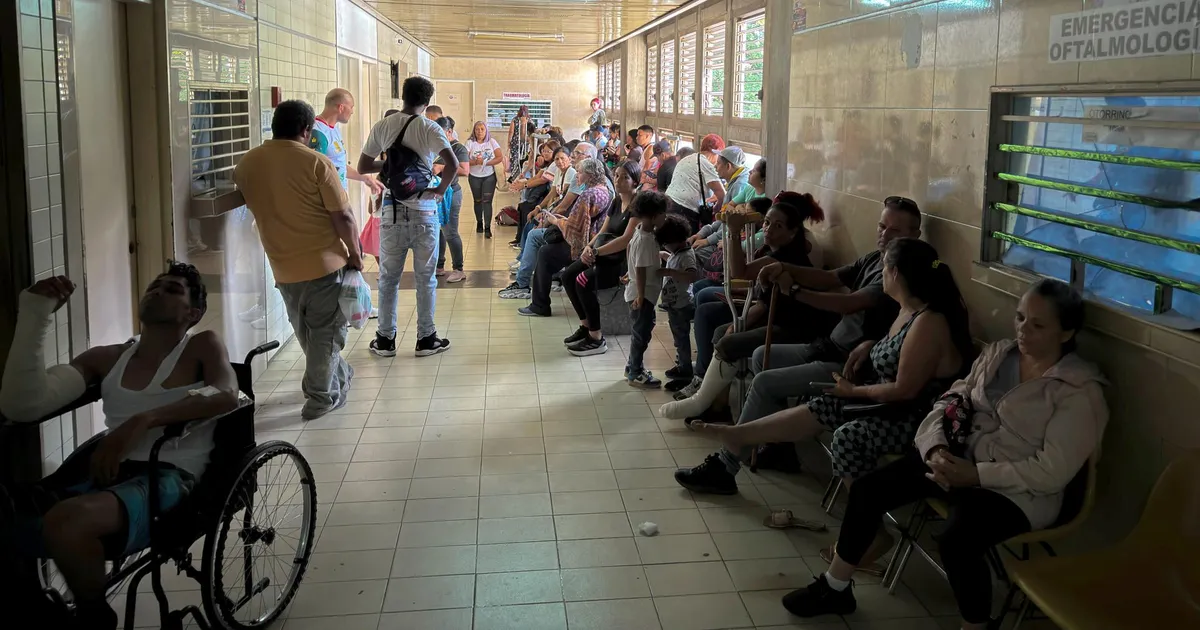
CARACAS – A workshop dedicated to the manufacture of prostheses in Caracas is preparing to care for the amputees left by the double earthquake in Venezuela, and to this end it has established an alliance with a group of foundations that seeks to attract and finance the largest number of these patients.
There are still no official figures on earthquake-related amputees. However, There could be at least 100 or 200, according to estimates based on data provided by doctorssaid Bianca Dámaso, part of this workshop called Orthoprotécnica.
She and her father, the founder of Ortoprotécnica, will offer prostheses at lower prices than usual in alliance with Fondo Humanitario 77, a project recently created by the CIREC foundations of Colombia and the Venezuelan Juan Pablo Dos Santos and Hospital Ortopédico Infantil foundations.
The three organizations want to raise two million dollars to care for the amputees left by the earthquake, but also for those who lost a limb before, taking into account the cost of prostheses.
Complexity
These pieces can be worth between 3,500 and 25,000 dollars, depending on their complexity, Dámaso explained, in a country where there is no mass access to credit, the minimum wage is less than a dollar a month and a public worker earns up to 240 dollars a month at the official exchange rate through government bonuses.
In addition, an amputee has to be cared for for life: children need replacement parts as they grow and adults require adjustments and maintenance of their prostheses.
Phantom limb
The collapse of structures during earthquakes caused crushing injuries, which were aggravated by remaining exposed for hours or days in contaminated environments.
As a consequence, many affected people required surgeries and others suffered amputations, explained Yesy Medina, a trauma doctor at the Domingo Luciani Hospital in Caracas.
He also highlighted that many patients suffered rhabdomyolysis due to crush syndrome. This occurs when the injured muscle releases large amounts of substances into the bloodstream that, when accumulated, can damage the kidneys and lead to kidney failure.
Medina highlighted the importance of adequate recovery before amputees receive prostheses, especially in the stumps, which is the part of the body where the piece will fit.
The care of these people, he noted, must be in charge of a team of doctors, rehabilitators and psychologists, who accompany the patient in the phase prior to the prosthesis, since the amputation leaves other effects beyond the loss of the limb.
For example, Medina explained that there are patients who experience itching or pain in the limb they no longer have. This is because they have active nerve memory, a condition known as phantom limb syndrome.
“My legs were not going to grow”
Juan Pablo Dos Santos, who leads the foundation that bears his name, has visited several of the amputees left behind by the earthquake, an experience that he considers a way to repay the support he received in 2019.
That year, he suffered a traffic accident and injuries that led to the amputation of both his legs. He was 20 years old when he underwent 16 surgeries to reconstruct his hip, femur and pelvis.
He accessed his first two prostheses thanks to donations and in 2020 he created a foundation to help amputees in Venezuela, “understanding that their families, in the vast majority, do not have the economic opportunity to pay for these treatments,” in his words.
Dos Santos recalled that, at first, he avoided looking in the mirror. However, he set out to improve his physical condition and since then he has been eating healthy and training to be the “closest version” of what he “would have liked to be” before losing his legs.
“I think that feeling of rage made me understand that there were many things that I had to accept, but that there were many others that I had the opportunity to change. My legs were not going to grow, that was something I had to accept no matter what,” he expressed.
After the earthquakes, Dos Santos was contacted by CIREC—an organization founded in 1976 that has supported amputees in the context of the Colombian armed conflict—to create Humanitarian Fund 77.
The Children’s Orthopedic Hospital was added to this alliance, which has 81 years of experience in Venezuela.
“Together we have made a very solid group to be able to build the database, to be certain of how many amputee patients this catastrophe left in Venezuela and thus be able to help the majority,” stressed Dos Santos, who estimates the registration in the Humanitarian Fund of between 300 and 400 people, including amputees left behind by the earthquake.
Dos Santos plans to create a center specialized in prosthetics in Venezuela, where these patients will be monitored and thus ensure that they receive the necessary therapies and support.
