
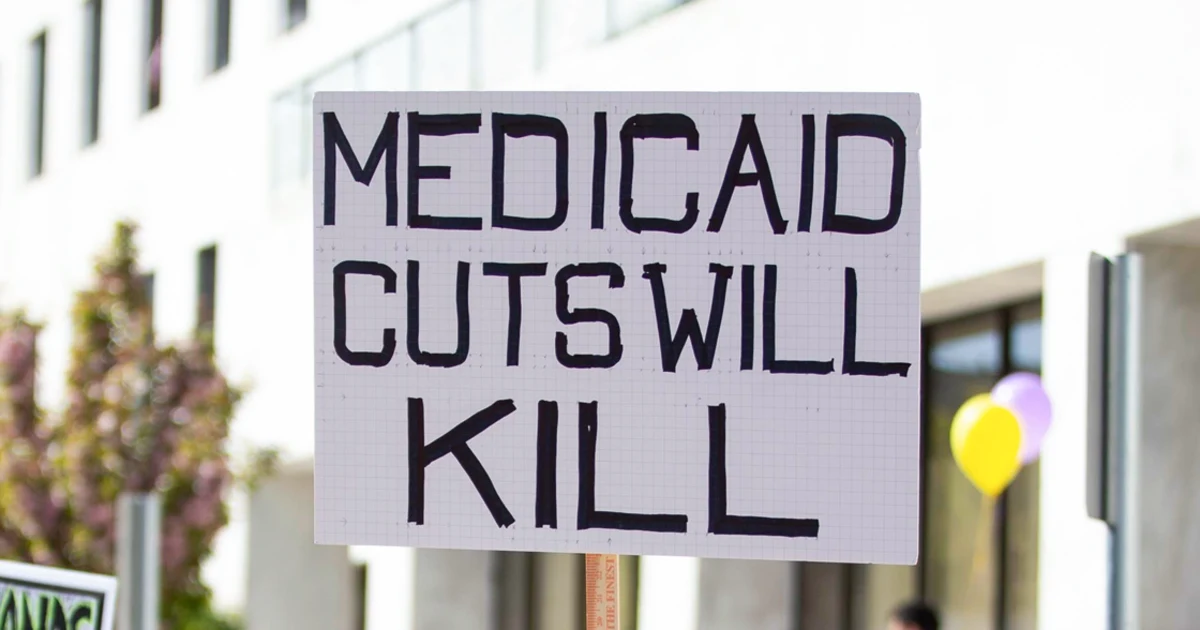
Hundreds of thousands of immigrants with legal status are at risk of losing government health coverage starting Oct. 1, according to state data, a sign that the impact of changes to Medicaid included in President Donald Trump’s major 2025 law could be greater than anticipated.
Many immigrants who are in the country legally will be among the first people to lose Medicaid coverage under the law One Big Beautiful Bill Actpassed by Republicans in Congress, which is expected to reduce federal-state health program spending for low-income people or people with disabilities by more than $900 billion through 2034.
Next year, the law will also eliminate subsidies for many more immigrants for Affordable Care Act (ACA) plans, better known as Obamacareand Medicare coverage.
Among those who will lose their health benefits, which until now they were eligible, are war refugees, people who received asylum after fleeing persecution, victims of sex trafficking and interpreters who risked their lives helping members of the United States Armed Forces in Afghanistan.
All of them are in the country with authorization from the federal government. The law does not affect coverage for some groups, including those who have a permanent resident card (green card).
The Congressional Budget Office (CBO), a nonpartisan entity that analyzes the budget impact of the laws, estimated that changes that eliminate Medicaid eligibility for many noncitizen adults with legal status would cause about 100,000 more immigrants to become uninsured by 2034.
asked several states how many Medicaid enrollees they had identified as potentially affected by this provision. More than 281,000 immigrants from nine states and the District of Columbia could lose Medicaid in October, suggesting the CBO vastly underestimated the number of people affected.
Although some could get coverage through other means, state figures suggest that hundreds of thousands of immigrants across the country face the imminent risk of being left uninsured.
The CBO declined to comment.
Florida alone identified nearly 177,000 immigrants who would become ineligible for the state’s Medicaid program starting in October, said Anna Holaday, a spokeswoman for the Florida Department of Children and Families. This agency verified the immigration status of the beneficiaries through government databases and sent notifications to give them the opportunity to present additional information demonstrating that they remain eligible, Holaday added.
Arizona estimates nearly 28,000 people could lose eligibility. New Jersey expects between 15,000 and 25,000 noncitizen residents to lose their Medicaid coverage.
In North Carolina, the number is about 29,000, and in Washington state, 11,000. Final figures from states on how many beneficiaries were disenrolled from Medicaid will be available later this fall.
Lawmakers depend on the CBO to understand the budgetary and economic effects of legislative proposals. However, the federal agency did not release its estimates of the impact of the One Big Beautiful Bill Act on noncitizens enrolled in Medicaid until a month after Congress passed the bill and Trump signed it into law.
Much of the attention on the Medicaid changes included in the law has focused on the implementation of work requirements as a new condition of eligibility for many beneficiaries starting in January. The CBO estimates that these requirements will increase the number of uninsured Americans by about 5 million by 2034.
Without health coverage, immigrants are likely to lose access to doctors, prescription medications, and most health services. However, they may still be eligible to receive emergency care coverage through a separate program known as Emergency Medicaid.
“I came here to have a better life,” said Ahin, a refugee who fled the war in Syria and moved to Turkey in 2011 before arriving in the United States in October 2024. She spoke to on condition of being identified only by her first name due to concerns for her privacy and safety.
Shortly after arriving in the United States, he began experiencing severe abdominal pain that required intestinal surgery. Medicaid covered those costs, as well as subsequent visits to specialists.
“I’m really worried about this,” she said. “It is truly a terrible situation.”
Ahin, 25, said he doesn’t know what he will do if he needs to go to the hospital because he wouldn’t be able to pay the bill. He lives with his mother in a small apartment in New Jersey.
Medicaid has also been essential for his mother, who has asthma.
Fewer health benefits for immigrants
The federal government required states to notify immigrants that they will soon lose their coverage, but immigrant rights advocates say some states didn’t start sending the letters until September. That has left them little time to react, including to respond in case the state has decided to end their coverage by mistake.
Eliminating Medicaid coverage is just the first step in reducing the government health benefits that many immigrants who are in the country legally receive.
Beginning with a change that takes effect in January, the CBO estimates that about 1 million will lose eligibility to receive government subsidies to purchase individual coverage in the ACA insurance markets by 2034. They will also lose access to Medicare, a change the agency projects will affect about 100,000 immigrants.
Trump has argued that taxpayer-funded programs should be reserved for American citizens. As Congress debated the legislation in May 2025, the White House released a statement making the misleading claim that the One Big Beautiful Bill Act would eliminate Medicaid coverage for people in the country illegally.
The law has long held that this group of people is not eligible for the general Medicaid program funded by state and federal funds.
The health coverage cuts are part of a broader strategy by Trump to convey the message that immigrants are not welcome in the United States, said Ben D’Avanzo, senior federal advocacy strategist at the National Immigration Law Center.
The Trump Administration has also taken steps to exclude people with legal status from SNAP, the Supplemental Nutrition Assistance Program, and attempted to do the same with the Head Start children’s program, until a federal judge intervened.
The law does not affect Medicaid coverage for those with green cardthose under 19 years of age or certain immigrants from Cuba, Haiti or certain Pacific Island countries.
Some states try to fill the gaps
Some states are avoiding the loss of coverage by using their own funds. California estimates that about 148,000 immigrants will lose Medicaid coverage. However, the state is allocating $365 million to a separate program to maintain its coverage through July 2027, according to Tony Cava, spokesman for the California Department of Health Care Services.
New York and Pennsylvania also have state-funded health coverage for many of the affected immigrants.
Carlos Alarcón, health policy and public benefits manager at the California Immigrant Policy Center, an immigrant advocacy organization, said taking away health coverage from immigrants will affect the health of the state as a whole. The fewer people who have access to medical care, the easier it will be for contagious diseases to spread, as happened during the COVID-19 pandemic, he said.
Alarcón said he hopes California’s next governor will expand state-funded coverage. A poll released in September showed Democrat Xavier Becerra, who was secretary of the Department of Health and Human Services under President Joe Biden, ahead of Republican Steve Hilton in the race for governor. Becerra has promised to issue an executive order to maintain health coverage for all Californians affected by federal cuts.
“I think there are people in the legislature who are really going to want to fight to make sure that we can restore things as much as possible,” Alarcón added.
Groups providing assistance to refugees say they have been trying to inform people in their communities and direct them to health clinics that are government-funded or offer free care.
“We’ve been running around trying to find free medical care,” said Julianna Larsen, co-founder of the Arizona Refugee Center. “To stop being a place that welcomes people is the least American thing I have ever seen.”
Andrea Mendez Perez, director of Interfaith-RISE, a refugee resettlement organization in southern New Jersey, said that the Trump Administration has prolonged the process to obtain the green card and now it is removing coverage from those who still do not have it.
Before 2025, it typically took about six months to obtain the green card, the status that allows a foreign person to live and work permanently in the United States, he said. Today, the process takes much more than a year.
For many of these immigrants who have Medicaid, losing the ability to obtain the medications they have been prescribed “is a life or death situation,” Mendez Perez said.
Ahin, the Syrian refugee, applied for permanent residency shortly after arriving in the United States two years ago. Mendez Perez said that Ahin should have already obtained it, which would have prevented him from losing coverage under the Republican law.
“She is stuck in the middle and has no control over the situation,” he said.
Colleen McCauley, director of policy and advocacy at Camden Coalition, a nonprofit that helps connect people to health services in southern New Jersey, said the loss of coverage is devastating.
“None of them did anything wrong,” McCauley said. “And they are losing their coverage.”
is a national newsroom producing in-depth journalism on health issues, and one of KFF’s flagship programs: the independent source for health policy research.
