
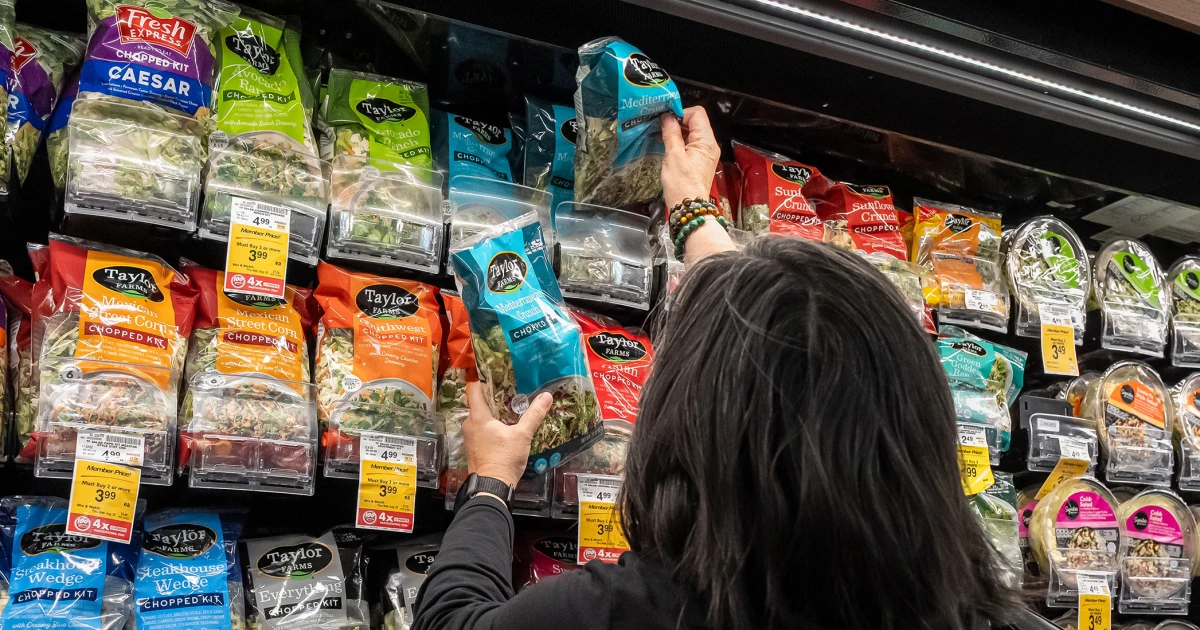
Health and Human Services Secretary Robert F. Kennedy Jr. declared this week that the cyclosporiasis outbreak is “under control.” However, many consumers have come to a different conclusion, taking into account that the outbreak is already present in nine states and more than 2,000 cases have been confirmed.
On social media, people are avoiding salads, deciding not to eat lettuce again, and wondering if it’s safe to order a burrito bowl. For many Americans, the question is no longer just where the outbreak came from, but whether any type of lettuce can be trusted.
The outbreak has also highlighted how difficult it can be for restaurants to maintain the trust of their customers when doubts begin to spread online.
Confusion reigns
“The scientific information is confusing. The regulations are confusing,” Molly McPherson, a crisis communications expert, told NBC News. “A lot of this case is really based on the confusion that surrounds it.”
Several weeks after the outbreak began, federal authorities are still investigating the origin of the disease, which causes severe diarrhea.
Authorities say they are making progress in the investigation. However, a series of conflicting messages has left many Americans unsure of what is truly safe to eat.
(The cyclosporiasis outbreak has already expanded to nine states: almost 2,000 cases are confirmed, according to the CDC)
That uncertainty has become a crisis in itself, one that has intensified following a rapid succession of announcements from the Food and Drug Administration (FDA).
On July 17, Taylor Farms — the world’s largest producer of salads and fresh cut vegetables — voluntarily recalled iceberg lettuce from the market after federal investigators linked it to a multi-state outbreak of cyclosporiasis.
The product recall had immediate repercussions for Taco Bell. The FDA determined that Taco Bell used lettuce from Taylor Farms in Mexico and that, as of July 13, at least 1,644 people claimed to have eaten at the chain before becoming ill.
Taco Bell quickly announced that it had removed all Taylor Farms lettuce from its restaurants nationwide. However, on that same day — July 17 — visits to the fast-food chain fell nearly 31% below its average Friday traffic during the first half of the year, according to foot traffic analytics platform Placer.ai; It was the steepest daily decline among all restaurant chains analyzed.
On July 18, the FDA announced that a sample of iceberg lettuce from Taylor Farms had tested positive for *Cyclospora*. The next day, the agency rectified and stated that the result had been a false positive. Taylor Farms remains under investigation and has stated that it is working closely with regulatory agencies.
“False positives happen in food testing,” said Dr. Mansour Samadpour, executive director of the food safety organization IEH Laboratories, hired by Chipotle after a major E. coli outbreak in 2015. “It’s really important that it was detected and that the information was corrected.”
(The FDA says it is continuing to investigate Taylor Farms in connection with the multi-state cyclosporiasis outbreak.)
A crisis of confidence
Despite official statements, uncertainty has spread rapidly. And when TikTok videos and social media posts circulate faster than corrections, it’s hard for brands to make themselves heard amid the noise.
“No one wants to be falsely accused of something they have nothing to do with. But the public doesn’t care about that,” McPherson said. “At this moment, the fundamental thing is to convey peace of mind.”
Fast food chains are trying to do just that, but customers haven’t been convinced.
Four days after announcing it was pulling lettuce from Taylor Farms, Taco Bell launched a new $1 “lettuce-free” stuffed tortilla in an effort to win back customers.
Other brands are rushing to disassociate themselves from the investigation before misinformation fills the void. Both Chipotle and Sweetgreen have announced, via the internet or their loyalty apps, that they do not serve iceberg lettuce at all.
(Here’s what you should know about outbreaks of cyclosporiasis, a foodborne illness.)
So far, none of these initiatives appear to have been very effective.
The domino effect is even reaching independent businesses. “We were serving 150 to 200 people a day, and since last Saturday that number has dropped to about 10 a day,” Sean Alexander, owner of Build-A-Salad, a self-service salad restaurant, told Local 3 News, an NBC affiliate in Chattanooga, Tennessee. “It is a very hard blow and, in reality, we are not protected against situations of this type.”
Jonathan Maze, a restaurant industry analyst and editor-in-chief of Restaurant Business magazine, told NBC News: “Much of the situation depends on who the customer blames for this problem, how serious the issue is, and how much impact it has on social media.”
Maze stressed that maintaining active communication is essential to protect a brand’s reputation. He cited McDonald’s response to the 2024 E. coli outbreak as an example of effective action.
“They took important actions. They communicated those actions and the reasons why they were taking them. They had Joel Erlinger (president of McDonald’s USA) appear on television repeatedly to talk about it,” Maze said. 2That’s the kind of response (Taco Bell and other companies) need to take.”
Of course, this is easier said than done.
