
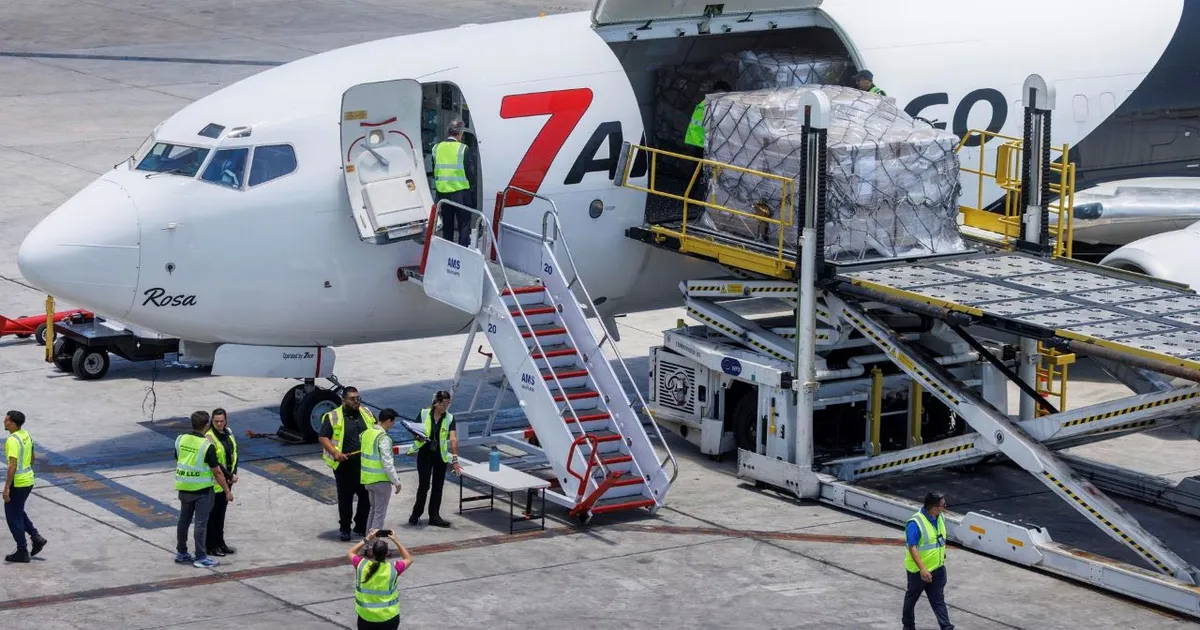
MIAMI.- The commitment of 100 million dollars in humanitarian assistance announced by the Secretary of State, Marco Rubio, began to materialize this Tuesday with the departure from Miami International Airport (MIA) of the first aid flight of the United States Executive to Cuba, an unprecedented operation, designed so that the supplies reach the population directly without passing through the structures of Castroism.
The 7Air cargo aircraft, identified as flight TXG959, took off at 2:54 pm heading to José Martí International Airport in Havana (HAV), where it landed at 3:41 pm according to the FlightAware tracking system, on board it transported 18 tons of food and hygiene items, including 700 personal hygiene kits and 700 food packages, intended to benefit about 700 families. vulnerable of the Cuban capital.
DIARIO LAS AMÉRICAS witnessed the shipment of the merchandise and had access to the press conference organized before takeoff. For several hours, forklifts moved the pallets to the aircraft while the ground staff supervised each stage of the process and the crew carried out the final checks before closing the gate.
The United States Department of State (DOS) explained that the distribution will be carried out by Catholic Relief Services (CRS), in coordination with Cáritas Cuba and the Catholic Church, a mechanism that, according to US authorities, guarantees that the products reach directly the people previously identified by the parishes of Havana.
The head of Foreign Assistance, Humanitarian Affairs and Religious Freedom, Jeremy Lewin, assured that the delivery scheme reduces to a minimum the possibilities of the Cuban regime interfering in the process, by leaving the distribution in the hands of the network of Catholic parishes and Cáritas Cuba.
The senior advisor of the Office of Western Hemisphere Affairs, Viviana Bovo, accompanied the departure of the flight along with representatives of CRS, one of the entities in charge of coordinating the delivery on the ground.
According to DOS, this first mission responds to the worsening humanitarian situation in the nation, marked by shortages of food, medicine, fuel and other essential goods. The US Government maintained that the objective is to ensure that assistance reaches those who face the greatest needs, without the intermediation of the ruling party.
The action resumes the experience developed in 2025, when the DOS, CRS and Cáritas Cuba coordinated the delivery of nine million dollars in aid after the passage of Hurricane Melissa. According to the officials in charge, this precedent allowed us to verify the effectiveness of the parish network to deliver resources directly to the sectors hit by the natural phenomenon.
Among the local representatives who closely followed the first transfer were the Miami-Dade tax collector, Dariel Fernández; the county Elections Supervisor, Alina García; and the property appraiser, Tomás Regalado, who agreed to highlight the scope of the initiative, although from different perspectives.
Fernández highlighted the role of Cáritas Cuba as guarantor of the delivery of supplies. He recalled that he knew first-hand the work of that organization to which he belonged during his life on the island and stated that he has extensive experience assisting communities in conditions of greater social fragility.
“The aid is going to arrive. It is not going to be distributed by the communist dictatorship,” he assured.
For his part, García described the shipment as a concrete response to the deterioration of living conditions in Cuba and expressed his confidence in the work that the chosen religious institutions will carry out to deliver resources to the population.
“This aid is going to reach the people directly,” he stated.
Regalado, on the other hand, focused his intervention on the scope of the decision adopted by the US. In his opinion, the main difference of this initiative is that the current administration defined from the beginning who would be responsible for delivering the assistance, preventing the process from being under the control of Cuban government structures.
“It is the first time that the United States says: ‘This is going to be distributed by whoever we determine,’” he said. He added that this decision represents a change in the way aid is channeled to the Greater Antilles and strengthens the possibilities of it reaching its recipients in full.
While the aircraft began taxiing towards the runway and completed takeoff towards Havana, logistics that began weeks ago with the coordination of all those involved concluded. For those who participated in the mission, the flight marked the beginning of an assistance program that seeks to establish a permanent channel of support for ordinary Cubans and alleviate the shortcomings caused by the crisis that the country is going through.
Already in Cuban territory, Cáritas Cuba confirmed the receipt of the shipment through its official Facebook profile. They reported that the delegation in charge of receiving the donation was made up of Cardinal Juan de la Caridad García Rodríguez, Carmen María Nodal Martínez, director of Cáritas Cuba, and Ángel Miguel Gutiérrez Valdivia, diocesan director of Cáritas Habana.
Likewise, they specified that it will channel 60 million dollars of the 100 million package committed by Washington to meet the needs of the Cuban population.
As of the closing of this note, there are no details of when the distribution process will begin.
