
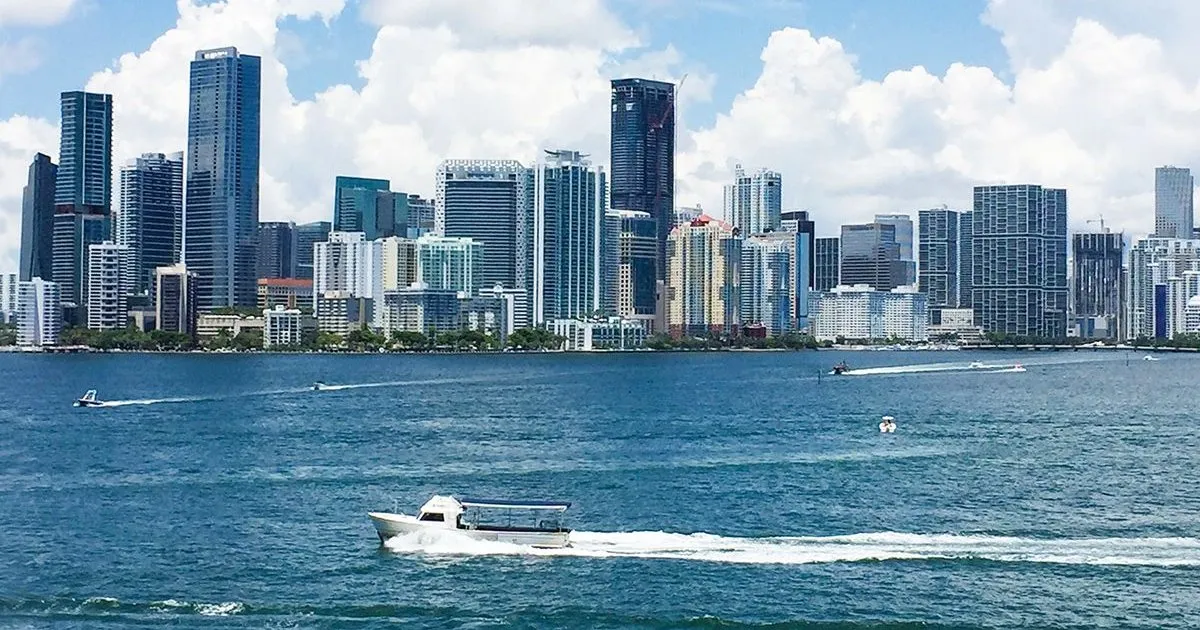
In recent years, Greater Miami has ceased to be a collection of medium-sized cities and has become a vibrant metropolis, with one of the most impressive urban skylines in the United States. However, that growth has also come at a high price.
Although Boomerang normally deals with other matters, the data supporting this report comes from the most recent data from the US Bureau of Economic Analysis (BEA).
This index compares the price level of each region with a national average set at 100.
According to the BEA, the Miami metropolitan area’s index reached 114,155, while New York’s was 112,563, including its surrounding areas.
In other words, although both regions are among the most expensive in the country, the average price of housing, goods and services in the Miami–Fort Lauderdale–West Palm Beach corridor already exceeds that of the New York–Newark–Jersey City region.
What drove this change?
According to the data, the sharp increase in prices began with the pandemic in 2020, which practically eliminated the traditional economic advantage that living in Florida offered.
Inflation
The South Florida Consumer Price Index (CPI) has increased 36% since 2020.
Total cost of owning a home
Currently, the total cost of owning and maintaining a home in South Florida is 5% higher than in New York and its suburbs.
Although the price per square foot is still lower in Miami ($357 versus $537 in New York), that savings virtually disappears due to additional expenses like insurance, taxes and maintenance.
Insurance crisis
Florida today has the highest homeowners insurance premiums in the country.
On average, a homeowner pays $8,292 a year, almost four times more than a homeowner in New York.
Going out to eat also costs more
Inflation is also reflected in lifestyle. According to data from OpenTable, so far in 2026 the average spending per person in restaurants was $94 in Miami, compared to $79 in New York City.
Tax advantage
These data ensure that Florida’s tax advantage, due to the absence of state taxes on wages and profits, no longer offsets all costs. New data shows that the traditional “Florida discount” has virtually disappeared when comparing high-end markets.
While the lack of a state income tax continues to be a huge advantage for high-income earners, rising property taxes and private school tuition puts Miami on par with New York and even, in some cases, above it.
Property taxes
Driven primarily by rising home values, property taxes in Miami have grown 62% since 2019, more than double the national average.
Tax rates
In Miami-Dade, the average effective rate ranges between 0.9% and 1.1%.
In New York City, single-family homes (Class 1) pay a rate close to 0.8%, although several suburban counties, such as Westchester and Nassau, exceed 2%.
The impact of rising home values
As property prices in Miami increased between 50 and 60 % After the pandemic, the final amount homeowners pay in taxes also skyrocketed.
The limit of the Save Our Homes program
The Save Our Homes (SOH) benefit limits the annual increase in tax assessment to 3%, but only for the primary residence.
Those who buy a new home or a second property begin paying taxes on the full updated market value, without that benefit.
Special evaluations in condominiums
Unlike many Manhattan co-op buildings, where maintenance costs are often spread over long periods, condo owners in Miami have faced significant mandatory special assessments to finance structural improvements implemented after the Surfside tragedy, which has significantly increased annual housing costs.
Possible tax relief in 2027
Florida lawmakers approved a constitutional amendment that will be voted on in November 2026.
If approved by voters, an exemption of up to $250,000 on property taxes (except the portion allocated to the school system) will be phased in starting in 2027 for those who use the home as their primary residence.
Private education: increasingly expensive
The massive arrival of residents with high purchasing power has generated strong pressure on the demand for private education in South Florida.
As a result, the most prestigious private schools in Miami currently charge between $25,000 and more than $50,000 a year, competing directly with the most exclusive educational institutions in Manhattan.
Salaries continue to favor New York
Despite the increase in the cost of living, incomes in Miami remain significantly lower than those in New York.
Data from Bankrate and the US Census Bureau show that the average annual salary in the New York metropolitan area reaches $82,050, while in the Miami metropolitan area it is $63,380.
This represents a difference of nearly $19,000 annually, a gap that makes it even more difficult to meet the rising cost of living for those who work and live in South Florida.
