
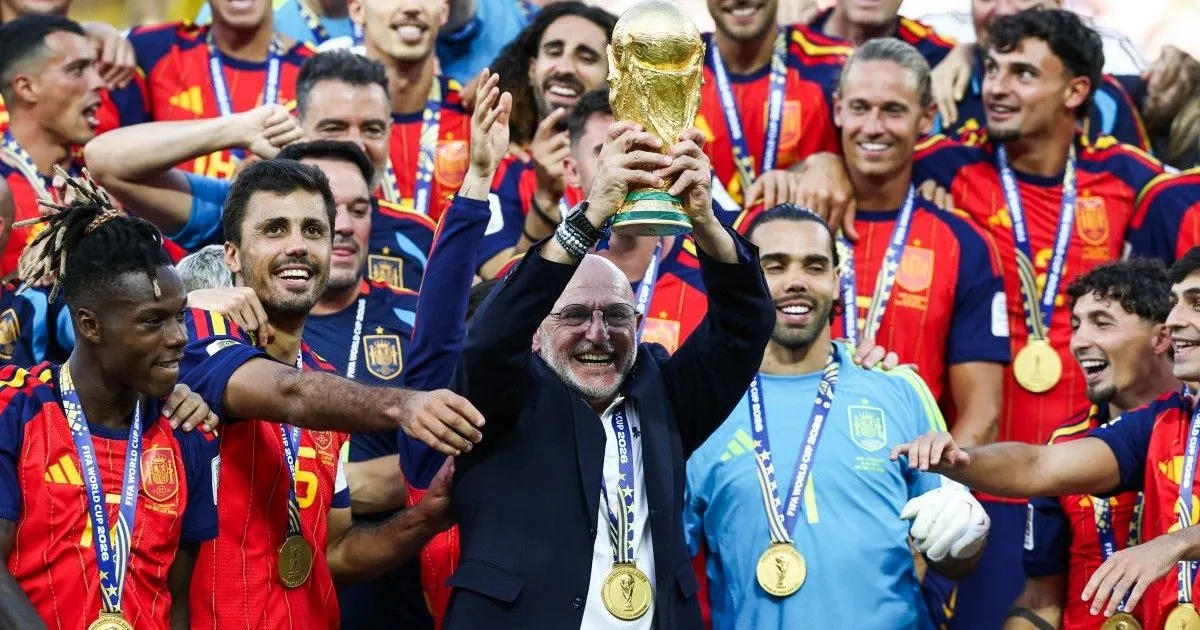
MIAMI.- After the forces that led Spain to win its second World Cup and how much we have seen of celebrations and outbursts, we draw on what great writers and thinkers of the 20th century thought about the beautiful game and other sporting events.
We know that football, like any other sport, is a source of entertainment, even excitement, but when the event, or events, reach a frenzy, we must take other details into account.
Let’s start with those who love, and defend, the dissemination of football, and sport in general.
For example, Pier Paolo Pasolini (1922-1975) a prominent Italian writer, poet and film director; Considered one of the most controversial and brilliant intellectuals of the 20th century, he openly challenged the social, political and religious conventions of his time through his multidisciplinary work.
And he said: “football (what they call soccer in the US) is a language, with grammar, syntax, styles and poets.”
Other famous people, the Frankish Angeleno writer Albert Camus, creator of multiple literary works, express: ““Everything I know with greater certainty about the morals and obligations of men I owe to football.”
However, other intellectuals of the 20th century considered football a mass spectacle, lacking “productive content.” And they said much more.
The Argentine writer, Jorge Luis Borges (1896-1986), winner of the 1979 Cervantes Prize; was drastic: “Football is popular because stupidity is popular.”
In Spain, the Spanish writer and philosopher Miguel de Unamuno (1864-1934) noted “football is the spectacle that has come to replace bullfighting.”
Now, it is worth qualifying this quote. Unamuno did not dedicate a deep philosophical criticism to football itself. His concern was broader: he distrusted mass phenomena when they encouraged conformism or distracted from cultural and spiritual issues. In other words, if someone summarizes their position by saying that Unamuno hated football, it is a simplification.
What he really criticized was the role it could play as mass entertainment when it eclipsed critical thinking and intellectual life. In other words, what we see today: great shows to attract attention and extremely high access prices that end up enriching the coffers of some and impoverishing the pockets of others.
On the other hand, George Orwell (1903-1950) considered, according to historical archives, that international games fuel chauvinist passions, transforming athletes into mere representatives of national superiority and described them as “war without shooting.”
In his famous essay The sporting spirit (1945), Orwell argued that mass sport fosters hatred, nationalist fanaticism and the sadistic desire to humiliate the rival, completely distancing itself from the ideals of fair play and camaraderie.
In the famous novel 1984Orwell used football (along with beer and gambling) as a key mechanism to keep the masses distracted and ensure their political submission.
The Irishman Oscar Wilde (1854-1900), who lived through the rise of football that was invented by the English, said: “Football is very good as a game for rough girls, but it is hardly suitable for delicate boys.”
The quote became popular decades after his death and is usually attributed to compilations of epigrams and testimonies, so some scholars consider that the attribution is not fully documented.
A great friend, who speaks little and when he speaks makes you think, said: “If the people took to the streets, in the same way they go out to celebrate the victory of a game, there would be no oppression or dictatorships.”
