
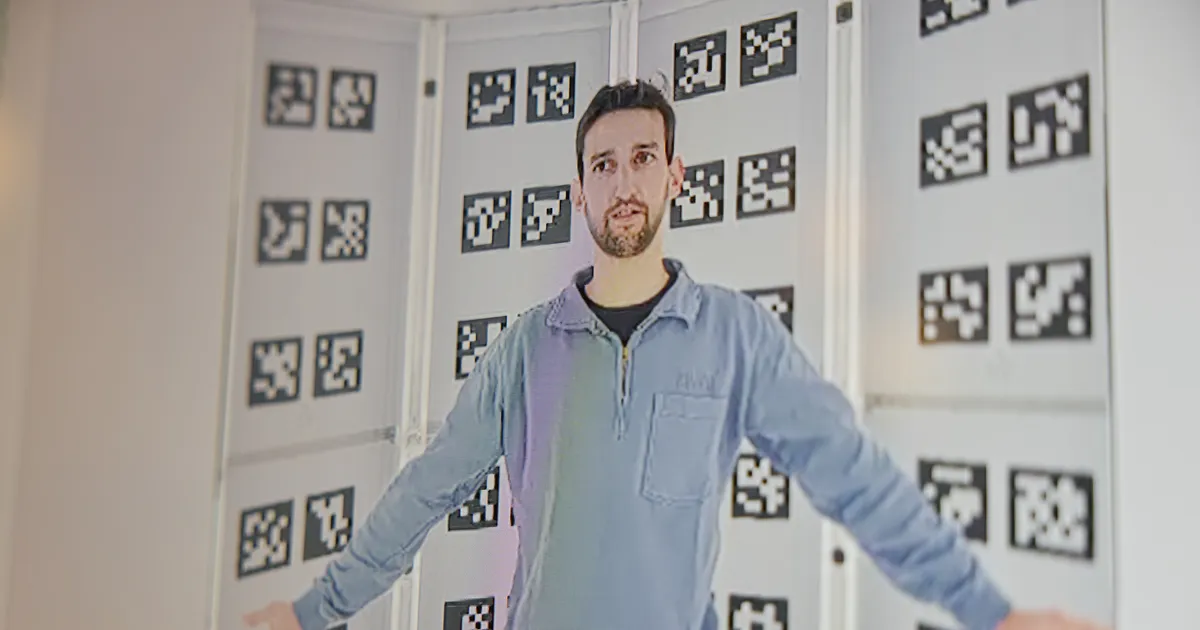
MIAMI.– The multinational Lenovo is currently scanning more than 1,200 soccer players to build hyper-realistic three-dimensional avatars that will replace generic silhouettes in offside replays during the 2026 World Cup, an innovation that the company presented in Miami together with the International Federation of Associated Football (FIFA).
The deployment, which covers the entire workflow, from body capture to the generation and management of digital models, will operate in the sixteen locations in the United States, Mexico and Canada, between next June and July.
From gray silhouettes to digital twins
Video refereeing remains among the most discussed innovations in contemporary football. According to those responsible for the project, the main challenge no longer lies in the precision of the measurements, but in the credibility of what the fan perceives.
Until now, offside plays were illustrated with gray, generic figures that barely bore any resemblance to the players involved, a representation that many spectators felt was abstract and distant from the reality of the field.
To correct this perception, FIFA and Lenovo opted for photorealistic avatars that replicate the individual physical dimensions of each athlete.
Valerio Rizzo, senior manager of artificial intelligence at the company, clarified that the objective is not to alter the referee’s criteria, but to make it easier for players, coaches and the public to understand each resolution.
For his part, Santiago Manso, director of Lenovo’s sports vertical, explained that “each of the digital twins of these footballers will be generated and will appear in the semi-automatic offside images, in such a way that it will be much more realistic.”
The manager stressed that this visual fidelity benefits both the refereeing team and the spectator who follows the game from home.
Thirty seconds in the scanner
The creation of each model starts with a short but demanding scanning session. The footballer enters a special cabin for about thirty seconds, although the actual capture lasts less than a second.
From this data, Lenovo technology creates a three-dimensional reconstruction of the player and applies textures and volume segmentation to the original mesh until an accurate replica is obtained. No avatar is identical to another, in the same way that no two bodies are the same on the grass.
The company undertook a comprehensive digital asset management service that covers scanning, quality verification, model generation and its maintenance throughout the tournament. Each avatar thus becomes an additional source of data for player monitoring and officials’ decisions.
A previous rehearsal in Doha
Lenovo and FIFA tested the three-dimensional avatars last December, during the Intercontinental Cup in Doha, Qatar. In that event, the CR Flamengo and Pyramids FC squads went through the scanner before their duel in the Challenger Cup, and the system functioned throughout the match as a test bed.
The result, according to the firm, confirmed the maturity of the tool to assist referees in North America.
Lenovo does not operate the VAR
The company specified the limits of its intervention. The operational management of the VAR and the detection of limbs for offside continue in the hands of Hawk-Eye Innovations, while Lenovo provides the three-dimensional models as another input to the system.
This information is combined with data from the official Adidas Trionda ball, equipped with a sensor that records up to 500 readings per second. By crossing the exact point of contact with the ball and the precise position of the limbs reflected in the avatars, the system determines the offside position in seconds instead of minutes.
“3D avatars with artificial intelligence will ensure accurate identification and tracking of each player, a breakthrough in semi-automatic offside technology, with clear images, faster decisions and clear understanding for everyone,” said FIFA President Gianni Infantino.
For his part, the organization’s secretary general, Mattias Grafström, maintained that the union of precise data and advanced visualization strengthens confidence in the decisive resolutions and brings the fan closer to the arbitration process than ever.
A centralized ecosystem in Coral Gables
The avatars are part of a broader technology package that Lenovo will deploy as an official partner of the tournament. Critical operations will be coordinated from a Technology Command Center installed in Coral Gables, in Miami-Dade County, in charge of supervising the network of the sixteen headquarters in real time.
Added to this is the FIFA AI Pro platform, a knowledge assistant that analyzes thousands of metrics to bring high-level tactical analysis to the 48 participating teams.
